


Best Technology Stack for News App Development in 2026
Table of Contents
News App Technology Stack
What Makes It Different?
Best Frontend Technologies
Choosing the Right Backend
Cloud & CDN Infrastructure
Essential APIs & Integrations
AI Technology Stack
Technology & Development Cost
CodeAegis’s Technology Approach
Final Verdict
Frequently Asked Questions
 Add us as a preferred source on Google
Table of Content
+Best News App Technology Stack in 2026
A news app that crashes during a breaking story is worse than no app at all. That's the uncomfortable truth behind most technology stack decisions in this space: the architecture only really gets tested on the worst possible day, when a major story breaks and traffic spikes far beyond normal levels in a matter of minutes. One news organization documented a surge to over 413,000 requests per minute following a single major breaking story, according to Brightspot's analysis of high-traffic news events, a volume that would flatten an unprepared backend almost instantly. That's not a rare edge case in the news business. It's closer to an inevitability, and it's exactly the scenario most stack decisions never get tested against until it's already happening live.
Picking a news app technology stack isn't about choosing whatever's popular this year, or copying whatever a competitor's engineering blog happened to mention. It's about understanding what each layer of the system actually does under pressure, and which combination of tools holds up when a huge share of your audience shows up in the same twenty minutes instead of trickling in over a normal afternoon.
If you're earlier in the planning process and haven't nailed down scope yet, our broader news app development guide covers the full build process this stack supports.
What Is a Technology Stack for a News App?
A technology stack is the full set of tools and layers working together to get a story from a newsroom's CMS onto a reader's phone screen, usually within a second or two of opening the app. The main layers in a typical news app stack include:
- Frontend — the interface a reader actually sees and interacts with, whether that's a mobile app or a companion web experience
- Backend — the server-side logic handling requests, authentication, and business rules
- Database — where article content, user accounts, and metadata actually live
- APIs — the connections to external content sources, payment processors, and notification services
- Cloud infrastructure and CDN — where everything is hosted, and how fast content reaches a reader depending on where they are
- AI layer — the systems handling personalization, recommendations, and content intelligence
What Makes a News App Technology Stack Different?
News apps carry a specific set of technical pressures that a typical content app, say, a recipe app or a blog reader, simply doesn't face at the same intensity. It's worth being explicit about these, because they're what should actually be driving your technology decisions rather than a general "best practices" list pulled from an unrelated industry.
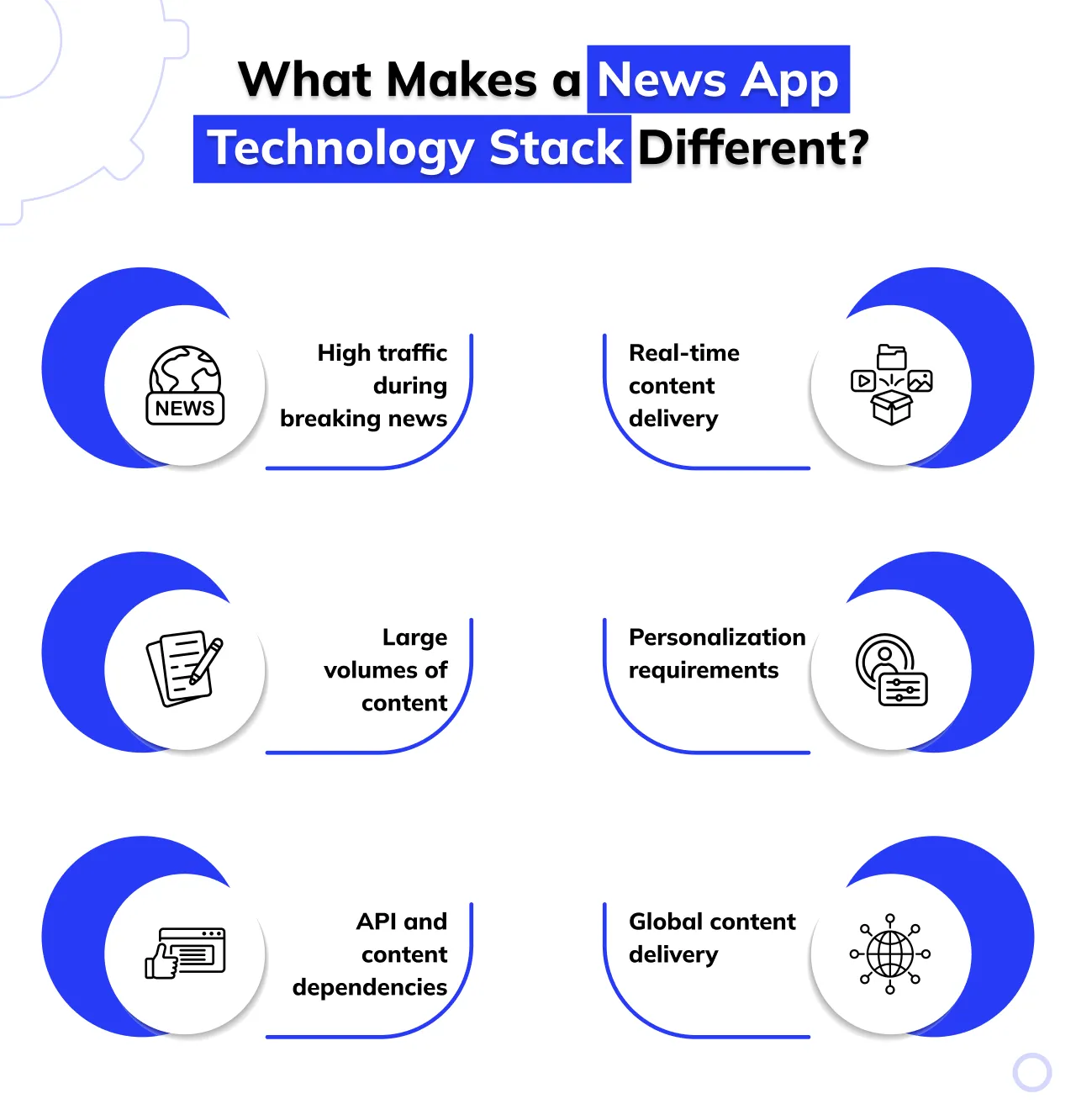
- High traffic during breaking news- A regular Tuesday might see steady, predictable traffic that any reasonably provisioned server handles without effort. A major story, an election result, a natural disaster, a celebrity death, can multiply that traffic several times over within minutes. The architecture needs to absorb that surge without the entire system slowing to a crawl, and it needs to do it automatically, because nobody's going to manually spin up new servers fast enough while a story is actively breaking.
- Real-time content delivery- Readers who open a news app during a fast-moving story expect updates to arrive within seconds, not the next time they happen to refresh. That requires infrastructure genuinely built for low latency, push notifications that fire the instant a story updates, not a system optimized purely for batch processing overnight.
- Large volumes of content- Years of published articles accumulate fast for any active publisher: images, embedded video, author metadata, categories, tags, and increasingly rich content types layered on top of plain text. The database and search infrastructure need to handle that volume without archive browsing or search functionality slowing to a noticeable crawl five years into the app's life.
- Personalization requirements- A feed that genuinely adapts to a reader's history and preferences needs real infrastructure behind it, event tracking, a data pipeline, somewhere to store and process behavioral signals. A basic content database built to store articles and nothing else wasn't designed for this kind of workload, and trying to bolt personalization onto it later tends to be painful.
- API and content dependencies- Most news apps aren't generating every piece of content internally. They pull from external news APIs, RSS feeds, or their own CMS system, and the stack needs to handle those integrations reliably, including the moments when an external source is slow, rate-limited, or temporarily down entirely.
Global content delivery- Readers are rarely clustered in one city near your servers. Content needs to reach someone in Singapore about as fast as it reaches someone in New York, and that's genuinely where CDN and caching architecture stops being a nice-to-have and becomes something that determines whether your app feels fast or feels broken depending on where a reader happens to be.
Best Frontend Technologies for News App Development
The frontend is what a reader actually touches, and for news apps, specifically, news app development services need to ensure it loads fast and stays responsive even when someone's on a spotty train wifi connection trying to catch up on the news during their commute.
Flutter
Flutter gives you a single codebase that compiles down to apps that genuinely feel native on both iOS and Android, which is a bigger deal than it sounds. UI consistency across both platforms tends to be strong, since you're not maintaining two separate implementations that can quietly drift apart in look and behavior over time. Development speed is a real, practical advantage for teams that need to ship on both platforms without doubling their engineering effort. It tends to fit well for startups and mid-sized publishers who need to move fast and want visual consistency without spending months polishing two codebases separately.
React Native
React Native works from that same single-codebase principle, but it leans on the JavaScript and TypeScript ecosystem specifically, which is a genuinely practical advantage if your team already has web development expertise sitting around. Native modules let you drop into platform-specific code where something really does need to be handled differently on iOS versus Android, and development tends to move quickly for teams that are already comfortable thinking in React's component patterns.
Swift for iOS News Apps
Swift is the native option for iOS specifically, and it earns its extra cost when performance and deep platform integration genuinely matter, smooth, buttery animations, tight integration with iOS-specific features like widgets or Live Activities, and a level of polish that's harder to fully replicate through a cross-platform framework no matter how good that framework has gotten. Our iOS app development team builds specifically in Swift for exactly these cases, where the extra investment is justified by the audience and use case.
Kotlin for Android News Apps
Kotlin is the equivalent native choice on Android, giving full access to the latest Android capabilities and the strongest possible performance on that platform specifically. Where Android genuinely dominates your target audience, and that varies a lot by region, Kotlin through our Android app development work is often worth the extra investment over a cross-platform compromise.
Flutter vs React Native vs Swift vs Kotlin
| Framework | Best For | Trade-off |
|---|---|---|
| Flutter | Fast, visually consistent cross-platform builds | Slightly larger app size than fully native |
| React Native | Teams with existing JavaScript expertise | Occasional native module complexity |
| Swift (iOS) | Maximum iOS performance and polish | Separate codebase from Android |
| Kotlin (Android) | Maximum Android performance | Separate codebase from iOS |
For most publishers building their first app, or genuinely still validating whether there's demand at all, cross-platform frameworks make by far the most sense. Native development earns its cost once an app has real, proven traction and platform-specific performance becomes an actual differentiator rather than a nice idea, a decision that also feeds directly into how we scope broader mobile app development services for a given project.
Choosing the Right Backend for a News App
The backend handles everything the frontend doesn't see directly: business logic, authentication, content delivery, and every connection to your database and any external services the app depends on.
Node.js vs Python vs Java
| Backend | Best For | Consideration |
|---|---|---|
| Node.js | Real-time features, high-concurrency APIs | Less ideal for heavy CPU-bound processing |
| Python | AI/ML, recommendation engines, data processing | Can be slower for raw request throughput |
| Java | Enterprise-scale, complex backend systems | Longer development cycles, heavier infrastructure |
Cloud Infrastructure and CDN for News Apps
Where a news app actually runs, and how content gets delivered to readers scattered across the globe, matters just as much as anything happening in the backend code itself.
AWS
AWS offers a mature, extensively documented set of services for compute, storage, auto-scaling, and monitoring, and its sheer breadth makes it a common default choice for news platforms that need flexibility across a lot of different infrastructure needs simultaneously, without wanting to stitch together services from multiple providers.
Microsoft Azure
Azure tends to fit organizations already genuinely invested in the Microsoft ecosystem, where existing enterprise tooling, licensing agreements, and internal familiarity make it the more natural extension rather than introducing an entirely separate platform your team has to learn from scratch.
Google Cloud
Google Cloud stands out specifically for data-intensive workloads, analytics, and AI or ML infrastructure, which makes it a genuinely strong fit for news platforms leaning heavily on AI-driven personalization or doing large-scale content analysis across their archive.
APIs and Integrations Every News App May Need
A news app rarely operates in isolation. It's usually stitched together with a handful of external services, and each one needs to be built into the stack deliberately rather than bolted on at the last minute.
News APIs
News APIs aggregate content from multiple sources, or connect directly to your own CMS and publisher feeds via RSS or a custom internal API, forming the actual content pipeline your entire app is built on top of.
Social APIs
Social APIs support sharing to external platforms and, where it makes sense for your audience, social sign-in, extending an article's reach well beyond the app itself at essentially no marginal cost.
Payment APIs
Payment APIs handle subscriptions, memberships, and premium content access, forming the practical backbone of most publisher monetization strategies today, particularly as ad revenue continues facing pressure across the industry.
Analytics APIs
Analytics APIs track engagement, retention, and article-level performance, giving both editorial and product teams the actual data needed to make informed decisions rather than relying on gut feeling about what's working.
Push Notification Services
Firebase Cloud Messaging for Android and Apple Push Notification Service for iOS handle the breaking news alerts and re-engagement notifications that are genuinely core to how readers actually use a news app day to day, arguably more than any single feature on the reading side of the app. For a deeper look at exactly which features these integrations support, our news app features guide covers the full functional picture in more detail.
AI Technology Stack for Modern News Apps
AI has moved from an experimental add-on to a genuine layer in the stack for most competitive news apps, sitting alongside the core backend rather than replacing it.
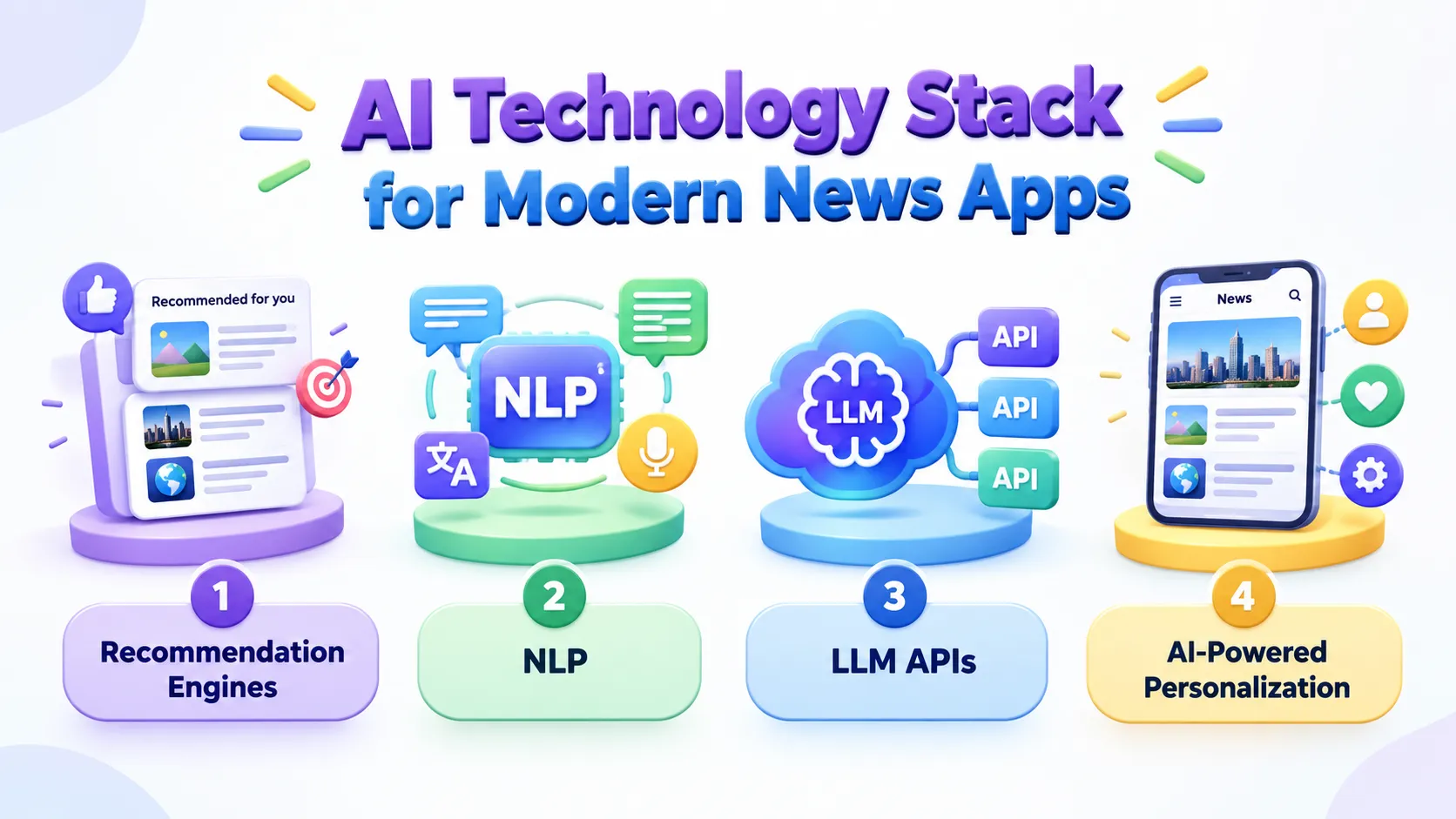
Recommendation Engines
Recommendation engines use content-based filtering, collaborative filtering, or a hybrid of both to decide what a specific reader sees first in their feed, learning from actual reading behavior over time rather than relying purely on a category checkbox someone ticked once during onboarding and never revisited.
NLP
Natural language processing powers automated classification, topic extraction, summarization, sentiment analysis, and entity recognition, work that would otherwise consume a genuinely significant amount of editorial time if done manually across a high volume of daily published content.
LLM APIs
LLM APIs increasingly support article summarization, semantic search that actually understands intent rather than just matching keywords, and conversational content discovery, letting a reader ask for roughly what they want rather than only being able to browse through rigid categories.
AI-Powered Personalization
The general flow, stripped down to its basics, looks like this: user behavior generates data as someone reads, that data feeds into a recommendation model, and the model outputs a personalized feed shaped by what that specific reader has actually engaged with, not what they said they liked once during signup. This section deliberately stays focused on the technology layer itself; for a broader strategic look at how AI is reshaping news app product decisions more generally, see our dedicated piece on AI in news app development.
How Technology Choices Affect News App Development Cost
Every decision covered in this guide has a cost attached to it, and it's worth understanding roughly where that cost actually comes from.
Native development for both iOS and Android costs meaningfully more than building a single cross-platform codebase, often by a significant margin once you account for two separate development and QA cycles. Backend complexity, particularly real-time features and AI integration, adds both development time upfront and ongoing infrastructure cost that continues well past launch. Database choice tends to matter less for overall cost than integration and API work often does, since connecting to third-party systems reliably is frequently more time-consuming than the database layer itself. Cloud infrastructure costs scale fairly directly with traffic volume and how much CDN and monitoring tooling is in place. For a full, detailed breakdown of how these individual decisions actually translate into a real project budget, our guide on news app development cost covers pricing by tier and feature depth in much more depth than makes sense to duplicate here.
How CodeAegis Approaches News App Technology Stack Decisions
Reading a comparison table is one thing. Actually deciding what fits a specific publication, with its own audience, budget, and growth plans, is a different exercise entirely, and it's where a lot of teams get stuck.
Stack Decisions Grounded in the Actual Project
CodeAegis doesn't default to the same stack across every client. Frontend, backend, database, and AI decisions get made based on your audience size, content model, and monetization plan, the same framework covered throughout this guide, applied to your specific situation rather than treated as a one-size-fits-all recommendation.
Built for the Traffic Pattern That Matters Most
Given how much of this guide focuses on breaking news traffic specifically, it's worth saying plainly: architecture that only performs well on an average day isn't architecture that's actually been tested. Caching, CDN strategy, and auto-scaling get planned around the traffic spikes your app will eventually face, not just the traffic it sees on a quiet Tuesday.
A Foundation That Doesn't Need Rebuilding
Even when advanced features like AI personalization or live streaming are planned for a later release, the underlying stack gets architected to support them without a rebuild down the line. That avoids the common and expensive situation where an MVP has to be re-architected from the ground up the moment a publisher is ready to scale.
Final Verdict: Which Technology Stack Is Best for a News App in 2026?
There's genuinely no single universal answer here, because "best" depends entirely on your scale, your team's existing skills, and your specific business model. That said, a practical foundation for many modern news apps ends up looking fairly consistent once you strip away the specifics: a cross-platform frontend like Flutter or React Native, a Node.js or Python backend depending on whether real-time features or AI work carries more weight in your particular product, PostgreSQL as the primary database with Redis layered on top for caching, solid cloud infrastructure paired with a genuine CDN strategy, the specific API integrations your content model actually requires, and an AI layer added once there's enough real usage data to make it genuinely useful rather than built speculatively on day one before anyone's actually used the app.
Frequently Asked Questions
What is the best technology stack for a news app in 2026?
For most projects, a practical combination is a cross-platform frontend (Flutter or React Native), a Node.js or Python backend, PostgreSQL with Redis caching, cloud infrastructure with a CDN, and an AI layer added once usage data supports it. The right mix still depends heavily on scale and budget.
Is Flutter good for news app development?
Yes. Flutter offers strong UI consistency across platforms, fast development from a single codebase, and near-native performance, making it a solid default for startups and mid-sized publishers building for both iOS and Android at once.
Is React Native better than Flutter for a news app?
Neither is universally better. React Native tends to fit teams with existing JavaScript expertise particularly well, while Flutter often edges ahead on UI consistency and raw development speed. The right choice usually comes down to what your existing team already knows.
Which backend is best for a news application?
Node.js suits real-time features and high-concurrency API traffic particularly well. Python is the stronger choice when AI and recommendation systems are genuinely central to the product. Java fits large enterprise platforms that prioritize long-term reliability over fast iteration.
Which database is best for a news app?
PostgreSQL handles structured data like users and subscriptions reliably and predictably. MongoDB fits better where content metadata varies significantly from piece to piece. Most modern news apps use one of these as a primary database, with Redis added specifically for caching.
Do news apps need Redis?
Most benefit significantly from it. Redis caches trending content, session data, and frequent API responses, meaningfully reducing load on the primary database, which matters a great deal during breaking news traffic spikes specifically.
Which cloud platform is best for a news app?
AWS offers the broadest general-purpose service ecosystem, Azure fits organizations already running on Microsoft infrastructure, and Google Cloud tends to suit data-intensive or AI-heavy workloads particularly well.
How does AI affect a news app technology stack?
AI adds a distinct additional layer, typically Python-based, for recommendation engines, NLP, and LLM-powered features like summarization, running alongside the core backend rather than replacing it entirely.
What APIs are required for a news app?
Most news apps need content APIs (news aggregation, RSS, or a CMS), push notification services, analytics APIs, and, wherever subscriptions apply, payment APIs, with social APIs added depending on your specific sharing and sign-in requirements.

Sakshi Aggarwal is the Co-CEO of CodeAegis, a visionary leader with 12+ years of experience in transforming complex business requirements into high-impact technology solutions across industries. Her core contribution lies in architecting the company's customer-centric service delivery model and optimizing cross-functional execution. She has become a driving force for ensuring project success and cultivating a culture of accountability across the software development life cycle.