


How to Develop a News App in 2026: Features, Cost, Technology Stack & Process
Table of Contents
What Is News App Development?
Why Businesses Are Investing in News Apps
Types of News & Media Apps You Can Build
Essential Features of a News App
Advanced Features for Modern News Apps
How AI Is Transforming News App Development
Technology Stack for News App Development
How to Develop a News App: Step-by-Step Process
How Much Does It Cost to Develop a News App?
News App Monetization Strategies
Common Challenges in News App Development
How to Choose a News App Development Company
How CodeAegis Has Built The BNEA News Platform
Future Trends in News App Development
Conclusion
Frequently Asked Questions
 Add us as a preferred source on Google
Table of Content
+How to Develop a News App in 2026: Features, Cost & Tech
Today the mobile news apps market is valued at roughly $16.92 billion in 2026, and it’s expected to climb past $24 billion by 2030. That growth isn’t happening because people suddenly care more about news. It’s happening because the way people want to receive news has changed, and the publishers who’ve adapted their delivery mechanism are the ones capturing the audience that’s leaving traditional formats behind.
Social platforms have already pulled ahead as the dominant news source for a lot of readers, TikTok and YouTube especially. But that’s not actually bad news for publishers who own a strong app. An app is the one channel where you’re not renting attention from someone else’s algorithm. Analysts tracking the space expect AI-driven content curation, subscription-first models, and short-form multimedia formats to define the next phase of growth through 2030 and beyond. This guide walks through what that actually means if you’re building one: the features that matter, realistic costs, the tech choices, the development process, and where AI genuinely moves the needle versus where it’s just marketing.
What Is News App Development?
News app development is building a mobile product that gets news content, whether that’s articles, video, audio, or an AI-curated feed, in front of users quickly and in a way that fits how they actually use their phone. It’s not a mobile wrapper around a website. It’s its own software product, with a backend that editorial teams publish through, a frontend built around fast scanning and quick decisions, and infrastructure that has to handle the kind of traffic spike that only happens when something big breaks at 2 am.
Key Components of a News App
Strip a news app down to its working parts and you get a content management system editors actually publish through, a recommendation engine deciding what each person sees, a notification layer for breaking alerts, a media pipeline for video, audio and images, and an analytics layer feeding both editorial and monetization decisions.
News App vs Traditional News Website
A website is built to be browsed. An app is built to be returned to. Push notifications, offline reading, biometric login, a feed that actually learns what you read, none of that translates cleanly to a mobile browser tab. That gap is exactly why apps have become the primary distribution channel for a large share of digital-first publishers moving into 2026, and why the ones treating their app as a second-class citizen next to their website are quietly losing ground.
Why Businesses Are Investing in News Apps
The math behind news apps has gotten more compelling, not less, even with attention scattering across social platforms.
Growing mobile readership
The Asia-Pacific News and Magazines App market alone is forecast to grow from roughly $10.4 billion in 2025 toward $16.2 billion by 2033, and that’s just one region. Mobile-first consumption isn’t a phase publishers are waiting for, it’s the baseline now.
Notification-driven engagement
An app gives you a direct line to a reader’s lock screen. That’s a kind of access a Facebook post competing against a hundred other posts simply can’t match.
Subscription revenue
As programmatic ad revenue keeps getting squeezed by privacy restrictions, subscriptions inside a well-built app have become one of the more durable revenue paths available to publishers, and that pressure is only expected to intensify through the rest of the decade.
Ownership, not renting
An app’s user base and behavioral data belong to the publisher. A social following belongs, functionally, to the platform. That distinction gets more valuable every time a platform changes its algorithm overnight and traffic disappears with it.
Personalization readers actually want
Preference for AI-curated news inside apps has grown sharply in the last few years, and market analysts expect algorithmic personalization to become close to table stakes by the time you’re reading this in 2026, not a differentiator anymore.
Types of News & Media Apps You Can Build
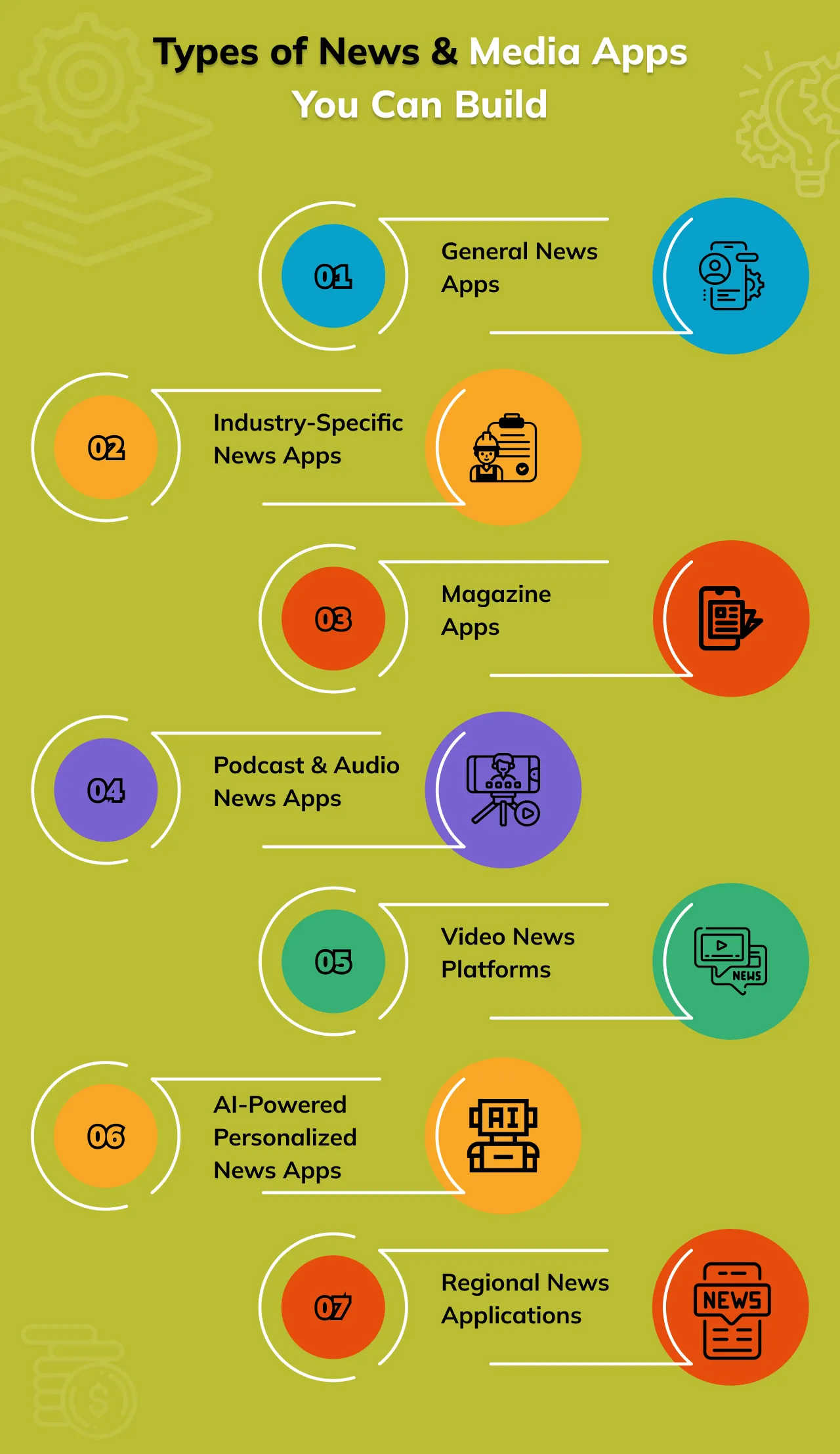
General News Apps cover the daily churn, politics, business, sports, world events, for a broad readership.
Industry-Specific News Apps narrow in on one vertical like finance or healthcare, serving a smaller but far more engaged, often more monetizable audience.
Magazine Apps bring the long-form, visually rich reading experience of print into a digital-native format.
Podcast & Audio News Apps meet people where a lot of news consumption is actually happening now, on a commute, mid-workout, hands busy.
Video News Platforms compete directly with the short-form video ecosystem that’s been eating into traditional news time.
AI-Powered Personalized News Apps build a feed that’s genuinely different for every single user based on behavior, not just a category checkbox they ticked once during onboarding.
Regional News Applications cover the hyperlocal ground that large national outlets routinely leave uncovered, and it’s a strong niche for smaller publishers who know it well.
Essential Features of a News App
There’s a baseline set of features readers now expect by default, shaped almost entirely by whatever the biggest apps in the category have already trained them on.
User Features:
- User registration and profile management
- Personalized news feed
- Category browsing
- Search functionality
- Push notifications
- Bookmarking and reading lists
- Social sharing
- Offline reading
- Multi-language support
- Dark mode
Admin Features:
- Content management for editorial teams
- User management and access controls
- Advertisement management
- Analytics dashboard
Advanced Features for Modern News Apps
Past the baseline, the apps actually pulling ahead in a crowded field tend to invest in a fairly specific set of capabilities: AI recommendations that keep refining as behavior changes, voice search, AI-generated news summaries for readers skimming on the go, live streaming for breaking events, native podcast playback instead of forcing a separate app, in-app chat or comments, geo-targeted content, interactive polls, and sentiment analysis that gives editorial teams a real-time read on how a story is actually landing with readers.
How AI Is Transforming News App Development
By 2026, AI in a news app isn’t a nice-to-have layered on top. It’s closer to foundational infrastructure.
AI-Powered Recommendations
Modern recommendation engines look past declared preferences and track actual reading behavior, time on article, click depth, scroll patterns, to keep refining a feed that keeps evolving rather than staying static.
Content Tagging & Categorization
AI now handles most of the tagging and categorization work that used to eat editorial hours, which is what actually makes personalization possible at real scale.
News Summarization
AI-generated summaries let a reader get the gist of a story in seconds before deciding whether it’s worth the full read. This has turned into a genuine retention lever, not a gimmick feature nobody uses.
Fake News Detection
AI-assisted verification tools flag questionable claims before publication. Given how much trust in news has eroded, this has moved from optional to close to expected for any publisher trying to build credibility with a skeptical audience.
Automated Translation
Real-time AI translation lets a single editorial pipeline serve multiple language markets without duplicating the entire content operation.
Predictive User Engagement
Predictive models help editorial and product teams see, before publishing, which stories are likely to land with which audience segments, so the right content gets pushed to the top of the right feed instead of everyone seeing the same homepage.
Technology Stack for News App Development
The right stack depends on your scale, timeline, and how central AI is to the product, but a few combinations have become the practical default.
Frontend: Flutter and React Native cover most cross-platform builds efficiently. Swift and Kotlin remain the choice when native performance is non-negotiable.
Backend: Node.js handles real-time features like breaking alerts well. Python tends to show up where recommendation and AI logic sit close to the core product. Java still holds up in large, enterprise-scale platforms that need proven stability under heavy load.
Database: PostgreSQL for structured, relational content. MongoDB for the more flexible, varied metadata that articles tend to carry. Redis is layered in for caching, especially where personalized feeds need to load instantly rather than compute on every request.
Cloud Infrastructure: AWS, Azure, and Google Cloud all support the elastic scaling a news app needs for the traffic spikes that come with breaking news, and just as quickly settle back down once the story cools off.
Third-Party Integrations: News APIs, payment gateways, analytics tools, and push notification services all need to be architected in from the start, since bolting them on after launch tends to create technical debt that shows up fast under real traffic.
How to Develop a News App: Step-by-Step Process
1. Market Research
Understand who you’re building for and how they currently consume news.
2. Competitor Analysis
Study what’s already working in the space, and more importantly, where the gaps are.
3. Define Features
Lock an MVP scope built around your actual audience, not every feature a competitor happens to have.
4. UI/UX Design
Design for fast scanning, since news readers move quickly and abandon anything that adds friction.
5. Choose Tech Stack
Pick frontend, backend, database, and cloud based on scale needs and how much AI capability you’re building in.
6. Development Phase
Build iteratively, core reading and personalization first, advanced features layered in afterward.
7. Testing & QA
Test across devices and, critically, under the kind of unpredictable traffic spikes news apps are unusually exposed to.
8. Deployment
Launch with a rollout plan that accounts for both iOS and Android review timelines.
9. Maintenance & Updates
A news app is never really finished. Content pipelines, security patches, and feature updates continue well past launch day.
How Much Does It Cost to Develop a News App?
| App Type | Estimated Cost |
|---|---|
| MVP News App | $15,000–$30,000 |
| Mid-Level App | $30,000–$70,000 |
| Enterprise News Platform | $70,000–$150,000+ |
These figures move based on feature depth, how many platforms you’re targeting, design complexity, team composition, third-party integrations, and how much AI capability gets built in. AI-driven recommendation engines and moderation tooling tend to be the single biggest factor separating a mid-tier build from an enterprise-grade one.
News App Monetization Strategies
Most apps doing well right now aren’t betting on one model. They’re layering subscriptions with advertising and sponsored content, so no single revenue stream carries all the risk.
Subscription Model
Recurring access to premium or ad-free content, and generally the most durable long-term revenue path.
Freemium Access
Free core content with premium depth locked behind a paywall.
In-App Advertising
Standard display and native ad placements within free content.
Sponsored Content
Clearly labeled branded content woven into the regular flow.
Affiliate Marketing
Commission-based revenue from relevant product or service links.
Membership Plans
Tiered access combining content, features, and community perks.
Event Promotions
Ticketed access to publisher-hosted events and webinars.
Common Challenges in News App Development
Content Overload
Readers drown in undifferentiated volume. Strong personalization, not more publishing, is the actual fix.
User Retention
News apps see plenty of installs and weaker long-term retention. Notifications tied to genuine reader interest, not blanket blasts, move this number meaningfully.
Fake News Management
Trust has taken a real hit industry-wide. AI-assisted verification paired with clear editorial standards helps rebuild it gradually.
Scalability Issues
Breaking news spikes can crush infrastructure that wasn’t built for it. Cloud-native, auto-scaling architecture is the practical answer, and it’s exactly the kind of problem projects like BNEA are built to solve upfront.
Real-Time Content Delivery
Readers expect breaking updates instantly, which means a backend architected specifically for low-latency publishing rather than a general CMS stretched to fit.
Security Risks
User data, payment details, and increasingly sensitive behavioral data all need real security architecture from day one, not an afterthought bolted on before launch.
How to Choose a News App Development Company
CodeAegis has built exactly this kind of product before, real-time government news infrastructure with BNEA, alongside broader mobile app development and AI capability across other industries. That combination of media-specific experience and technical depth is what a lot of publishers are looking for when they start evaluating partners for a 2026 build.
Industry Experience
Look for a team that’s actually shipped media products, not generic apps with a news skin on top.
Portfolio
Review real news or content-driven projects and how they handled personalization and scale under pressure.
Technology Expertise
They should be genuinely fluent across frontend, backend, and cloud choices suited to high-traffic, content-heavy apps.
AI Capabilities
Given how central AI has become, look for real experience building recommendation engines and content intelligence, not a generic AI feature bolted onto a sales deck.
Post-Launch Support
A news app is a living product. The right partner sticks around well past launch.
Communication Process
Clear, consistent communication throughout the build keeps scope and expectations aligned.
Scalability Experience
Ask for concrete examples of handling real traffic spikes, not theoretical claims.
How CodeAegis Has Built The BNEA News Platform
Talking about news app architecture in the abstract only goes so far. Here’s a project that shows how these pieces actually come together in production.
CodeAegis built BNEA, a real-time government news app for the Bahamas, designed to give citizens fast, concise news updates in a distinctive 60-word format built for quick reading rather than long scrolling. The platform supports personalization and multiple languages, so different readers across the islands get news relevant to them, in the language they’re most comfortable reading in, without the app feeling like a generic one-size-fits-all feed.
What made BNEA a genuinely hard build wasn’t the feature list, it was the reliability bar. As a government-backed platform, it had to deliver breaking news and updates in real time without the delays or downtime that a lot of consumer news apps can quietly get away with. That meant building the backend architecture around low-latency publishing from day one, not retrofitting it after launch once traffic problems showed up.
It’s a good example of what this guide has been getting at throughout: a news app succeeds less on how many features it lists and more on whether its underlying architecture, real-time delivery, personalization, multi-language support, was built to hold up under the exact conditions the app was actually designed for.
Future Trends in News App Development
AI-Powered Newsrooms
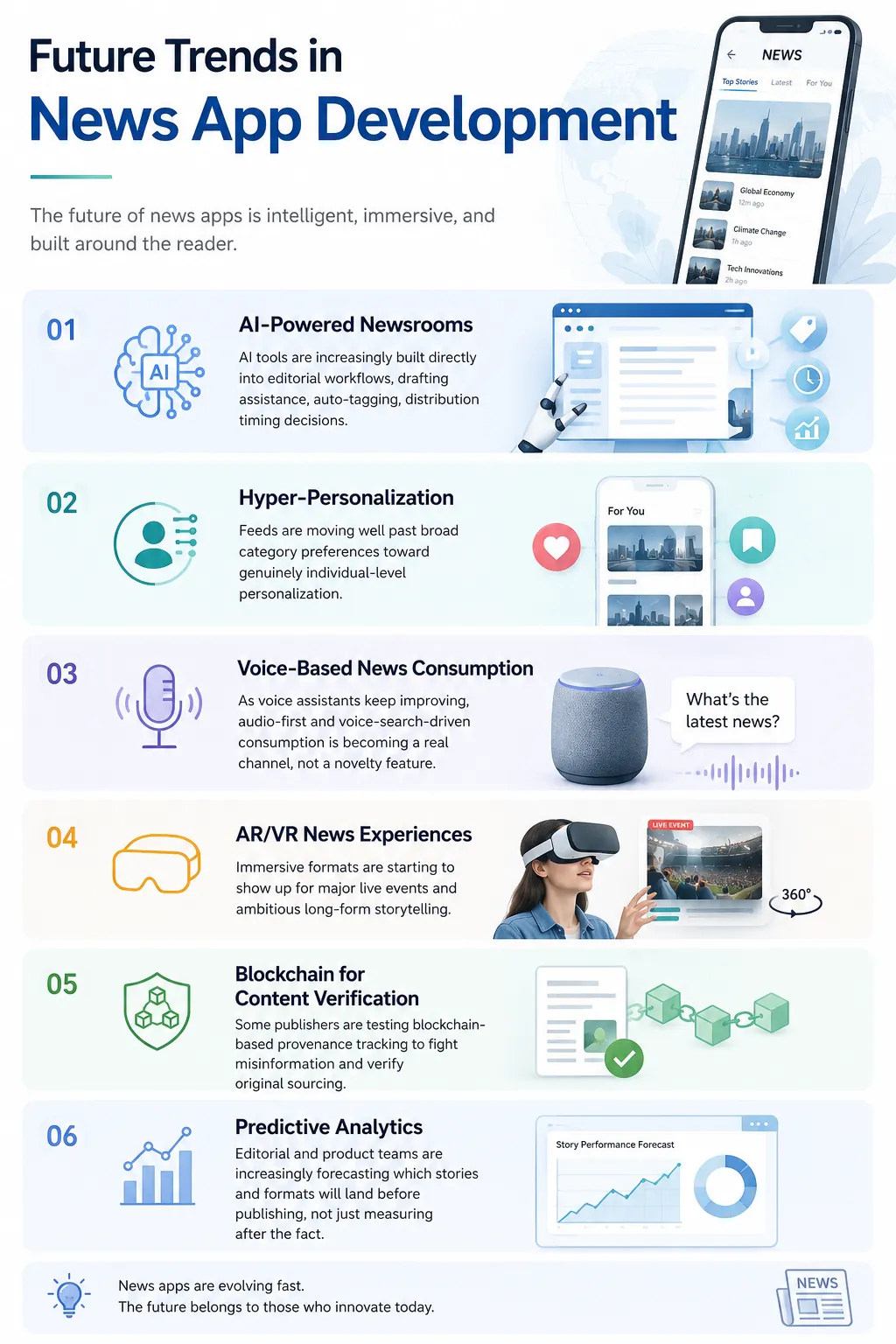
AI tools are increasingly built directly into editorial workflows, drafting assistance, auto-tagging, distribution timing decisions.
Hyper-Personalization
Feeds are moving well past broad category preferences toward genuinely individual-level personalization.
Voice-Based News Consumption
As voice assistants keep improving, audio-first and voice-search-driven consumption is becoming a real channel, not a novelty feature.
AR/VR News Experiences
Immersive formats are starting to show up for major live events and ambitious long-form storytelling.
Blockchain for Content Verification
Some publishers are testing blockchain-based provenance tracking to fight misinformation and verify original sourcing.
Predictive Analytics
Editorial and product teams are increasingly forecasting which stories and formats will land before publishing, not just measuring after the fact.
Conclusion
Building a news app in 2026 means designing for a reader with more places to get information than ever before, and a lot less patience for anything generic. The apps winning that attention combine a genuinely strong core feature set, real AI-driven personalization, architecture built for real-time delivery at scale, and a monetization mix that doesn’t lean on a single revenue stream. Government-scale platforms like BNEA show what’s possible when reliability and personalization are treated as requirements from day one, not features added after launch.
Whether you’re a media company modernizing distribution, a publisher building a subscription product from the ground up, or a founder stepping into the news space for the first time, the technical decisions made early on shape how well the app scales and competes years down the line. CodeAegis works with media organizations, publishers, and government platforms on custom news app development and news and media app development solutions that pair editorial-grade content architecture with real AI capability. If a news app build is on your 2026 roadmap, it’s worth talking to a team that’s already shipped this kind of product before you write a single line of code.
Frequently Asked Questions
How much does it cost to develop a news app?
Costs generally run $15,000–$30,000 for an MVP, $30,000–$70,000 for a mid-level app, and $70,000–$150,000+ for an enterprise-grade platform, depending on features, platforms, and AI capabilities.
What features should a news app have?
At minimum, personalized feeds, category browsing, search, push notifications, bookmarking, offline reading, and a solid content management backend. Competitive apps also build in AI recommendations, live streaming, and podcast integration.
How long does it take to build a news app?
An MVP typically takes 3–5 months. A mid-level or enterprise-grade platform with advanced AI and personalization can run 6–12 months depending on scope.
Which technology is best for news app development?
It depends on scale and goals. Flutter or React Native suit most cross-platform builds, while Node.js or Python backends are common, particularly where AI-driven personalization is central to the product.
How do news apps make money?
Most successful apps combine subscriptions, in-app advertising, sponsored content, and affiliate marketing rather than depending on one model.
Can AI improve news app user engagement?
Yes. AI-driven personalization, summarization, and predictive recommendations directly improve session length and retention by making each reader’s feed genuinely relevant to them.
What is the difference between a news app and a media app?
A news app is typically focused on timely news and breaking updates, while a media app is a broader category that can include entertainment, video streaming, podcasts, and other content beyond news alone.

Sakshi Aggarwal is the Co-CEO of CodeAegis, a visionary leader with 12+ years of experience in transforming complex business requirements into high-impact technology solutions across industries. Her core contribution lies in architecting the company's customer-centric service delivery model and optimizing cross-functional execution. She has become a driving force for ensuring project success and cultivating a culture of accountability across the software development life cycle.