


How AI Is Transforming News App Development in 2026
Table of Contents
What “AI-Powered” Actually Means for a News App Today
AI Content Recommendation and Personalized News Feeds
AI Content Recommendation and Personalized News Feeds
Automated Content Tagging and Categorization
AI News Summarization
Sentiment Analysis for Editorial and Audience Insight
Fake-News Detection and AI Content Moderation
Voice-Based News and AI Search
Automated Translations for Multilingual Newsrooms
What These AI Features Actually Cost to Build
How CodeAegis Builds AI-Powered News Apps
Conclusion
Frequently Asked Questions
 Add us as a preferred source on Google
Table of Content
+AI in News App Development 2026 | CodeAegis
A few years back, "AI in a news app" usually meant one thing: a recommendation strip on the homepage that nudged you toward three more articles. That's changed. AI in news app development now shows up in the tagging system behind the scenes, in how a story gets ranked for one reader versus another, in whether a suspicious claim gets flagged before it ever goes live, and in whether someone can just ask their phone to read them the headlines on the way to work.
Research from the World Association of News Publishers found that 62% of European publishers now use AI for personalized content recommendations, a number that’s only climbed since.
Reader attention is harder to hold onto than it used to be, and a feed that treats every reader the same way just doesn't compete. The publishers gaining ground right now are the ones building AI in as core infrastructure rather than tacking it on after the fact. This post goes through each capability on its own terms instead of lumping them into one overview paragraph, because "AI-powered" ends up covering a lot more ground than most people expect walking in.
What "AI-Powered" Actually Means for a News App Today
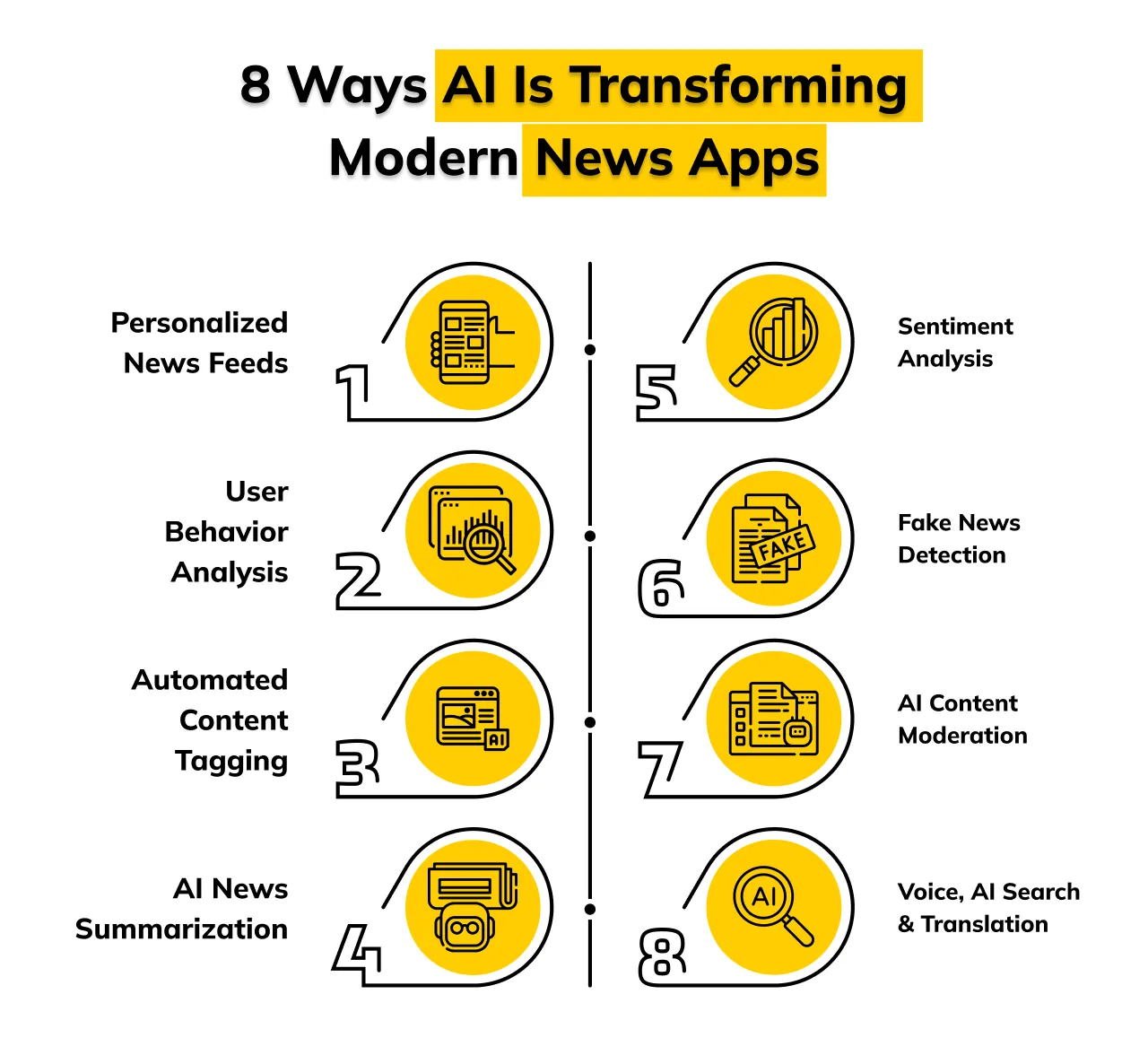
Ask ten publishers what an AI-powered news app looks like and expect ten different answers. Some picture recommendations. A few jump straight to chatbots. Realistically, the work splits into four rough layers.
There's content intelligence, the behind-the-scenes stuff like tagging and summarizing articles. There's discovery, which covers recommendations and search, basically how a reader actually finds anything worth reading. Trust and safety handles verification and moderation, and that's become a bigger deal with every news cycle that includes a viral falsehood. And then there's access: voice and translation, the layer most publishers quietly underinvest in even though it decides who can use the app at all.
The sections below follow that same order. For the broader feature picture beyond AI specifically, our news app development guide covers the rest of what goes into a build like this.
AI Content Recommendation and Personalized News Feeds
Most guides on this topic give recommendations in a single sentence: "AI suggests relevant articles." Fine as far as it goes, but it skips the part that actually matters. This is where the bulk of engineering effort in a modern news app tends to go, and understanding why helps explain a lot of the decisions further down.
How a Recommendation Engine Actually Ranks a Story
Actually, there are three methods behind all of this. The first is collaborative filtering that takes similar users and recommends items based on what these similar users have clicked, the same approach that Netflix uses to recommend shows to viewers. Content-based filtering, on the other hand, examines the article itself and matches it to the user’s previous interactions by considering the topic, entities mentioned in the article, style, and other parameters.
Recommendation Method | How It Works | Main Data Used | Key Benefit |
|---|---|---|---|
Collaborative Filtering | Analyzes similar users' behavior | Clicks & interactions | Finds relevant content |
Content-Based Filtering | Matches articles to user interests | Topics & entities | Delivers related stories |
Hybrid Recommendation | Combines both approaches | User + content signals | Improves recommendations |
Editorial Placement | Supports recommendations for new users | Editorial signals | Solves cold-start issues |
In practice, however, teams tend to use both of these methods combined, because each of them covers something the other misses.
Speaking of which, one of the major challenges of news recommendation machine learning systems is the problem of the cold start. In other words, a brand-new user has no history, while a brand-new article has no engagement information. That’s why news recommender systems overcome this problem using content-based signals and editorial placement during the first couple of days.
Building a Feed That Doesn't Trap Readers in a Bubble
Here's something rarely discussed outside the industry: a feed optimized purely for engagement will happily show someone the same handful of topics forever, because that's what keeps the clicks coming. Great for a short-term metrics dashboard. Genuinely bad for a news outlet trying to keep its credibility intact.
Keeping AI personalization healthy means someone has to deliberately inject editorial variety into the mix rather than letting the model run unsupervised. When we built this for BNEA, that meant a feed that personalized around what each reader group actually cared about while still surfacing coverage across categories a purely engagement-driven ranking would've quietly buried. Different language communities, different reading habits, and none of it collapsing into one flattened, generic feed.
User Behavior Analysis: The Data Layer Behind Personalization
None of the ranking logic above has anything to work with unless user behavior analysis is running underneath it. Dwell time, scroll depth, click-through, what gets shared, what gets abandoned two paragraphs in, all of it becomes a signal feeding the model.
That data earns its keep twice over. It trains the recommendation engine, sure, but it also goes back to the newsroom, showing editors which headlines actually hold a reader's attention versus which ones get the click and then lose them immediately after. That second use gets skipped almost everywhere this topic comes up online, and honestly it might matter more to a newsroom than the personalization angle does.
One thing worth saying directly: tracking at this level needs a real privacy and consent framework behind it from the start. Anywhere GDPR-adjacent rules apply, this can't be something a legal team flags after launch and engineering scrambles to bolt on. It has to be part of the architecture from day one.
Automated Content Tagging and Categorization
None of the above functions beyond a certain scale without this one, and this is by far the least exciting item in the entire list. Automated content tagging is what allows for personalization to be effective once the newsroom is putting out hundreds of pieces a day, not just dozens.
Tagging stories manually via the efforts of the editorial staff becomes unsustainable beyond a certain scale, and is inconsistent the very moment there are multiple people applying different judgments to it. Entity extraction via NLP and topic modeling takes the job over, recognizing entities within a text piece and providing structured tags the recommendation system could use. It happens mostly at the time of publication, and is repeated periodically when new information is added to an evolving story. AI is only one piece of what makes a news app work well end to end. For the full list of features worth building alongside it, read more in our news app features blog.
AI News Summarization
The fact that people skim more often when they read on their phone is precisely what makes news summarization one of the most visible AI tools in the modern app. People get immediately accustomed to it, and there are two truly different approaches to building it.
In extractive summarization, the sentences from the text that are considered important are just copied from the original source and strung up.
This way seems more secure because there is nothing mentioned in such a summary which wasn't in the source itself. Abstractive summarization generates new sentences reflecting the essence of the article without copying the exact words used in it. In this way, the summary sounds much more natural, but it may include some misrepresentations if the algorithm generating it wasn't properly trained on the news data.
Both approaches to summarization are usually implemented in the form of LLM-generated bullet points positioned above the full article.
Sentiment Analysis for Editorial and Audience Insight
Nobody else covering this topic gives sentiment analysis much space, which is strange. There's real editorial value here that has nothing to do with the usual brand-safety pitch.
Track sentiment in real time across published stories and reader comments, and an editorial team suddenly has a live pulse on how coverage is actually landing. Say a story starts generating confusion or backlash nobody expected. That's usually a sign the framing missed, or that a follow-up piece needs to go out fast to clear things up. Editors end up using this signal to make calls on tone, on what to cover next, and on where to put more reporting hours.
Fake-News Detection and AI Content Moderation
Trust in news media hasn't had an easy decade. At this point, fake-news detection isn't a nice extra, it's something readers assume a credible outlet already has running quietly in the background. Talk about this as a trust issue first. The technical part comes second.

How AI Verification Models Flag Questionable Claims
Better implementations check claims before a story goes live at all, cross-referencing sources and flagging anything unsourced or inconsistent. This doesn't hand editorial judgment to a machine. It just means a shaky claim gets caught while a human editor can still act on it, instead of a correction going out after readers have already seen the wrong version.
Moderating Comments and User-Generated Content at Scale
Once a platform hits real scale, comment sections and citizen reporting produce more volume than any team could review by hand. AI-assisted moderation picks up that load, filtering out obvious spam and harassment automatically and routing the genuinely tricky calls to a person. AI handling volume, people handling judgment. That combination holds up a lot better than either one running solo.
Voice-Based News and AI Search
These two live in the access layer, and they're consistently the least built-out part of a news app, even though each one opens the door to a completely different reading, or listening, context.
Voice Assistants and Audio-First News Consumption
TTS (text-to-speech) makes it possible to convert an article into an audio file that one can hear while commuting or working out without having to look at the screen. The integration with Siri, Google Assistant, and Alexa takes it to the next level, by making it possible for a person to request a briefing without having to open the application. There is an increasing trend of listening to news, and it would be very unwise for any news application to overlook it.
AI Search: Moving Past Keyword Matching
Traditional app-based searches take keywords literally, and as soon as you rephrase the question in any way not stated within the article, your search fails. Semantic searches through an AI understand what you mean to ask, not the literal text of the query. For example, the question "what is happening with the transit strike?" would still find relevant articles despite no one phrasing it exactly that way.
Automated Translations for Multilingual Newsrooms
Any publisher serving more than one language community runs into the same operational headache: keeping a separate editorial pipeline per language is expensive, slow, and most newsrooms just can't staff it. Automated translations solve that by letting one editorial workflow serve multiple language markets from a single source, without duplicating the reporting or editing work behind it.
That was a core piece of how BNEA's platform handled multilingual delivery, and it fed directly into the same personalization layer described earlier, so language never became the reason a reader got a worse, less relevant feed than anyone else.
What These AI Features Actually Cost to Build
Every one of these capabilities sounds reasonable in isolation. Add them up and you're looking at a noticeably bigger technical lift than a standard news app, and there's not much point pretending otherwise.
Recommendation engines and summarization both need real data infrastructure behind them, event tracking, a training pipeline, ongoing model upkeep, none of which a basic content app requires at all. AI in news app development is one of the biggest single factors separating a mid-tier build from an enterprise-grade one, more than most other feature categories put together. Rather than rehashing the numbers here, our news app development cost guide breaks down real planning ranges for each of these AI capabilities individually.
Where AI Implementations in News Apps Usually Go Wrong
Most of the AI capabilities above work fine in a demo and then quietly underperform in production, and it's worth knowing why before committing budget to any of them.
The most common failure is training a recommendation engine on too little data and shipping it anyway. A model that hasn't seen enough reader behavior yet will latch onto noise, early clicks that don't actually reflect broader reader interest, and confidently over-personalize around it. The fix isn't a smarter model. It's holding off on full personalization until there's genuinely enough behavioral data to work with, and leaning on editorial placement in the meantime instead of forcing the algorithm to guess.
The second one shows up with summarization specifically. Publishers often turn on abstractive summarization without reviewing enough real output first, and it takes surprisingly few subtly wrong summaries before readers stop trusting the feature, and sometimes the publication, entirely. A short manual review period before full rollout catches most of this early.
The third is treating moderation as fully automated once it's live. AI moderation models drift as language and slang shift, and a system that was catching 95% of policy violations at launch can quietly slip to 80% eight months later if nobody's periodically checking its output against a human baseline. This one's less about the initial build and more about who owns reviewing it afterward, which is a conversation worth having before launch, not after something gets missed.
How CodeAegis Builds AI-Powered News Apps
Most of what's covered above isn't hypothetical for us. Building BNEA meant shipping an AI-powered news app with real-time, multilingual, personalized delivery for a genuinely varied reader base, which meant solving the feed-diversity problem, the translation pipeline, and the personalization layer all at once, not as three separate projects stacked on top of each other.
That's really the gap between talking about AI features and shipping them under actual constraints: multiple languages, real-time expectations, and readers who don't all behave the same way. If you're scoping something similar, our news and media app development solutions will walk through how we approach these builds from the ground up.
Conclusion
AI in news app development isn't a menu of features to pick a few from anymore. It's infrastructure at this point, the same way push notifications and offline reading quietly became infrastructure a decade back. The publishers pulling ahead in 2026 are treating personalization, trust, and accessibility as one system that has to work together, not three separate line items competing for the same budget.
If you're figuring out how AI development fits into your own news app plans, we're glad to talk through what that actually looks like for your reader base and your newsroom's specific setup.
Frequently Asked Questions
What does AI actually do inside a news app?
It handles tagging, ranking articles for recommendations, summarizing longer pieces, reading sentiment, flagging questionable claims, moderating comments, reading stories aloud, and translating content, basically everything that shapes what a reader sees and whether they can trust it.
How does AI-powered personalization work?
It blends collaborative filtering, based on similar readers' behavior, with content-based filtering, based on the article itself, into one hybrid ranking. Editorial diversity controls sit on top of that so the feed doesn't narrow down to two or three topics over time.
Does AI increase news app development cost?
Yes, and by a meaningful amount. Recommendation engines and summarization both need data infrastructure a basic app never touches, which makes AI capability one of the bigger cost drivers in a modern build. The cost guide linked above has planning ranges.
Can AI stop fake news from spreading on a news app?
It can catch a lot of it. Verification models flag questionable claims before publication, and moderation tools catch a large share of bad-faith comments automatically. Neither one replaces an editor's judgment entirely, and nobody seriously claims otherwise.
What's the difference between AI recommendations and simple category filters?
Category filters are static, a reader picks a few topics once and that's it. AI recommendations adjust continuously based on actual reading behavior, which means the feed keeps shifting as interests do, rather than staying frozen on a choice made months ago.
Is voice search worth building into a news app in 2026?
For most publishers, yes. Audio-first news consumption keeps climbing, especially around commutes and workouts, and skipping it means handing that reading time straight to a competitor who built it.
How long does it take to add AI features to an existing news app?
Depends a lot on which feature and how much historical data already exists to train against. Something like summarization can go in within a few weeks. A properly tuned recommendation engine takes longer, since it needs real usage data to get good.