


Top AI Trends in 2026: What Businesses Need to Know
Table of Contents
AI Adoption in 2026
Top AI Trends in 2026
Why AI Projects Fail
AI Implementation Roadmap
AI Trends Across Industries
Your AI Transformation Partner
Conclusion
Frequently Asked Questions
 Add us as a preferred source on Google
Table of Content
+AI Trends in 2026: What Businesses Need to Know | CodeAegis
AI is already here, reshaping how businesses operate, make decisions, and compete. According to McKinsey's State of AI in report, 88% of organizations now use AI in at least one business function, up from 78%. Yet most businesses still haven't figured out how to move beyond pilots and actually scale AI across their operations.
But here’s where it gets interesting and honestly a bit frustrating for most companies. Just because 88% of organizations are using AI doesn’t mean they’re actually getting value from it. Most of them are stuck in pilot mode. They’ve tried it out, they’re experimenting, but they haven’t figured out how to actually scale it across their entire operation. That gap between trying AI and actually winning with AI? That’s where the real opportunity is hiding.
Here’s What You’re Going to Learn in This Guide
- Agentic AI is moving out of the lab and into real production work, and it’s completely changing what we think automation means
- Generative AI isn’t just about chatbots anymore. It’s getting embedded into the actual work your company does every single day
- The massive, expensive AI models everyone talked about? They’re not winning. Smaller, specialized models are taking over for most real-world problems
- AI governance used to feel like red tape. Now it’s actually a competitive advantage if you do it right
- Most companies are completely unprepared for what’s happening, which means if you move fast, you get a real edge
The gap between using AI and using it well is where real opportunity lives. Organizations that understand what's changing and act on it are pulling ahead. Those that wait are falling behind. This guide walks through the AI trends that matter right now, what they actually mean for your business, and how to prepare.
AI Trends in 2026: Where Business Adoption Stands Today
About 62% of companies are experimenting with AI agents specifically. That's interesting because agents are becoming the core of how enterprise AI actually delivers value. But then you get to production-scale deployments, and suddenly you're talking about 23% of organizations that have actually gotten agents working at real scale.
Gartner's predictions for the rest of 2026 show something wild happening. They're expecting 40% of enterprise applications to have some kind of AI agent built in by year-end. That's a huge jump from almost nothing in 2025. The acceleration is real. But here's where it gets concerning: at the same time, Gartner is predicting that more than 40% of these agentic AI projects will get cancelled or paused before 2027 is done.
But here's the reality check that nobody wants to discuss openly. Over 40% of agentic AI projects are expected to be cancelled by end of 2027. That tells you something important about execution quality. It's not that the technology doesn't work. It's that many organizations aren't executing properly on their AI strategies.
Key Statistics and Data Points
| Metric | Latest Figure | Source and Year |
|---|---|---|
| Organizations using AI in at least one business function | 88% (up from 78%) | McKinsey, The State of AI in 2025 |
| Organizations experimenting with AI agents | 62% | McKinsey, The State of AI in 2025 |
| Organizations actively scaling agentic AI systems | 23% | McKinsey, The State of AI in 2025 |
| Enterprise apps with task-specific AI agents by end of 2026 | 40% (from under 5% in 2025) | Gartner prediction |
| Agentic AI projects expected to be cancelled by end of 2027 | Over 40% | Gartner prediction |
The most important insight from adoption data is this widening gap between awareness and action. Every organization knows AI exists and matters. Most have started some kind of AI work. But the ones actually getting value from AI remain a small percentage. That gap represents opportunity for organizations willing to be disciplined about how they approach AI.
Top 8 AI Trends Reshaping Business in 2026
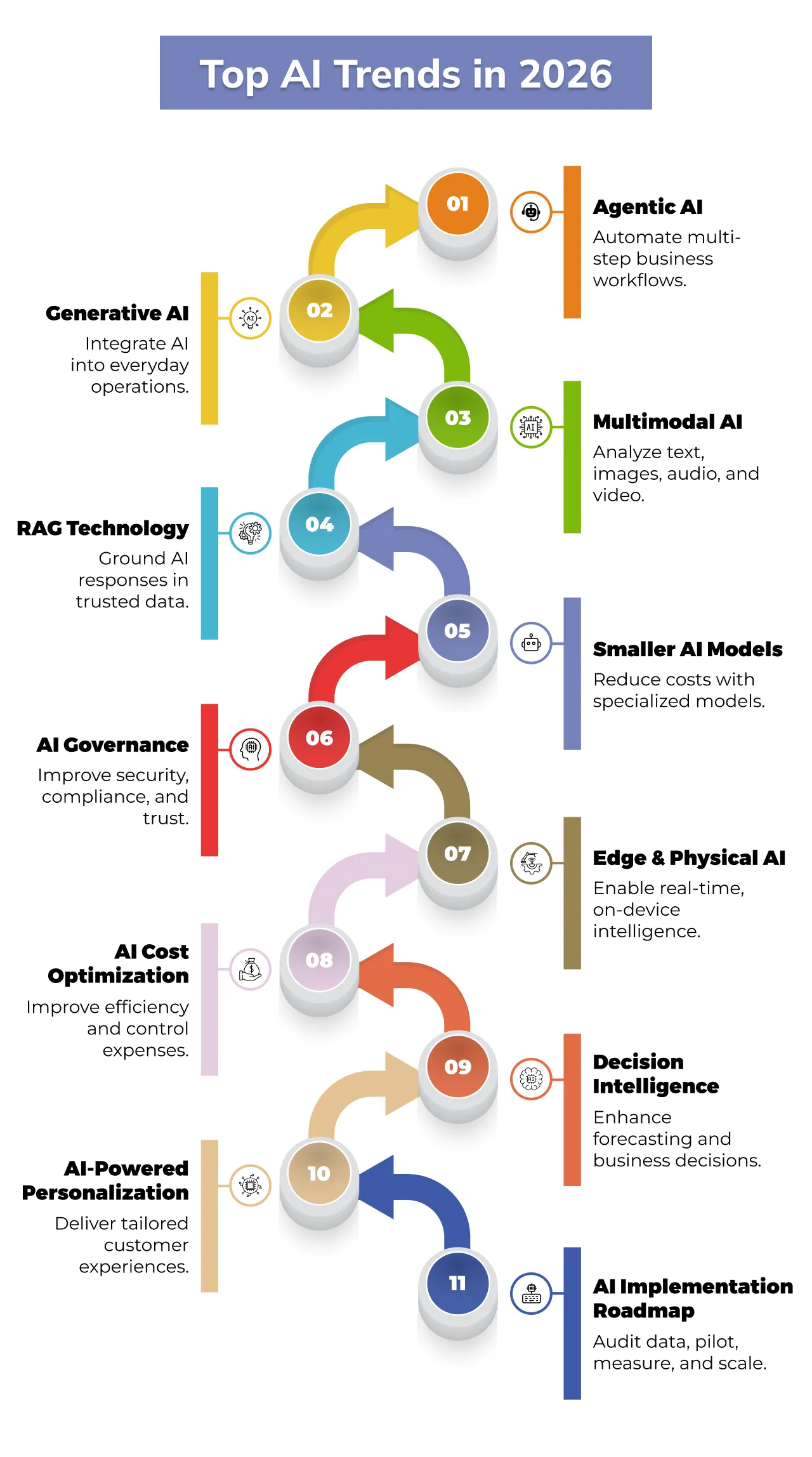
There are nine distinct trends reshaping how companies approach AI in 2026. Some are brand new. Others are becoming mainstream. Understanding them isn’t about checking boxes. It’s about figuring out what actually solves your specific problems.
1. Agentic AI: The Real Deal Happening Now
Okay, so agentic AI is fundamentally different from the chatbots everyone’s been playing with. A chatbot sits there waiting for you to ask it something. An agent? An agent actually does stuff. You give it a goal, and it figures out the steps, executes them, and if something goes wrong, it adapts.
This is already happening in real businesses. Support teams are deploying agents that handle routine tickets completely without a human ever looking at them. Finance teams have agents processing expense reports, flagging weird stuff, and only escalating things that actually need a human decision. IT departments have agents diagnosing common problems and handling server provisioning. Sales teams have agents qualifying leads and booking calls.
The numbers are compelling if you’re looking at this from a business perspective. Companies deploying support agents are seeing 40-60% drops in ticket volume. Finance teams are processing expense reports two to three times faster. That’s not marginal improvement. That’s transformative.
The really interesting part is something called agent interoperability. Right now, most agents are isolated. One handles support, another handles finance, and they don’t talk to each other.
What this means for your business: Your workflows shift from people doing repetitive work to people handling exceptions. Speed goes through the roof. Your team stops doing mechanical tasks and starts thinking more strategically.
2. Generative AI Isn’t Experimental Anymore
Generative AI moved from “this is cool to play with” to “this is how we actually work” faster than most technology transformations. Organizations have mostly moved past the pilot stage and are now scaling it into their actual operations.
Here’s what’s actually happening in real companies. Marketing teams are generating product descriptions automatically instead of hiring copywriters to write them from scratch. Engineering teams are using it for code generation and documentation. Finance is generating reports and doing analysis. Customer support is using it to draft responses. HR is using it for resume screening.
The pattern is consistent everywhere. Generative AI speeds up work by 2 to 5 times without actually replacing the humans. People don’t go away. They shift what they do.
Organizations that have figured this out report that having a human review AI-generated content takes about 20-30% of the time that creating from scratch would take. That’s a game-changing productivity gain, especially when you multiply it across a whole team or department.
3. Multimodal AI: More Than Just Text
Multimodal AI processes text, images, audio, and video all in the same model. This actually matters more than it sounds in practice.
Think about what your business actually deals with. Manufacturing needs to look at product photos alongside specification sheets. Healthcare needs to review patient imaging studies alongside the written clinical notes. Insurance companies need to assess damage claims where you’ve got both written descriptions and photos.
Traditional AI required separate models for each data type, then some other system to combine what they figured out. Multimodal models do it natively. One model understands all the data types at once, and that leads to better analysis overall.
4. RAG: Solving the Hallucination Problem
Generative AI has this annoying tendency to confidently make stuff up when it doesn’t know the answer. That works fine if you’re writing creative fiction.
Hallucinations drop dramatically when the model is working from your actual data instead of from what it thinks it knows. RAG works best for specific, data-heavy situations. Customer support where you have a knowledge base. Policy questions where you have actual policies documented. Product questions where you have product data. It’s not useful for open-ended strategic questions, but for operational questions where accuracy against your specific data matters, it’s exceptional.
5. Smaller Models Are Winning
This is a big shift from what everyone was saying a couple years ago. Massive general-purpose models were supposed to be the future. Now smaller, specialized models trained on specific domains are outperforming the big ones for most real-world use cases.
DeepSeek’s recent work demonstrates this clearly. Models with 70 billion parameters can match the performance of much larger models on specific tasks while using way less computational power.
6. AI Governance Became Competitive Advantage
For years, AI governance felt like compliance overhead. Something you did because lawyers told you to. Now it’s actually a competitive advantage if you get it right.
Bias in AI systems is real and it excludes people from loans, jobs, and services. That’s not just unfair. It’s illegal in many places. Data leaks from AI systems expose customer information, trade secrets, sensitive health data. That’s expensive and reputation-destroying. Unapproved “shadow AI” systems proliferate without oversight, creating compliance risk that nobody’s managing. Models trained on bad data make bad decisions at scale.
Organizations that treat governance as infrastructure instead of an afterthought actually move faster, not slower. They build confidence that systems work reliably. They’re not waiting for problems to happen. They’re preventing them.
7. Physical and Edge AI: Intelligence Moving to the Real World
AI running in data centers is useful. AI running in robots, sensors, drones, and on actual devices? That’s transformative.
Edge AI is the key here. It runs intelligence on devices instead of sending everything back to the cloud. Latency disappears because you’re not waiting for round-trip communication. Privacy improves because data stays local. Costs drop because you’re not paying for constant cloud connectivity.
Manufacturing facilities are using edge AI for predictive maintenance. Sensors embedded in equipment continuously monitor vibration patterns, temperature, and performance. When the system detects failure signatures before they become catastrophic, maintenance gets alerted. Equipment gets fixed proactively. Downtime plummets. Repair costs drop. Production keeps moving.
8. AI Infrastructure and Cost Management: The Reality of Scale
Here’s something that might shock you. A large language model inference costs anywhere from $0.001 to $0.01 per request depending on the model and your infrastructure. Sounds cheap, right? But run that at scale. A company doing 100,000 inferences daily faces $30,000 to $300,000 in monthly infrastructure costs. That’s real money.
Model efficiency directly impacts profitability. A model that runs efficiently on a single GPU costs 80% less than one that needs multiple GPUs. Smaller models are winning not just because they’re better, but because they’re fundamentally cheaper to operate at scale.
The practical levers aren’t fancy. Quantization compresses models. Batch processing reduces API calls. Caching stores results instead of recomputing. None of this is new, but everything matters tremendously at production scale. Energy consumption is becoming a competitive concern as organizations look at renewable energy sources and more efficient models.
Why AI Projects Actually Get Cancelled
Here’s something nobody likes admitting. Over 40% of agentic AI projects will get cancelled by 2027 according to Gartner. Not fail. Cancelled. Paused. Shelved. Abandoned.
It’s not because the technology doesn’t work. It’s because execution is genuinely difficult.
Organizations start with enthusiasm. Board approves it. Budget gets secured. Teams get hired. Work starts. Then around month three or four, things get real. The project takes longer than expected. Data is messier than anticipated. The business case isn’t as clear. Costs are higher than estimated. Value is uncertain.
At that point, many companies pause or cancel.
Why does this happen:
- Business value ends up being unclear. The problem you’re solving isn’t actually costing the organization enough money. Or cost savings are smaller than projected.
- Costs keep rising. Infrastructure, training, maintenance end up way more expensive than initial estimates.
- Data is a mess. The data your AI system needs is dirty, incomplete, stored in incompatible systems, or requires extensive cleaning.
- Governance gets skipped. Security is weak. Accountability is unclear. When something goes wrong, nobody knows who’s responsible.
The common thread is lack of rigor at the beginning. Organizations don’t do proper discovery. They don’t audit data. They don’t define clear success metrics. They don’t build governance into the plan. When reality doesn’t match assumptions, things fall apart.
Organizations that actually survive this phase and get value? They share one trait: they started small. They defined clear metrics upfront. They built governance from day one. They only expanded after proving value. They didn’t try to do everything at once. They picked one focused use case. They made sure data was actually clean. They defined success before starting. They got organizational buy-in. When the project demonstrated value, they expanded.
How to Prepare Your Business for AI Trends: A 5-Step Roadmap
Step 1: Audit what you actually do (2-3 weeks)
Talk to your teams. What work is repetitive? What takes time but doesn’t require judgment? What would change if you could cut time in half? Those conversations surface two or three obvious candidates. Pick your best one.
Step 2: Fix your data (2-6 weeks)
Data quality is foundational. AI built on bad data produces bad results. Understand your data. Where is it? How clean is it? Can you access it? Does it have what you need?
You’ll spend weeks cleaning and organizing data. That feels like wasted time when you want to get to the AI part. It’s not. Clean data makes everything downstream faster and better.
Step 3: Run a pilot (6-8 weeks)
Small pilot. Real data. Real people. Define success metrics before you start. What would success actually look like? Lower costs? Fewer errors? Faster processing? Define it. Measure before and after.
Build the system. Test it. Collect data. Validate results. You’re not building the final production system. You’re proving the concept works.
Step 4: Add governance (parallel with step 3)
Governance shouldn’t be an afterthought. Build it while you’re building the pilot. Establish access controls. Set up audit logging. Define review processes. Document policies. Set up performance monitoring.
This doesn’t slow you down. It actually accelerates you. Governance built in from the start prevents problems that show up later.
Step 5: Scale and optimize (ongoing)
Once your pilot proves value, you expand. More workflows. More users. More optimization. This phase is ongoing. You’re refining continuously based on real-world data.
How AI Trends Are Reshaping Key Industries?
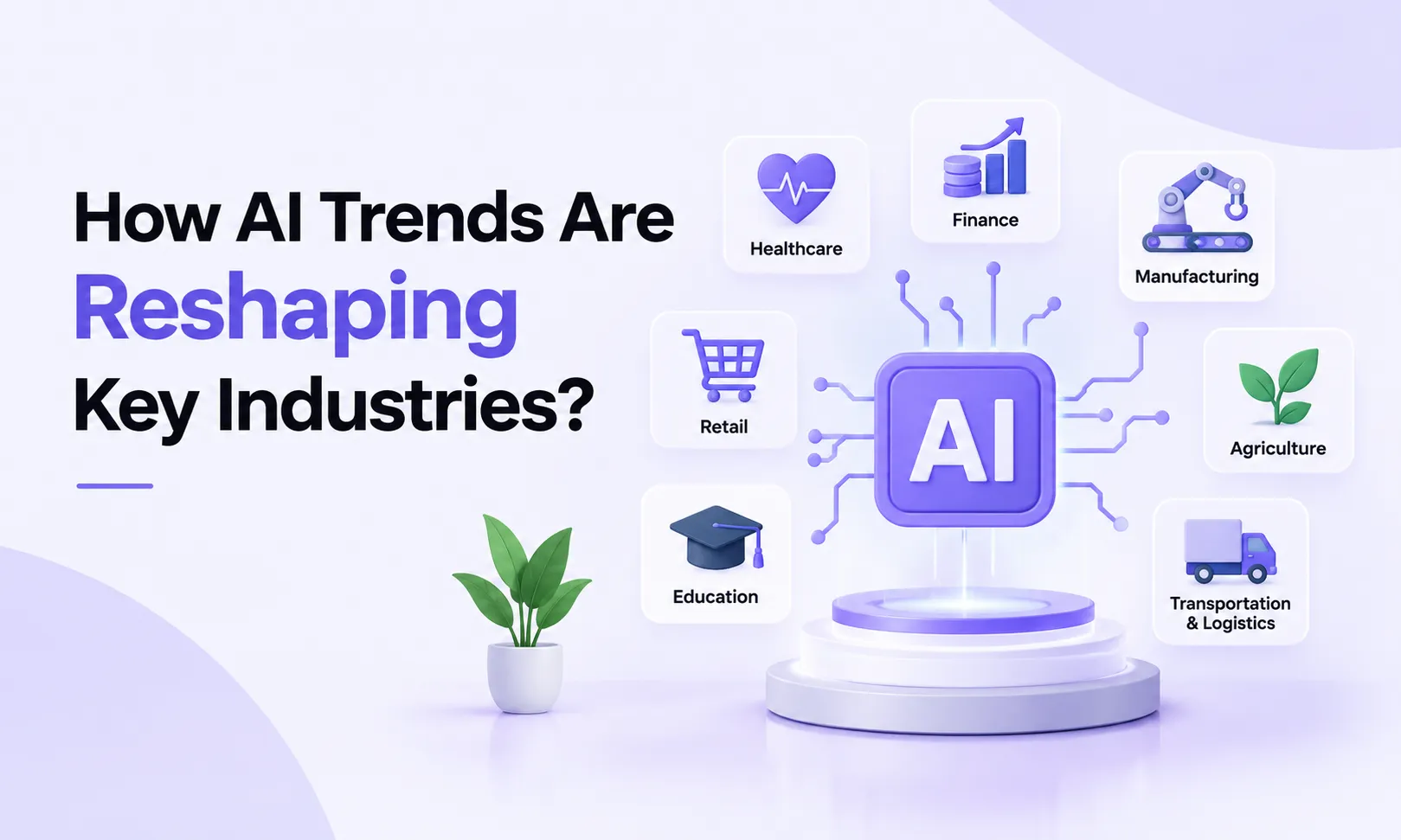
Different industries are adopting different trends because different trends solve different problems. The patterns emerging show clear alignment between industry challenges and specific AI capabilities that address them most effectively.
Healthcare Is Using Multimodal AI and Governance
Healthcare organizations are leaning hard on multimodal AI for diagnostic support and governance for regulatory compliance. Medical imaging combined with patient records, lab results, and clinical notes creates a complete picture. One model understands all these data types at once and catches subtle patterns that separate analysis would miss.
Governance is critical in healthcare. Patient data is sensitive. HIPAA is strict. Organizations that build governance frameworks from the start can deploy AI confidently while maintaining compliance. The outcome is faster, more consistent care with better diagnostic accuracy.
Finance Is Focused on Agents and Security
Financial services are using agentic AI for operational efficiency and AI security for fraud prevention. Agents automate loan checks and process applications faster while maintaining accuracy. Security systems detect fraud patterns in real-time.
Agents in finance handle routine decisions without human involvement for most cases. Complex applications escalate to human review. This hybrid approach keeps costs manageable while maintaining quality standards. The outcome is shorter decision times and fewer errors.
Retail Is Combining Generative AI and Personalization
Retail and eCommerce organizations are using generative AI for content creation and decision intelligence for personalization. Product descriptions get generated automatically. Pricing optimization algorithms adjust prices based on demand, competition, inventory.
Each visitor sees a personalized homepage, personalized recommendations, personalized offers. The system learns from behavior and adjusts in real-time. Conversion rates go up because customers see products they’re interested in. Retention improves because the experience feels personalized.
Manufacturing Deploys Physical and Edge AI
Manufacturing uses physical AI and edge AI for predictive maintenance. Sensors embedded in equipment continuously monitor vibration patterns, temperature, pressure, performance. Edge AI runs locally, analyzing data in real-time without sending everything to the cloud.
When the system detects failure signatures before catastrophic failure, maintenance gets alerted. Equipment gets serviced proactively. Downtime drops dramatically. Repair costs drop. Production velocity increases.
Logistics Uses Decision Intelligence
Logistics and supply chain organizations use decision intelligence for demand forecasting and route optimization. Predictive models forecast demand weeks ahead, allowing optimal inventory positioning. Route algorithms consider traffic, delivery windows, vehicle capacity, driver availability.
These systems improve continuously. Demand forecasts get more accurate. Routes get more efficient. The outcome is lower operational costs, fewer delays, better customer satisfaction.
Media Uses Generative AI and RAG
Media and news organizations use generative AI and RAG for AI-assisted summaries and personalized content feeds. Generative AI can summarize long articles into concise summaries. RAG ensures summaries stay grounded in actual article content, reducing hallucinations.
Personalization systems learn from reading behavior and adjust what stories each reader sees. Faster publishing happens because generative AI handles routine content processing. Better engagement happens because readers see content aligned with their interests.
CodeAegis: Your Partner in AI Transformation
The gap between knowing about AI trends and successfully implementing them is enormous. We've seen organizations with unlimited budgets fail at AI implementation because they lacked discipline and clear strategy. We've seen organizations with tight budgets succeed because they approached AI strategically and systematically.
At CodeAegis, we've delivered over 150 AI deployments across industries. We've seen what works and what doesn't. We know the mistakes that most organizations make, and we help you avoid them. We've managed 50+ AI systems at scale, from initial proof-of-concept through production deployment and optimization.
Our Approach to AI Implementation
We don't believe in one-size-fits-all solutions. Your business is unique. Your data is unique. Your challenges are unique. Your AI strategy should reflect that. We start with deep understanding of your business, your goals, and your constraints. Then we design an approach specific to you.
We handle the full journey. Strategy and consulting to identify your highest-value use cases. Custom development to build AI systems that work with your specific data and workflows. Integration to connect AI to your existing systems so data flows seamlessly. Governance implementation to ensure your AI systems are secure, compliant, and trustworthy.
Delivering Measurable Business Value
Governance
Every project we run has clear metrics defined upfront. We measure before and after. We track ROI. We prove value. Organizations working with us know whether their AI investment is working because we provide regular dashboards and reports showing impact.
Our approach eliminates the common pitfalls. We don't start building without clear use cases. We don't build without clean data. We don't deploy without governance. We don't wait for problems. We're constantly monitoring and optimizing.
Conclusion
AI trends in 2026 aren't theoretical. Organizations are deploying agents, scaling generative AI, building governance, and measuring outcomes.
AI trends represent genuine opportunity. The organizations winning right now are the ones that started early, stayed disciplined, and kept iterating based on data. They didn't wait for perfect technology. They started with available technology and got good at using it.
You don't need to understand all nine trends to get started. You need to identify one high-value use case, audit your data, run a focused pilot, build governance in parallel, and measure results. That's a 12-16 week journey that proves whether AI creates value for your business.
Ready to turn AI trends into action for your organization? Let's talk about what an AI implementation roadmap looks like for your specific situation. Whether you're just starting to explore AI or you're already running pilots, we can help you move from awareness to value.
Talk to CodeAegis About Your AI Strategy!
Frequently Asked Questions
What are the top AI trends in 2026?
Agentic AI, generative AI at scale, multimodal AI, RAG, smaller and vertical models, AI governance and security, physical and edge AI, AI infrastructure efficiency, and decision intelligence represent the nine key trends reshaping business. The first three are attracting the most investment. The governance and security trend is where caution is concentrated because the risks are real and the penalties for getting governance wrong are high.
What is agentic AI and why does it matter for business?
Agentic AI is software that plans and executes multi-step tasks with minimal human input. It matters because it automates entire workflows, not just individual tasks. An agent can handle a customer support issue from start to finish. That shifts support from a cost center where you're paying people to answer questions to an efficiency center where most questions are answered automatically.
Which AI trends deliver business value first?
Grounded AI using RAG, workflow automation with agents, and decision intelligence deliver value quickly because they attach directly to existing processes and have clear metrics. You can measure impact within weeks, not quarters. These trends also require less cultural change than other trends, so adoption is faster.
What are the biggest risks of adopting AI?
Inaccurate outputs that create problems downstream. Security gaps that expose data. Compliance violations that create legal exposure. Cost overruns that make ROI negative. Inaccuracy is the most common negative consequence organizations report, according to McKinsey research available at https://www.mckinsey.com/capabilities/quantumblack/our-insights/the-state-of-ai-in-2025.
How can a business adopt AI without a large budget?
Start with one narrow use case, use data you already have, run a time-boxed pilot, measure results rigorously, then expand only if metrics justify it. You don't need massive infrastructure for a successful pilot. You don't need perfect data to start. You need discipline and clear metrics. Most successful AI adoptions started with modest budgets and tight focus.
How do businesses keep AI secure and compliant?
Limit access to systems and data to only those who need it. Keep detailed audit logs of everything. Keep humans in review loops for high-stakes decisions so there's always accountability. Monitor models for performance drift and accuracy degradation so you know when systems are breaking. Follow a clear data-use policy aligned to recognized frameworks like ISO/IEC 42001 or NIST AI Risk Management Framework. These aren't optional if you want your AI systems to be trustworthy.

With over 12 years of experience, Mansi Garg is the Chief Operating Officer (COO) of CodeAegis, specializing in optimizing business performance and ensuring operational maturity across the technology landscape. Known for designing scalable governance and quality assurance frameworks, she ensured on-time project delivery. Mansi is the true leader behind the successful execution of cutting-edge digital solutions for a diverse global clientele.