


The Role of AI in Modern Healthcare
Table of Contents
Current State of AI in Healthcare
AI for Medical Diagnosis
Drug Discovery Revolution
Healthcare AI Applications
Role of AI Healthcare Startups
Health App Development Company
Future of AI in Healthcare
How CodeAegis Can Help?
Conclusion
 Add us as a preferred source on Google
Table of Content
+The Role of AI in Modern Healthcare: From Diagnosis to Drug Discovery
Healthcare stands at the threshold of a technological revolution. Artificial intelligence in medicine has transformed from a futuristic concept into a present-day reality that's reshaping how we diagnose diseases, treat patients, and discover new drugs. Incorporating AI technologies is radically redefining what is possible in healthcare, not just making it better.
Historically, it has taken years or even decades to go from symptom detection to ground-breaking therapy. However, AI is significantly lowering these durations while increasing accuracy and cutting expenses. As we explore this transformation, we'll discover how AI for medical diagnosis and drug discovery are working together to create a more efficient, precise, and accessible healthcare system.
The Current State of AI in Healthcare
AI usage in healthcare has increased at a never-before-seen rate. The astounding rate at which medical professionals are adopting this technology is demonstrated by recent data. Knowing where we are now gives us important context for where the industry is going.
Adoption Statistics That Matter
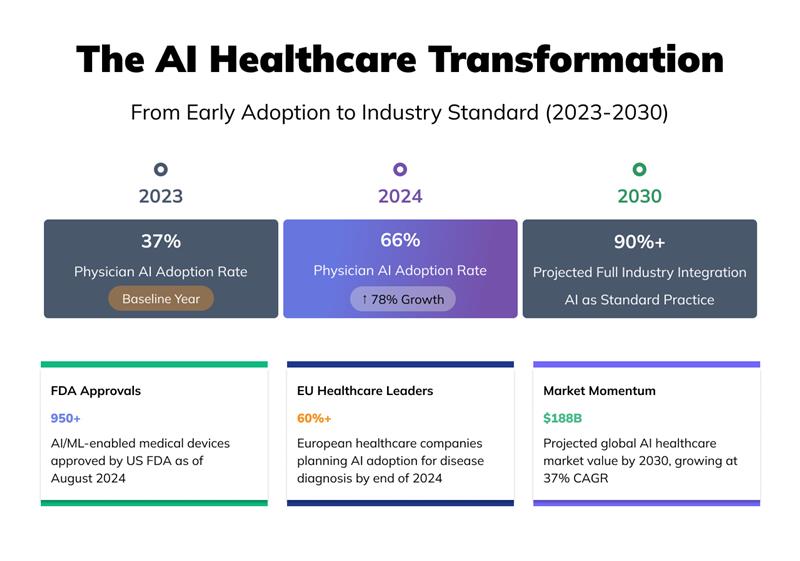
The data presents a convincing picture of how AI is being incorporated into healthcare systems around the globe. According to a poll, 66% of doctors said they used health care AI in 2024, a notable 78% increase from 2023. This quick uptake shows that AI isn't merely a fad; rather, it's quickly becoming a necessary tool in contemporary medicine.
Healthcare firms in Europe are similarly excited about the use of AI. Over 60% of EU healthcare companies intend to utilize AI for disease diagnosis by the end of 2024. This broad adoption among many healthcare systems demonstrates how AI's promise is widely acknowledged.
This change in technology is also affecting the regulatory environment. About 950 medical devices that incorporate AI or machine learning have been approved by the US FDA as of August 2024; the majority of these devices are intended to help with disease diagnosis and detection.
Market Dominance and Geographic Trends
North America leads the global AI healthcare market, with some impressive statistics:
Region | Market Share | Key Focus Areas |
North America | 54% | Medical imaging, diagnostic tools |
Europe | 25% | Patient monitoring, predictive analytics |
Asia-Pacific | 15% | Mobile health apps, telemedicine |
Rest of World | 6% | Basic diagnostic support |
With more than 54% of sales as of 2024, North America leads the market. The region's prominence is a result of early adoption by healthcare institutions, attractive legislative frameworks, and significant research investments.
Technology Distribution in Healthcare AI
The application of AI varies significantly across medical specialties:
- Radiology dominates the landscape, with 76% of all AI-enabled medical devices authorized for sale in the US being those used in radiology.
- Pathology follows closely, utilizing AI for tissue analysis and cancer detection.
- Cardiology leverages AI for ECG interpretation and heart rhythm analysis.
- AI is used in dermatology to screen for and diagnose skin cancer.
- AI is used in ophthalmology to diagnose diabetic retinopathy and other eye conditions.
AI for Medical Diagnosis: Transforming Patient Care
Accurate diagnosis has always been essential to successful medical care. By offering instruments that can evaluate intricate medical data with previously unheard-of speed and precision, artificial intelligence (AI) technologies are transforming this core area of healthcare.
Breakthrough Applications in Disease Detection
AI solutions from Modern Diagnostic perform exceptionally well in fields where pattern recognition is essential. Large volumes of laboratory data, patient histories, and medical imaging data can be processed by these algorithms to find possible health problems that could go unnoticed by humans.
Medical Imaging Revolution
In a number of medical disorders, AI-powered imaging systems are attaining impressive accuracy rates:
- Diabetic Retinopathy Detection: AI algorithms are more than 95% accurate in detecting diabetic eye impairment.
- Chest X-ray Analysis: Automated techniques identify lung diseases such as TB and pneumonia.
- CT and MRI scans: AI helps radiologists spot anomalies, fractures, and malignancies.
- Mammography Screening: AI in mammography screening improves cancer detection rates while lowering false positives.
Early Disease Identification
These models help doctors detect diseases early and with greater accuracy, including diabetic retinopathy and TB. Early identification lowers treatment costs and complexity while greatly improving patient outcomes.
Real-World Impact on Patient Outcomes
The implementation of AI for medical diagnosis has yielded measurable improvements in patient care:
Accuracy Improvements:
- Reduction in diagnostic errors by up to 30%
- Faster diagnosis times, particularly in emergency situations.
- Enhanced detection of rare diseases through pattern analysis.
- Improved consistency in diagnostic interpretation across different practitioners.
Efficiency Gains:
- Reduced waiting times for diagnostic results.
- Lower healthcare costs through early intervention.
- Decreased need for repeat testing and procedures.
- Streamlined workflow for healthcare professionals.
Addressing Healthcare Disparities
Omdena uses AI in healthcare to improve diagnostics, especially in underprivileged areas. AI-driven diagnostic technologies are making high-quality healthcare more accessible by:
- Providing expert-level diagnostic capabilities in remote areas.
- Reducing dependency on specialist availability.
- Enabling cost-effective screening programs.
- Supporting healthcare workers with limited specialized training.
Drug Discovery Revolution Through Machine Learning in Healthcare
AI has been welcomed by the pharmaceutical sector as a revolutionary tool for medication research and discovery. Predictive models and clever algorithms are streamlining the traditional drug development processes, which used to take ten to fifteen years and cost billions of dollars.
Accelerating the Discovery Pipeline
Machine learning in healthcare is transforming every stage of drug development, from initial compound identification to clinical trial optimization. This all-encompassing strategy is increasing success rates while saving money and time.
Target Identification and Validation
AI systems look through enormous biological datasets to find possible targets for drugs:
- Protein Structure Prediction: AI models are used to predict 3D protein structures for drug design purposes.
- Genomic Examination: Machine learning finds genetic variants that cause disease.
- Maps of Pathways: Complex biological pathways are mapped by AI systems for targeted therapy.
- Biomarker Discovery: Algorithms find molecular signatures to diagnose illnesses and track their effects.
Compound Screening and Optimization
Traditional compound screening involved testing millions of molecules in laboratories. AI has revolutionized this process:
Virtual Screening Benefits:
- Analysis of billions of potential compounds computationally.
- Prediction of drug-target interactions before laboratory testing.
- Optimization of molecular properties for better efficacy.
- Reduced the need for extensive laboratory experiments.
Clinical Trial Enhancement
AI-based methods can accelerate the drug discovery process and enable the development of more effective medications. Clinical trials, historically the most expensive and time-consuming part of drug development, are being optimized through AI:
Patient Recruitment Optimization:
- AI identifies ideal patient populations for specific trials.
- Predictive models estimate patient response rates.
- Geographic analysis optimizes trial site selection.
- Risk assessment reduces trial failure rates.
Trial Design Improvements:
- AI optimizes dosing strategies.
- Early detection of possible adverse effects is made possible by predictive analytics, and protocols are modified in adaptive trial designs in response to interim findings.
- Real-world data integration enhances trial relevance.
Cost and Time Reduction
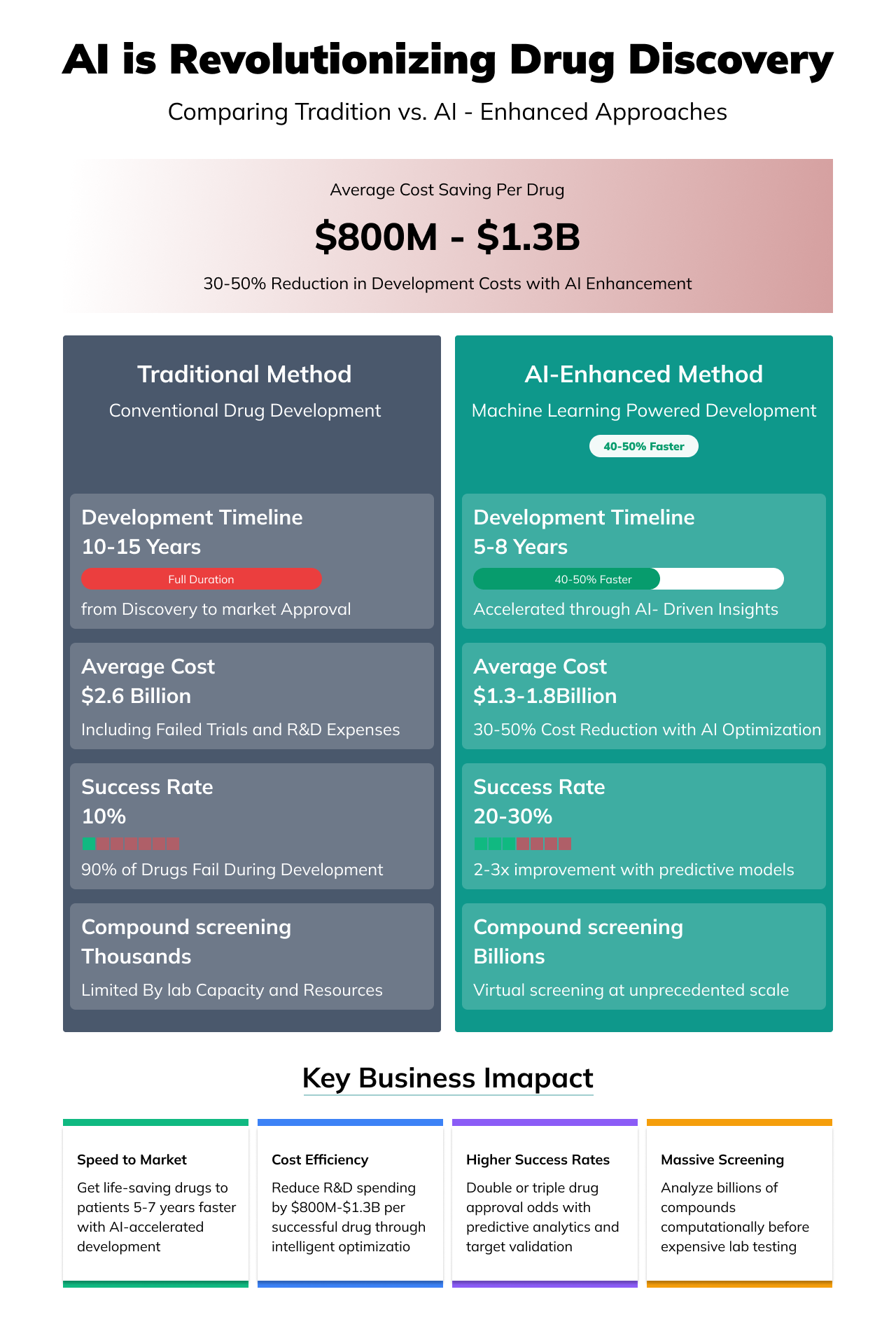
The financial impact of AI in drug discovery is substantial:
Traditional Method | AI-Enhanced Method | Improvement |
10-15 years | 5-8 years | 40-50% faster |
$2.6 billion average cost | $1.3-1.8 billion | 30-50% cost reduction |
90% failure rate | 70-80% failure rate | 10-20% better success |
Limited compound screening | Billions screened virtually | 1000x screening capacity |
Healthcare AI Applications: Beyond Diagnosis and Discovery
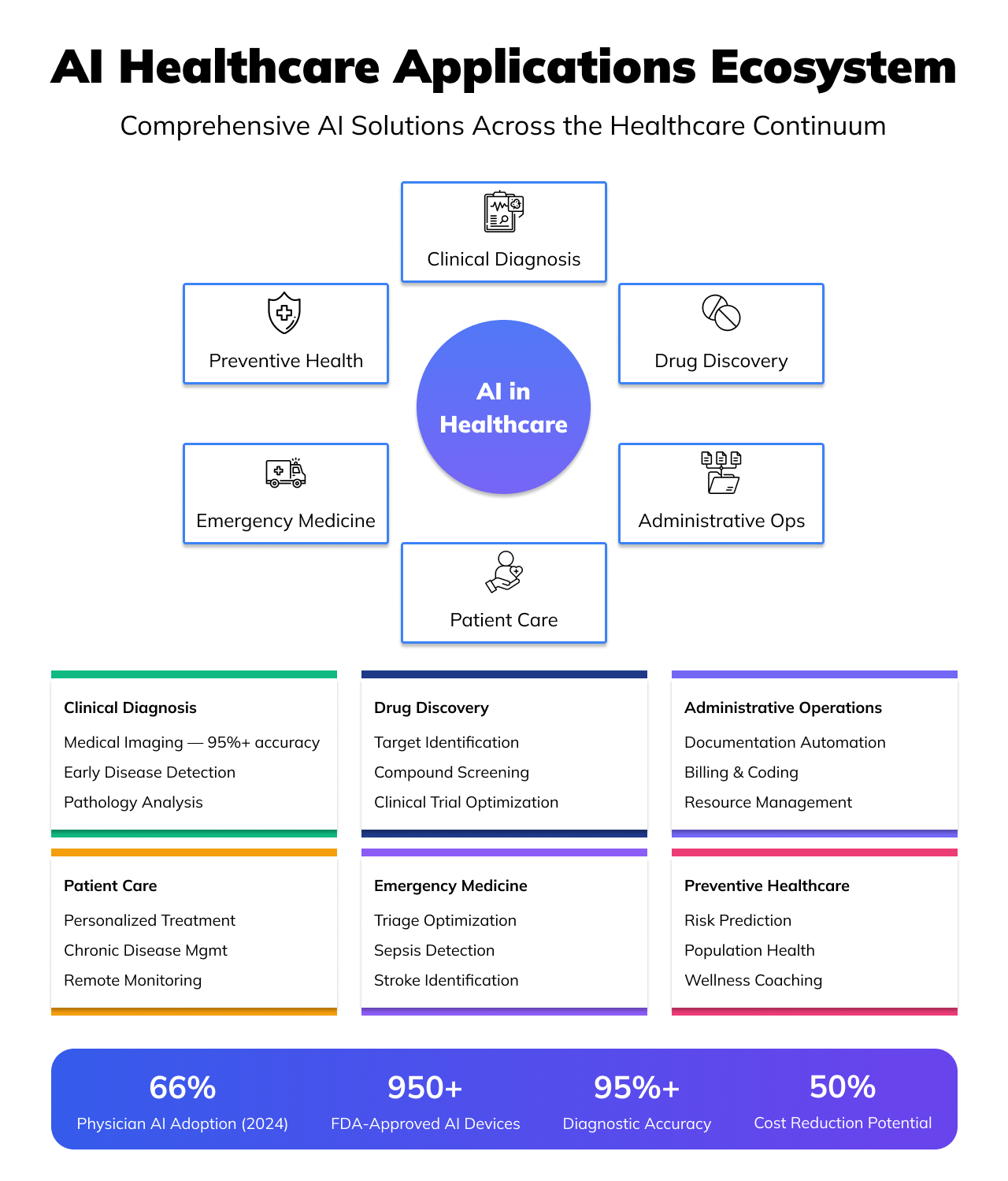
The scope of artificial intelligence in medicine extends far beyond diagnostic tools and drug discovery. AI applications are transforming every aspect of healthcare delivery, from administrative tasks to personalized treatment plans.
Administrative and Operational Efficiency
Healthcare administrators are leveraging AI to streamline operations and reduce costs:
Documentation and Billing:
- AI for documentation of billing codes, medical charts, or visit notes; creation of discharge instructions, care plans.
- Automated insurance claim processing.
- Reduced administrative burden on healthcare providers.
- Improved accuracy in medical coding and billing.
Resource Management:
- Predictive analytics for hospital bed management.
- Staff scheduling optimization based on patient flow.
- Equipment maintenance predictions.
- Supply chain optimization.
Personalized Medicine and Treatment Planning
AI is enabling truly personalized healthcare by analyzing individual patient data to create customized treatment plans:
Precision Medicine Applications:
- Genetic analysis for personalized drug selection.
- Treatment response prediction based on patient characteristics.
- Dosage optimization using patient-specific factors.
- Risk stratification for preventive care.
Chronic Disease Management:
- AI health assistants are helping users track symptoms, receive guidance, and manage chronic conditions.
- Continuous monitoring through wearable devices.
- Predictive alerts for disease exacerbations.
- Medication adherence support.
Emergency and Critical Care
AI applications in emergency medicine are saving lives through rapid decision support:
- Triage Optimization: AI systems prioritize patients based on severity.
- Sepsis Detection: Early warning systems identify life-threatening infections.
- Cardiac Event Prediction: AI monitors for heart attacks and arrhythmias.
- Stroke Identification: Rapid analysis of brain imaging for time-critical treatment.
The Role of AI Healthcare Startups in Innovation
The future of AI in healthcare is being shaped significantly by innovative startups that are pushing the boundaries of what's possible. These companies are often more agile than established healthcare organizations, allowing them to experiment with cutting-edge technologies and business models.
Pioneering New Technologies
AI healthcare startups are at the forefront of developing revolutionary healthcare solutions:
Breakthrough Innovations:
- Computer vision for real-time surgical guidance.
- Natural language processing for clinical note analysis.
- Predictive models for outbreak detection and prevention.
- Robotic process automation for laboratory operations.
Niche Specializations:
- Mental health monitoring through smartphone sensors.
- Rare disease diagnosis using pattern recognition.
- Drug repurposing through molecular analysis.
- Telemedicine platforms with integrated AI diagnosis.
Investment and Growth Trends
The startup ecosystem in healthcare AI is attracting significant investment:
Funding Patterns:
- Venture capital investments exceeding $15 billion annually.
- Government grants supporting healthcare innovation.
- Corporate partnerships with established pharmaceutical companies.
- International collaboration on global health challenges.
Success Stories and Market Impact
Several AI healthcare startups have achieved remarkable success:
- PathAI: Revolutionizing pathology through machine learning.
- Tempus: Precision medicine through genomic analysis.
- Zebra Medical Vision: AI-powered medical imaging analysis.
- Babylon Health: AI-driven virtual health consultations.
Health App Development Company: Building the Future
The rise of mobile health applications represents one of the most accessible ways AI is reaching patients directly. A specialized health app development company plays a crucial role in translating complex AI algorithms into user-friendly applications that can improve health outcomes at scale.
Essential Features of AI-Powered Health Apps
Advanced AI skills are incorporated into contemporary health applications:
Core AI Functions:
- Symptom checkers using natural language processing.
- Medication reminders with adherence tracking.
- Health risk assessments based on user data.
- Individualized wellness advice.
Advanced Capabilities:
Combining wearable technology with ongoing surveillance.
AI-assisted diagnosis telemedicine platforms.
Conversational AI to support mental health.
Chronic disease management with predictive analytics.
Development Challenges and Solutions
Creating effective AI-powered health applications requires addressing several technical and regulatory challenges:
Technical Considerations:
- Maintaining HIPAA compliance and data privacy.
- Connecting to current healthcare systems.
- Maintaining accuracy in AI predictions.
- Optimizing performance across different devices.
User Experience Priorities:
- Intuitive interfaces for diverse user populations.
- Features that are accessible to people with impairments.
- Support for multiple languages for a worldwide audience.
- Offline functionality for areas with limited connectivity.
Market Opportunities
The market for AI-powered health applications continues to expand:
Application Category | Market Size (2024) | Growth Rate | Key Features |
Chronic Disease Management | $4.2 billion | 23% annually | AI monitoring, predictive alerts |
Mental Health Support | $2.8 billion | 28% annually | Mood tracking, therapy chatbots |
Fitness and Wellness | $3.6 billion | 18% annually | Activity analysis, personalized plans |
Telemedicine Platforms | $5.1 billion | 32% annually | AI diagnosis, remote monitoring |
Future of AI in Healthcare: Emerging Trends and Possibilities
As technology develops, the use of AI in healthcare is expected to undergo even more revolutionary developments in the future. According to emerging trends, we are heading toward a healthcare system that is more accessible, individualized, and predictive than it has ever been.
Next-Generation AI Technologies
A number of innovative technologies have the potential to further revolutionize healthcare:
Generative AI in Healthcare:
- 92% of healthcare leaders believe Generative AI improves operational efficiency, while 65% see it as a tool for faster decision-making.
- Automated generation of clinical reports and documentation.
- Creation of personalized patient education materials.
- Drug molecule design through generative algorithms.
Quantum Computing Applications:
- Exponentially faster drug discovery simulations.
- Complex protein folding predictions.
- Optimization of treatment protocols.
- Enhanced medical imaging analysis.
Predictive Healthcare and Prevention
The shift toward predictive healthcare represents one of the most promising aspects of AI's future in medicine:
Preventive Medicine Revolution:
- AI models are predicting disease onset years before symptoms appear.
- Population health management through big data analysis.
- Risk assessment and environmental health monitoring.
- Genetic profile-based preventative tactics that are tailored to each individual.
Systems of Early Intervention:
- Continuous health monitoring through ambient sensors.
- Predictive models for mental health crises.
- Automated health coaching and behavioral interventions.
- Community health optimization through AI analytics.
Integration Challenges and Solutions
The future of AI in healthcare must address several integration challenges:
Interoperability Solutions:
- Standardized data formats across healthcare systems.
- API development for seamless system integration.
- Blockchain technology for secure health data sharing.
- Cloud-based systems for the deployment of scalable AI.
Regulatory and Ethical Considerations:
- AI bias reduction in healthcare algorithms.
- Transparent decision-making processes.
- Patient consent and data ownership rights.
- International standards for AI in medicine.
How CodeAegis Can Transform Your Healthcare AI Journey
Working with a seasoned development business becomes essential as healthcare organizations traverse the challenging terrain of using AI. Leading the way in healthcare technology innovation, CodeAegis provides all-inclusive solutions that close the gap between state-of-the-art AI research and useful healthcare applications.
Comprehensive AI Healthcare Solutions
CodeAegis focuses on creating comprehensive AI solutions that tackle the most important issues facing contemporary healthcare:
Custom AI Development Services:
- Medical imaging analysis platforms tailored to specific diagnostic needs.
- Predictive analytics systems for patient outcome optimization.
- Natural language processing tools for clinical documentation.
- Machine learning in healthcare models for personalized treatment recommendations.
Integration and Implementation Support:
- Smooth interaction with current EHR (Electronic Health Record) platforms.
- Security of patient data is ensured via a HIPAA-compliant design.
- Scalable cloud infrastructure supporting growing healthcare organizations.
- Employee education and assistance with change management.
You Can Also Read : Top 25+ Use Cases Of Generative AI
Conclusion
One of the biggest developments in healthcare is the use of artificial intelligence in medicine. From AI for medical diagnosis, detecting diseases early, to machine learning in healthcare, accelerating drug discovery, we're witnessing a fundamental transformation in medical care delivery.
By 2030, 66% of doctors will be adopting healthcare AI; therefore, we can stop wondering if AI will change healthcare because it has already done so. AI healthcare businesses and health app development companies make AI-powered solutions available worldwide, and healthcare AI applications are not limited to clinic walls.
Through generative AI, quantum computing, and predictive medicine, the future of AI in healthcare is expected to yield ground-breaking discoveries. Reactive healthcare is being replaced with preventative, customized, and predictive healthcare. The technology is accessible, usage is accelerating, and the results show how AI may benefit billions of people worldwide and save lives.

Sakshi Aggarwal is the Co-CEO of CodeAegis, a visionary leader with 12+ years of experience in transforming complex business requirements into high-impact technology solutions across industries. Her core contribution lies in architecting the company's customer-centric service delivery model and optimizing cross-functional execution. She has become a driving force for ensuring project success and cultivating a culture of accountability across the software development life cycle.