


AI in Marketing: Benefits, Use Cases, Implementation Process and More
Table of Contents
What Is AI in Marketing?
Benefits of AI in Marketing
AI Marketing Use Cases
AI Marketing Examples
How to Implement AI
Best AI Marketing Tools
AI Marketing Challenges
AI Marketing Across Markets
Future AI Marketing Trends
Why Choose CodeAegis for AI
Conclusion
Frequently Asked Questions
 Add us as a preferred source on Google
Table of Content
+AI in Marketing: Benefits, Use Cases & Implementation Guide
Enter almost any marketing meeting today and AI will definitely be brought up. Sometimes, it is an enthusiastic slide highlighting the chatbot on the homepage, while sometimes, it is the subtle confession that the pilot test run last spring didn’t go beyond the spreadsheet phase. The recent State of Marketing report by Salesforce for India showed that 81% of the marketers in India have implemented AI in some way. The debate has now changed from whether or not AI should be used to how to get started with it, show its ROI, and ensure it doesn’t die out silently after the initial demo.
This guide tries to answer those questions in plain terms. We'll cover what AI in marketing actually does, the benefits worth chasing, the use cases with the strongest track record, and a six-step process you can run without betting the whole budget. We'll also look at tools, the risks you shouldn't skip past, and how things differ in India, the USA, and the UAE.
Key Takeaways
- Link each of your firm's projects to a performance metric that it already measures like CTR or CAC.
- You are likely to see successful results more quickly from AI initiatives around personalization, predictive lead scoring, and content production compared to AI initiatives in other areas.
- Buy standardized solutions. Create custom solutions only where there is a clear advantage from your unique data and workflow.
- Make sure you comply with data protection and privacy requirements before rolling out your AI tools across India, the USA, and UAE.
- Carry out sufficient testing for each implementation in a trial run of four to eight weeks, in the presence of a control group, before rolling it out on a large scale.
What Is AI in Marketing and How Does It Work?
The application of AI in marketing is defined as the use of techniques associated with machine learning, language, and automation in the process of executing and evaluating marketing tasks. The previous generation of marketing tools utilized rule-based systems whereby every instruction was provided in advance and was obeyed literally. AI systems operate differently by processing actual behavior of the customers, i.e. what emails work, how many ads are clicked, which leads have the successful closing afterward. Based on these insights, they adjust the customer’s next exposure accordingly so that they provide the customer with the information tailored specifically to him/her.
The tools may be compared according to several innovations in terms of functioning principles. The trends in the use of machine learning serve to detect patterns in clients' campaigns which ordinarily would have taken the analyst a couple of weeks to discover. Natural language processing includes reading/writing text as it forms the basis for chatbots and more intelligent site search. Generative AI utilizes the brief supplied in order to create content, images or short videos instead of creating everything from scratch.
Why AI in Marketing Matters in 2026: Key Benefits
Budgets and buyer habits are shifting, and the numbers point in one direction. The global AI in marketing market is projected to grow from USD 25.86 billion in 2024 to USD 296.32 billion by 2035, a 25.2% compound annual growth rate, according to MarketsandMarkets' AI in Marketing Market report.
Adoption gives you information on how far along your competition is. Neither adoption nor maturity tells you if artificial intelligence will work for you since that will depend on the problem you are solving and the data you have available. That is why the rest of this guide is based on concrete use cases.
What you will gain from using AI is dependent on your channels, size of team, and the problem you are trying to solve. The two gains that most teams realize are in the area of personalization and speed. Cost reductions and improved measurement come afterward.
Personalization at Scale
Nobody has the time to write a personalized email to each customer, and most consumers will be able to recognize when the email they receive is just generic content. Personalization using AI in marketing allows you to customize offers, subject lines, and product recommendations at an individual level or for a smaller group of people. This is possible through the use of signals generated from their browsing history, purchase behavior, or non-purchase behavior. What the consumer sees becomes relevant since it actually is.
Faster, Data-Backed Decisions
It used to take weeks before marketers would see campaign reports after launching them; however, AI-powered dashboards can identify poor-performing ad sets in just a few days and even recommend areas in which the budget should be shifted. This means that your marketers will not waste their time on creating spreadsheets but will focus on making decisions.
Higher Marketing ROI
ROI increases with the amount of money directed to successful marketing channels, audiences, and creative efforts. It's important to have predictive models that rank prospects in terms of their chances of purchasing the products and direct more spending to the best-performing ones. You should record the baseline of your marketing activities before the pilot starts. Without one, you won't know what the tool actually changed, and the next budget conversation gets harder.
Time and Cost Efficiency
The process of creating different copy variants, adjusting banners to fit twelve different locations, and pulling the same weekly stats takes up a lot of time. It all comes to be saved thanks to AI-based marketing automation, which lets people focus on strategic and creative aspects. The savings are real only if there is a person looking through the results.
Real-Time Customer Insights
Customer feedback comes in from reviews, chat conversations, surveys, and social media messages. And it tends to come all together and disorganized. With the help of AI, the information will be organized by topic and sentiment in a matter of minutes, thus allowing you to catch an emerging problem in its early stages.
Always-On Customer Experience
The customers have their questions to ask anytime, and many of them operate in other time zones. AI-based chat and automated journeys allow you to answer at any hour of the day. In case of difficult questions requiring judgement and empathy, human support representatives will be dealing with those.
AI in Marketing Use Cases Across the Funnel
AI can help at nearly every stage, from the first ad someone sees to the repeat purchase they make months later. The table gives a quick overview. The sections after it walk through each use case and where teams usually run into trouble.
AI Content Creation and Optimization
Generative tools are capable of producing drafts of advertisements, outlines of blogs, and even descriptions of products within seconds. It is essential to use testing. Test several different headlines for the same audience and stick to the best performing option. The editor is needed to check the information and ensure that the brand's voice remains safe since confidence does not mean truth.
Audience Segmentation and Targeting
Classical segments are mostly built upon age, geographical data, and some demographics. In comparison, AI-powered segments include browsing history, purchase time, and other indicators of engagement. AI segments can surprise with unexpected groupings that react positively to communication with them based on their activity.
Predictive Lead Scoring
Salespeople waste time working with leads that could never become buyers. AI lead scoring analyzes past conversions and highlights new leads similar to the best buyers of your product. The model will be only as good as your CRM data.
Personalized Email and Customer Journeys
The AI will choose which email to send, schedule the sending of the email, and also know the perfect timing when to cease all forms of communication after receiving complaints and unsubscribe requests. Journeys work well when there is a single purpose for the journey, such as onboarding or re-engagement. Test your process through the use of control group, so that you will know whether the automation works or it creates more emails.
Programmatic Advertising and Media Buying
Machine learning has been embraced by media buying platforms when it comes to bidding and serving ads. It is up to you to provide the ad creative, conversion event, and budget required by the algorithm. Beware of the common pitfall of buying cheap traffic with no potential for generating revenue.
AI Chatbots and AI Agents
Chatbots handle routine questions about pricing, delivery times, and product fit. AI agents go further and complete tasks, like booking a demo or updating an order. If you need an assistant wired into your own systems, our AI agent development services cover the work from design through deployment.
AI-Powered SEO and Search
Currently, all major tasks including the keyword discovery process, the analysis of lost content, as well as on-page optimization are based on AI-driven solutions. The industry itself is changing as well since a number of consumers now receive data that comes from the summaries provided by AI. Therefore, it is critical to place the content in a way that it can be quoted. Rather than concentrating on your ranking, you should pay particular attention to your visibility in these answers.
Social Listening and Sentiment Analysis
Social listening software provides coverage to fine-tune and track multiple thousand mentions while maintaining distinction in the nature of opinion, i.e. positive or negative. As can always happen, sentiment analysis algorithms can fail to capture sarcasm and slang, so be sure to perform manual sampling just in case.
AI in Marketing Examples From Leading Brands
Some big companies have explained their use of AI in marketing. You should regard these examples as references and verify the source itself first as there is always something new happening within campaigns and products.
- Netflix employs recommendation models that choose which titles and what artwork a particular user sees when opening the application. Personalization is embedded into the product rather than sitting on top of it.
- Starbucks has mentioned the use of its Deep Brew platform for making personalized offers and recommendations through the app. Suggestions made based on customer’s order history and local weather serve as motivation for a return visit. Source: Starbucks Newsroom, 2023.
- Sephora provides users with a chance to try out makeup shades virtually through augmented reality technology. It’s a perfect example of imaging AI eliminating barriers to purchase. Source: Sephora product announcements.
- Coca-Cola has applied generative AI technologies in its 2024 holiday campaign under the supervision of creative human teams. This example proves that production has become faster without losing creative control.
How to Implement AI in Marketing: A 6-Step Process
Most AI projects that fail don't fail because the technology was weak. They fail because nobody set clear goals, checked the data, or agreed on how results would be measured. This process gives each stage an owner and a specific outcome, so nothing slips through.
Step 1: Define Goals and KPIs
Always start with a business outcome, not a piece of technology. Connect your project to revenue, cost of customer acquisition, or conversion rate, then write down where you are now on all of those metrics. Something like "increase innovation" will give you nothing to compare to. Get specific in your request so you know when you get there.
Step 2: Audit Your Data and Tech Stack
No matter how amazing AI is, it cannot process what it does not see. Look at where your first party data resides, confirm that all your CRM fields match in all of your tech, and ensure you have documentation for each consent for your intended uses. Often, the best source of data you have lies dormant in an old spreadsheet.
Step 3: Choose Tools or Build Custom
Buy when the need is standard, such as email sequencing or social scheduling. Build when your data or workflow is unusual enough that nothing off the shelf fits. Plenty of teams do both, buying a platform and building a custom layer on top. A custom AI development services partner can help with that layer, and our AI development services guide explains how to choose one.
Step 4: Pilot One High-Impact Use Case
Select one use case and one metric, such as lead scoring for a particular product line. Pilot for four to eight weeks using a control group that does not receive the AI technology. Without the control group, you won’t be able to distinguish whether the effect came from the tool or from the season.
Step 5: Integrate and Train Your Team
A tool that doesn’t get integrated with your CRM system or ads is not adding any value to the organization. Connect the tool with existing systems and train your team members on how to interpret results and in what cases they should override the results. Integration is often stalled by the lack of understanding of the output results.
Step 6: Measure, Govern and Scale
Following successful pilots, scale the usage. Monitor model drift, which appears due to deterioration of performance when consumer behavior changes. Look for targeting bias and creative misbranding and conduct a monthly meeting with lawyers and brand owners. Our AI governance services cover policies, risk checks, and ongoing oversight.
Best AI Marketing Tools to Consider
The right tool depends on your channels, your team's skills, and what you already run. Confirm each feature on the vendor's site before you finalize a shortlist, because AI capabilities change quickly and today's list may look different in six months.
| Tool | Best For | Key AI Feature | Good Fit For |
|---|---|---|---|
| HubSpot | CRM and marketing automation | Content assistant and predictive lead scoring | SMBs and mid-size firms with a sales team |
| Salesforce Marketing Cloud | Journey orchestration | AI-driven recommendations and send-time optimization | Large brands with complex customer data |
| Google Performance Max | Automated campaigns across Google channels | Automated bidding and creative asset generation | Teams focused on paid search and display |
| Jasper | Brand-aware copy generation | Brand voice settings and templates | Content teams producing high volumes |
| Surfer SEO | Content optimization | Content scoring against top-ranking results | Teams building organic search visibility |
| Hootsuite | Social scheduling and management | AI caption suggestions and analytics | Teams running several social accounts |
| Brand24 | Social listening | Sentiment classification and alerts | Brands tracking reputation and campaigns |
If you're comparing lower-cost open models for certain tasks, our look at DeepSeek's approach offers some useful context.
Challenges and Risks of AI in Marketing
AI can make marketing faster and sharper, but it can also make mistakes at scale. A bad targeting rule doesn't hurt one customer. It can hurt thousands before anyone notices, and by then the damage to trust is hard to undo.
Data Privacy and Compliance
Data quality problems and bad consent mechanisms are bigger issues than any other thing on this list. The model trained using outdated or unauthorized data sets will be targeting the wrong group of people, and you will lose all trust instantly. Auditing the data ahead of the pilot test is the most cost-effective way of protecting yourself. Data privacy laws are applicable to AI models just as much as they are to cookies and tracking pixels.
Rules Marketers Should Track
- India's Digital Personal Data Protection Act, 2023
- California's CCPA and CPRA for the USA
- The UAE Personal Data Protection Law under Federal Decree-Law No. 45 of 2021
Financial free zones like DIFC and ADGM have their own systems. Always verify whether these rules are still being enforced when you plan to start your campaign. We cannot provide you with legal advice in this guide.
Bias and Brand Safety
AI models work based on historical data. In many cases, historical data will already carry some inherent bias. For example, your targeting model could exclude certain audiences from a deal without you even knowing about it. Generative models can come up with false statements regarding your products and create creative ideas that go against your brand. Set review steps for both audience rules and creative output.
Skills, Cost and Weak Governance
Many teams don't have anyone who can read model output with confidence. Others adopt too many tools without a plan, which creates shadow AI nobody monitors. Costs pile up through licenses, data cleanup, integration work, and training time. Clear ownership and a written governance policy prevent most of these problems. Our AI governance services can help you build that structure.
AI in Marketing for India, the USA and the UAE
Teams in these three markets often use the same tools and chase similar goals. Buying habits, languages, and legal requirements differ, though, so one playbook rarely works everywhere. The table compares the basics, and the notes below go deeper.
India: Mobile-First and Multilingual
Indian audiences move constantly between devices and languages. AI tools that adapt content into Hindi and regional languages can widen your reach considerably. Journeys that run through messaging apps and UPI payments deserve close attention. Review consent under the DPDP Act before you build personalized outreach.
USA: Privacy Patchwork and ROI Pressure
The USA has no single federal privacy law, so marketers often work across several state rules. California's CCPA and CPRA set a high bar that many companies apply nationwide. Leaders also want proof of return quickly, which makes clear KPIs and controlled pilots especially valuable. Avoid claims you can't back up, because regulators watch deceptive advertising closely.
UAE: Bilingual and High AI Adoption
Shoppers in the UAE expect strong Arabic and English content, and many research and buy from their phones. With 70% of consumers already using AI to support shopping, product data, search quality, and recommendations will shape how people find you. Confirm your obligations under the federal PDPL and check whether any free zone rules apply.
The Future of AI in Marketing: Trends to Watch
A few shifts are already visible, and they'll shape planning over the next two years:
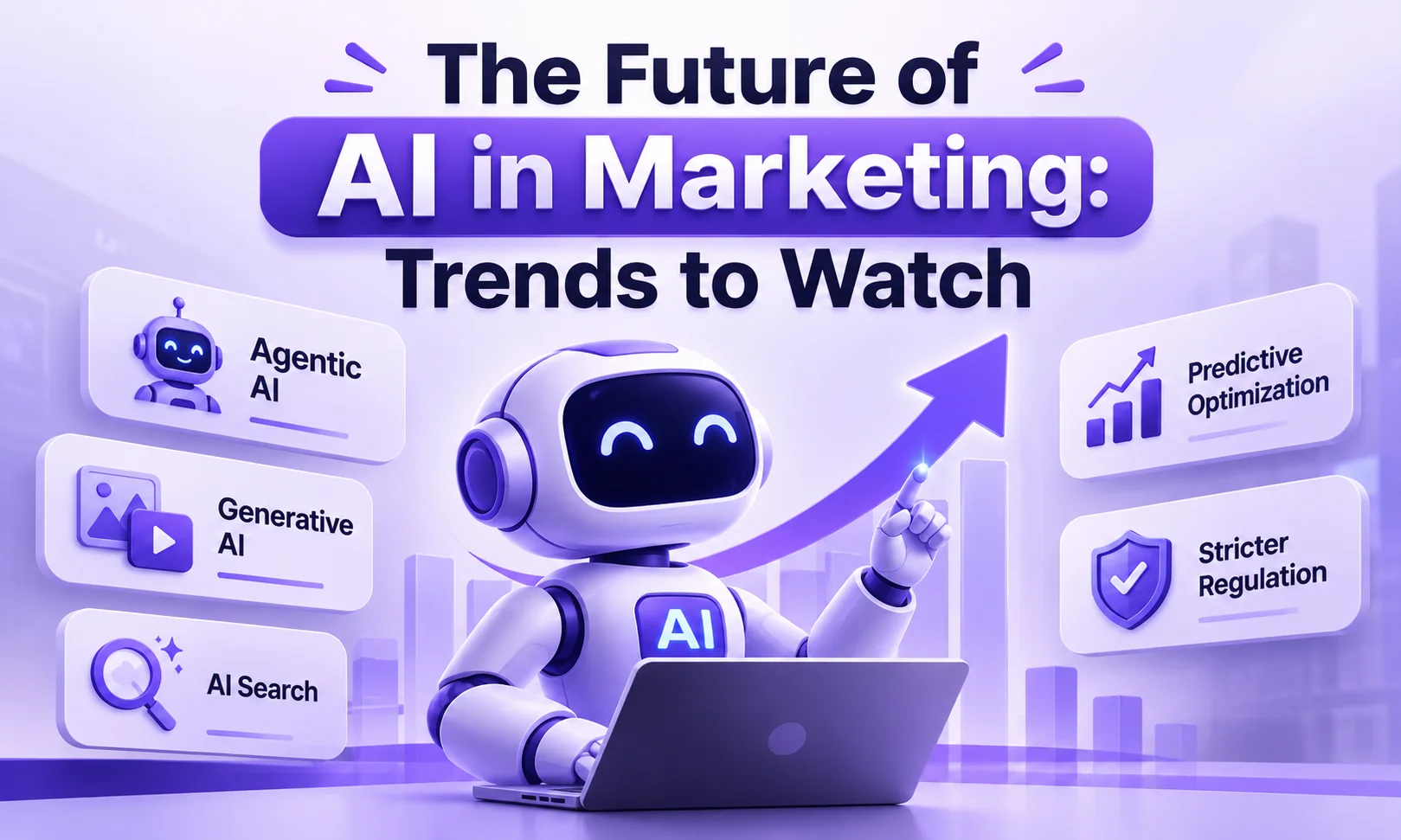
- Agentic AI that runs campaigns end to end, with humans setting direction and approving the big calls.
- Generative AI that makes personalized content affordable at a scale most teams couldn't reach before.
- AI search that changes how people discover brands, making visibility inside AI answers a channel of its own.
- Predictive, real-time optimization that moves budget and creativity across channels as results come in.
- Tighter regulation and growing demand for explainable AI, so teams that can show how a decision was made will have an edge.
For the wider view, read our overview of AI trends in 2026. Agentic marketing work also connects directly to AI agent development.
How CodeAegis Helps You Build AI-Powered Marketing Solutions
Many marketing teams know what they want from AI but don't have the engineering capacity to build it. CodeAegis works alongside marketing and product leaders to scope, build, and govern AI systems that connect to the data and tools you already use. Our work usually falls into three areas:
- Custom models, chatbots, and data integrations, delivered by our AI development company team.
- Autonomous marketing and support agents designed around your workflows, through our AI agent development services.
- Policies, risk checks, and compliance support, through our AI governance services.
Conclusion
AI in marketing pays off when it's tied to clear goals, clean data, and steady measurement. Pick the benefit that matters most to your business, then work through the six steps one pilot at a time. When you're ready to turn the plan into a working system, start a conversation with our AI development team.
Frequently Asked Questions
What is AI in marketing?
AI in marketing is the use of machine learning, language models, and automation to plan, create, deliver, and measure marketing activity. It helps teams personalize messages, score leads, adjust ad spend, and analyze customer feedback. It works best when tied to a specific business goal rather than adopted for its own sake.
What are the main benefits of AI in marketing?
The biggest benefits are more relevant personalization, faster and better-informed decisions, time saved on repetitive work, and smarter use of budget. Teams also gain quicker customer insights and more consistent service across channels. Results depend on clean data and clear measurement.
How do you implement AI in marketing?
Start by setting goals and KPIs, then audit your data and tools. Choose a vendor or decide whether a custom build makes sense. Run a four to eight week pilot against a control group. Once it proves value, integrate the tool, train the team, and keep watching performance and governance.
How much does AI marketing cost?
Costs depend on the tools you buy, the data work involved, integration effort, and training. Custom builds usually cost more than off-the-shelf platforms. A firm estimate comes from scoping your use case first, since a clear requirement list is the best basis for any quote.
Will AI replace marketers?
No. AI takes over repetitive work such as report building, variation testing, and routine replies. People still set strategy, judge brand fit, make creative calls, and answer for the results. Marketers who learn to direct and review AI output are well placed for the years ahead.
How is AI in marketing used in India, the USA and the UAE?
In India, teams focus on mobile-first, multilingual experiences and must follow the DPDP Act. In the USA, marketers work across state privacy laws and need strong evidence of ROI. In the UAE, bilingual Arabic and English content matters, and teams must comply with the federal PDPL. The regional section above compares all three markets side by side.

Sakshi Aggarwal is the Co-CEO of CodeAegis, a visionary leader with 12+ years of experience in transforming complex business requirements into high-impact technology solutions across industries. Her core contribution lies in architecting the company's customer-centric service delivery model and optimizing cross-functional execution. She has become a driving force for ensuring project success and cultivating a culture of accountability across the software development life cycle.