

Why AI Development Services Are No Longer Optional in 2026 (And How to Choose the Right Partner)
Table of Contents
What's Actually Changed in the Last Two Years
What Modern AI Development Services Actually Include
What Actually Gets Built When You Invest in AI Development Services
How AI Integration Services Actually Connect Your Business With AI Edge
Generative AI Development Services and Custom LLM Development: What to Choose
How to Choose the Right AI Development Company: What Actually Matters
How Much Does AI Development Services Cost?
About CodeAegis: How We Approach AI Consulting Services
Conclusion
Frequently Asked Questions
Table of Content
+AI Development Services 2026: Complete Guide | CodeAegis
Emails that used to take your team three days to sort through are now handled in three hours. Your competitor just deployed AI to their customer service. And they did it quietly, without a press release or fanfare. That's the current state of play in 2026.
Two years ago, AI felt like optional technology. Now? It's a competitive necessity. The companies that moved on AI development services 18 months ago aren't just using technology better. They're operating faster, automating tasks that waste human time, and making decisions based on what their data actually says instead of what someone thinks is probably true.
The problem is knowing where to start. This guide cuts through that noise. We'll walk you through what's really happening with AI development services in 2026, what you're actually getting when you hire someone, and most importantly, how to evaluate partners so you don't end up paying for consulting that doesn't solve your problem.
What's Actually Changed in the Last Two Years
The reasons companies are moving fast on AI development services right now aren't mysterious. They're practical and they're real.
Back in 2023, building custom AI solutions meant massive upfront budgets. You needed big teams. You were looking at months just to get started. That world has changed. Cloud infrastructure is cheaper. Pre-built frameworks mean you're not inventing everything from scratch. AI platforms that actually work are accessible now. Implementation costs have dropped 40 to 60 percent depending on what you're building. That changes the math completely. You can pilot AI capabilities for money that actually makes sense relative to potential upside.
Talking about AI benefits used to mean presentations with theoretical projections. Now there are actual results. Real companies have documented that automation reduces processing time by 75%. AI chatbots handle 60 to 70 percent of routine customer inquiries without human involvement. Predictive models catch problems before they become full-blown customer issues. Your board and CFO don't have to take this on faith anymore. The business case isn't theoretical. It's real.
What Modern AI Development Services Actually Include
Here's where things get confusing for most companies. "AI development services" is such a broad umbrella that it can mean almost anything depending on who's using the term. Let's be specific about what you're actually getting from a real partner.
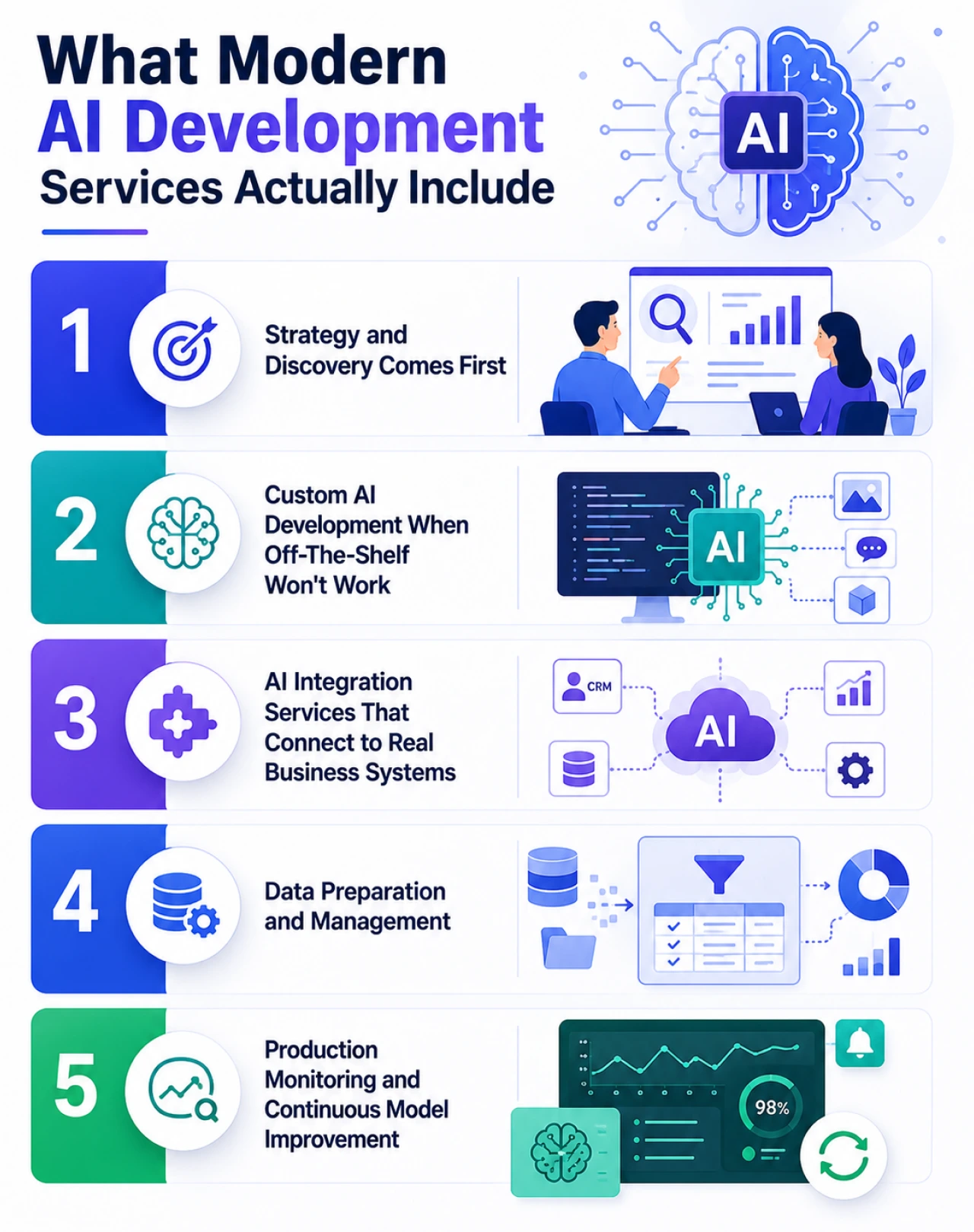
Strategy and Discovery Comes First
No credible AI development services company jumps straight to building something. That's how you end up with expensive projects that solve problems nobody has. Real discovery means asking hard questions. What's the actual problem you're trying to solve? Is AI the right tool for it, or are you reaching for it because it's trendy? Where in your business would AI create measurable value versus just adding complexity? This discovery phase takes weeks. It includes audit of your current data quality, your existing systems, what your team actually knows. At the end you should have written recommendations on what to build, in what order, and why that order matters. If a vendor skips this phase, they're not serious. Full stop.
Custom AI Development When Off-The-Shelf Won't Work
Sometimes you can buy something ready-made and it solves your problem. Most of the time you can't. If you're building AI that actually addresses your specific business problem, you need models trained on your data, tuned for your exact workflows, tested against your actual use cases. That's what custom AI development services means. It's not buying something off Amazon and hoping it fits your business. It's building something that actually works for you.
AI Integration Services That Connect to Real Business Systems
Here's the thing people miss: AI doesn't sit alone in the corner doing AI things. It needs to talk to your CRM. Your data warehouse. Your accounting system. Your customer database. Customer service platform. If AI development services don't include integration planning and execution, you end up with a system that sits disconnected from your actual business operations. It's like having a Ferrari parked in your garage that can't connect to the road. Real AI integration services means building APIs, data pipelines, and workflows so AI output actually gets used where decisions happen.
Data Preparation and Management
Your AI is only as good as the data it learns from. Bad data creates bad models. This is foundational work and it's not optional. It's the part most companies underestimate and most vendors downplay because it's not exciting. Serious AI development services include data audit, cleaning, labeling, and ongoing maintenance. Most companies find out partway through that they have way more bad data than they realized. That's actually good information because it means you can fix it before it costs you.
Production Monitoring and Continuous Model Improvement
Here's something people don't realize until they've lived it: AI models decay. The patterns they learned from historical data stop working because the world changed. Customer behavior shifted. Fraud tactics evolved. Your competitors changed their pricing strategy. A production AI model needs continuous monitoring to catch when it's performing worse than expected. Good AI development services include monitoring dashboards, alert systems, and retraining protocols. If your partner treats deployment as the finish line, that's another red flag.
What Actually Gets Built When You Invest in AI Development Services
When you hire a real AI development partner, you’re not just getting code. You’re getting a complete rethinking of how your software gets built from the ground up. Every layer from discovery to deployment gets smarter. Your team works faster. Your costs drop. Your quality improves. But it only happens if you’re building with AI as a foundation, not bolting it on afterward. Here’s what actually gets built.
• Developers stop writing boilerplate because GitHub Copilot writes it and they just review and adjust, making development 35-40% faster without sacrificing quality.
• Automated test case generation finds edge cases humans skip while visual testing catches UI issues, giving you same quality in half the time.
• Dashboards powered by AI predict what’s going to happen next, telling you which customers will churn and which features actually matter so you build based on data.
• Custom AI models trained on your specific data understand your business, your industry, and your customers in ways generic AI never can.
• Production monitoring continues after launch with AI retraining on new data and optimizing continuously so your software gets better over time instead of stale after deployment.
• Your software talks to CRM, ERP, and accounting systems with data flowing automatically instead of manual re-entry creating silos.
• Security gets built into architecture from day one with encryption, access controls, audit trails, and compliance frameworks instead of bolted on later when it’s expensive and breaks things.
How AI Integration Services Actually Connect Your Business With AI Edge
Real talk: most organizations don't have greenfield environments where you can build whatever you want. You've got systems that have been running for five years, ten years, sometimes longer. Entire departments depend on those systems. Processes are built around how they work. The current workflow is how people know to do their job. Plugging AI into that landscape is where integration becomes the core of the whole project.
AI Integration Services for CRM
Your CRM has customer data, interaction history, every call and email and meeting with that customer, pipeline information. AI can find patterns in that data that humans miss. Which customers are actually going to churn based on behavior, not gut feel. Which leads are actually sales-ready versus just getting routed in. Which support tickets need escalation before the customer gets angry. But for that to work, the AI doesn't live in some separate system. It lives inside your CRM workflows. It triggers based on your CRM data. It feeds recommendations back where your team actually works. That's what real AI integration services for CRM looks like.
AI in ERP Systems and Supply Chain
ERP systems are where your business actually runs. Procurement. Inventory. Production. Finance. Shipping. Every dollar and unit flows through there. AI inside ERP means better demand forecasting so you're not stuck with excess inventory. Smarter procurement identifying the best vendors and timing. Anomaly detection catching fraud or inefficiencies before they cost you. But ERP systems are complicated and security-sensitive. AI integration here isn't just connecting two systems. It's getting AI to work inside ERP constraints without breaking anything. That's more complicated than it sounds.
Connecting Modern AI to Legacy Systems
Some of your most important systems are ancient by tech standards. Ten, fifteen, sometimes twenty years old. They're running on databases that don't integrate easily with modern AI platforms. Data formats don't match up. Security layers work differently. But you can't just rip out the legacy system and replace it. That system is keeping your business running. Customers are using it. Revenue flows through it. Real AI integration services include building connectors and adapters that let modern AI work with legacy systems without touching the legacy system itself.
Generative AI Development Services and Custom LLM Development: What to Choose
Generative AI got all the attention in 2024 and 2025. Everyone wanted a chatbot. Everyone wanted to plug in ChatGPT and call it AI. But that narrative is starting to shift in 2026. Companies realized that generic large language models don't know their business. A ChatGPT instance might give you generic answers about your industry, but it doesn't know your customers. It doesn't understand your products. It hasn't read your internal processes. That's a limitation.
When Custom LLM Development Actually Makes Sense
Custom LLM development is expensive and complicated. You shouldn't do it unless you have a legitimate reason. Usually that reason is one of two things. Either you need the model to understand domain-specific knowledge that generic models don't have. Deep technical knowledge about your industry. Context about how your specific business works. Or you need the model to work offline because your use case can't depend on cloud APIs. Or you need the model to be private because your data is too sensitive to send anywhere. If none of that applies to you, then a fine-tuned version of an existing model works great and costs way less than building from scratch.
Fine-Tuning vs. Actually Building an LLM
Here's something important: most of the time when people talk about "building your own LLM" they don't actually mean that. They mean taking an existing model like Claude or GPT-4 and fine-tuning it on their data so it understands your specific language and use cases. That's way cheaper and faster than building a language model from the ground up. Actual LLM development from scratch is a specialized capability. Most companies don't need it and shouldn't waste money on it.
How to Choose the Right AI Development Company: What Actually Matters
If you're evaluating how to choose an AI development company right now, here's what actually matters versus marketing noise.
Do They Understand Your Business Before Pitching?
A good partner asks questions. Lots of them. What problem are you solving? Who's the actual user? What does success look like? How does it connect to your business metrics? What constraints are you dealing with? Bad partners jump straight to "we can build you an AI model." Good partners spend weeks understanding your world before recommending anything. If a vendor wants to start building before understanding what you need, that's a red flag. That means they're selling you their solution instead of solving your problem.
What's Their Real Track Record?
Industry experience matters more than you think. A partner who's built AI for healthcare companies understands HIPAA and data sensitivity challenges that a team building AI for e-commerce wouldn't know. A partner who's worked with enterprises knows the scaling and governance challenges. Ask for case studies and references from companies in your industry or similar situations. Don't accept generic case studies about "an AI company that did AI work." You need to see that they've solved problems like yours.
Will They Tell You AI Isn't the Answer?
A partner worth trusting will sometimes tell you that AI isn't the right solution for your problem. Maybe your problem is process, not technology. Maybe you need better data hygiene first before AI can work. Maybe a rules-based system works fine and costs way less. Bad partners need to sell AI, so they'll find a way to fit AI into every problem. Good partners tell you the truth even when it costs them a sale.
Do They Actually Build or Just Integrate?
Some companies calling themselves AI development services are really just systems integrators. They know how to plug ChatGPT into your Salesforce and call it AI development. That's fine if that's what you actually need, but don't confuse it with real AI development. If you need custom models, custom integrations, or something that requires actual engineering, make sure they have data scientists and machine learning engineers on staff. Not just consultants. Not just ChatGPT API wrappers.
What Happens After Launch?
AI models don't stay accurate forever. You need a partner who understands that and has a real plan for monitoring, retraining, and improving models over time. If their engagement ends the day they deploy, that's a problem. A partner worth paying for sticks around and helps you get value from AI over years, not just the weeks it takes to deploy.
How Do They Talk About Risk?
Credible partners talk openly about what can go wrong. Bias in training data. Models performing worse than expected on edge cases that weren't in training. Security risks. Privacy considerations. If a partner never mentions risks, they're either not thinking about them or they're hiding them. Either way, that's a bad sign.
How Much Does AI Development Services Cost?
Everyone wants to know the cost. Nobody wants sticker shock. Here's what you're actually looking at in 2026.
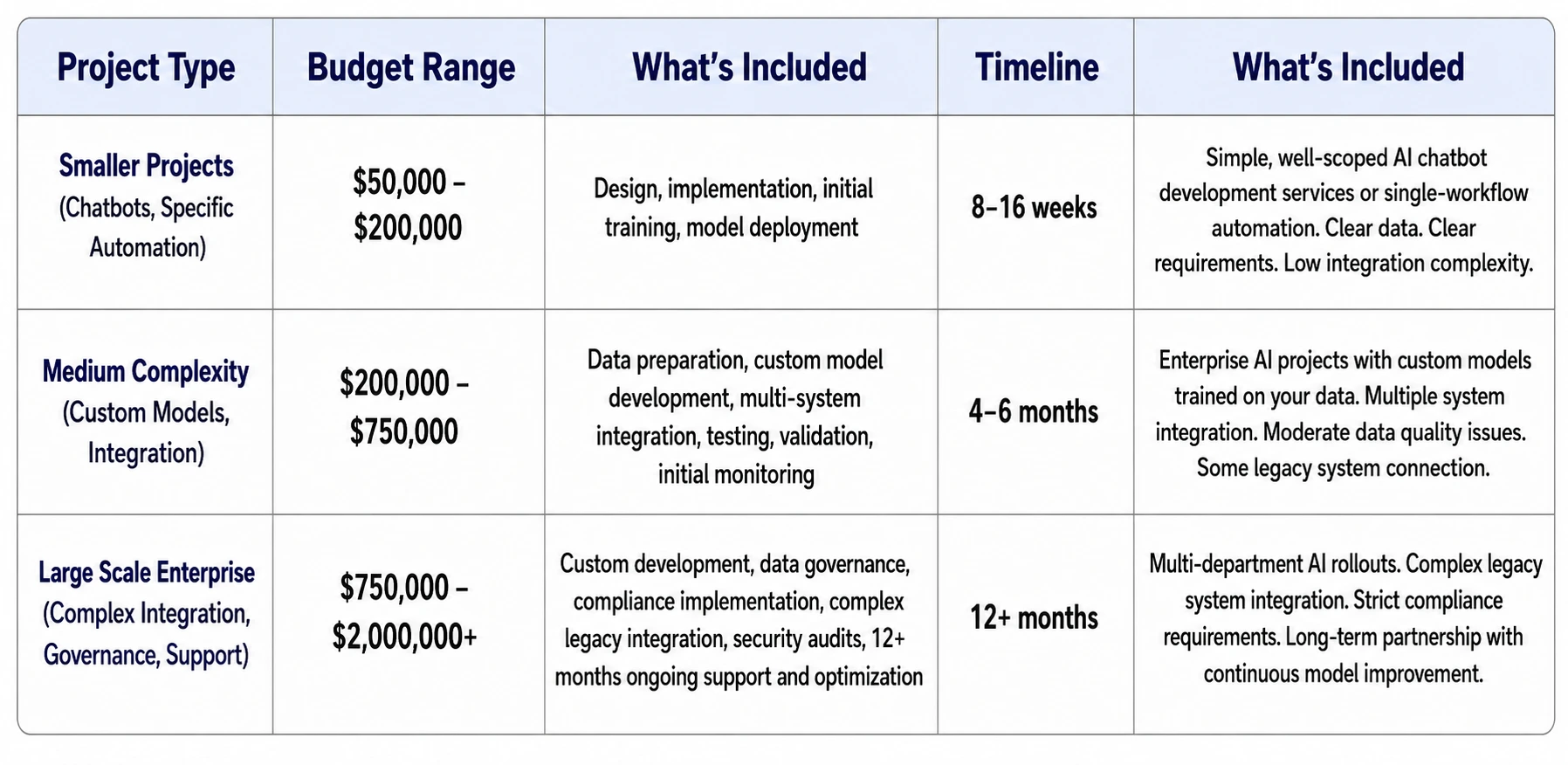
Most AI projects cost more than people expect. Here's why. Data preparation takes 2 to 3 times longer than anyone estimates. Integration complexity always exceeds initial scope. You discover mid-project that you need to retrain on better data. You realize the model needs monitoring infrastructure that wasn't in the original plan. Good partners budget for these things from the start. Bad partners surprise you with them later.
About CodeAegis: How We Approach AI Consulting Services
CodeAegis has been building custom software for enterprises for over a decade. We shifted focus to AI development services because that's where enterprises are moving, and that's where our expertise as builders actually matters.
We Actually Build Custom Product
We have machine learning engineers, data scientists, and infrastructure engineers on staff who build models from scratch when that's what clients need. We also know when existing models work fine and cost way less. We choose based on what solves your problem, not what generates bigger invoices.
We've Done Enterprise AI Development Multiple Ways
We've built custom models trained on proprietary data. We've integrated AI into legacy ERP systems. We've deployed AIOps solutions that prevent infrastructure problems before they happen. We've built chatbots that actually understand context instead of just matching keywords. We know what works and what doesn't because we've lived through it.
We Stick Around After Launch
We provide monitoring and support for 90 days after deployment as standard. Most clients extend beyond that because they realize AI needs continuous attention. We've never treated deployment as the finish line. That's when the real work starts.
We're Based in USA and Serve Global Enterprises
If you need AI development services USA-based with understanding of enterprise complexity, we're here. We've delivered across industries. Manufacturing. Healthcare. Financial services. Retail. SaaS. We understand the constraints each industry faces.
Conclusion
We've covered a lot of ground. What it comes down to is this: AI development services in 2026 aren't optional if you want to stay competitive. But they're also not a magic fix for bad processes or missing data. The companies winning with AI are the ones who started 18 months ago, learned what works and what doesn't, and now have models running in production actually solving real problems.
If you're starting now, you're not behind. You're entering a market where the conversation has matured, the technology is more stable, and the business case is clearer. But you need to be smart about choosing a partner.
If you're ready to have a real conversation about AI development services for your business, talk to CodeAegis. We've helped enterprises across manufacturing, healthcare, finance, and SaaS build AI that actually works. We understand the complexity you're dealing with. We'll tell you what's possible for your specific situation, what it costs, how long it takes, and what support looks like after launch.
Frequently Asked Questions
How long does actual AI development take?
Simple implementations with clear scope and clean data can happen in 8 to 12 weeks. Most enterprise projects take 4 to 6 months minimum. Long-term engagements with continuous improvement run 12 months or more. Timeline depends on complexity, data quality, and integration work. Any vendor promising faster than 8 weeks for anything substantial is overselling.
Does AI replace jobs or create different ones?
AI eliminates specific tasks, not jobs. Your customer service team might be smaller after implementing an AI chatbot, but the remaining team focuses on complex issues and relationship management, not routing tickets. Your finance team stops doing manual reconciliation and focuses on analysis. Every company we've worked with ended up wanting more people to manage AI and handle exceptions, not fewer. The skill mix changes though. You need different capabilities.
How do I know if my data is good enough?
You won't know for sure until you start looking. Most companies have more usable data than they think and worse quality than they'd like. Discovery includes data audit. We look at volume, variety, quality, and bias. If data is bad, we tell you upfront and recommend what to fix. Sometimes that's a separate project before AI development starts.
What happens if the model underperforms?
It happens sometimes. Maybe your data was more biased than expected. Maybe the problem is more complex than exploration suggested. Maybe you need more data or different data. Good partners have protocols for this. It's not a failure. It's part of the process. Bad partners disappear. Good partners troubleshoot with you and figure out what to do next.
Do I need to hire permanent AI staff?
Depends on scope. For one-off projects or simpler implementations, probably not. For ongoing AI that needs continuous evolution and monitoring, yes. Most enterprises end up needing at least one full-time person managing AI operations even if they partner with external vendors for development.

With over 12 years of experience, Mansi Garg is the Chief Operating Officer (COO) of CodeAegis, specializing in optimizing business performance and ensuring operational maturity across the technology landscape. Known for designing scalable governance and quality assurance frameworks, she ensured on-time project delivery. Mansi is the true leader behind the successful execution of cutting-edge digital solutions for a diverse global clientele.