


Securing AI Applications Begins with Visibility into API Risk
Table of Contents
Why AI Application Security Needs A New Approach
Why API Risk Visibility Needs A Complete API Inventory
Why API Visibility Matters Before AI Cybersecurity Controls
AI API Security Best Practices For Secure AI Applications
The Real Cost Of Ignoring API Risk In AI Applications
Where To Start Building API Risk Management This Quarter
AI Governance And API Security Strategy For Enterprises
How CodeAegis Delivers AI Application Security Solutions
Final Thoughts
Frequently Asked Questions
Table of Content
+Securing AI Applications with API Risk Visibility
Every company building AI tools right now has the same blind spot. They know what their AI application does. They know the model they used. They know the features they shipped. But ask them how many APIs are actually running behind that AI application, and most teams go quiet.
Nearly 99% of AI-related vulnerabilities trace back to APIs, according to Wallarm's research. That's not a small technical detail. That's almost the entire risk surface of AI applications sitting inside a part of the system most teams don't watch closely.
That gap is the real story in AI application security today. Not the model. Not the prompt engineering. The APIs sitting underneath, moving data back and forth, often unwatched.
This blog looks at why API risk visibility has become the starting point for any serious AI cybersecurity effort, what happens when businesses skip it, and what a working security approach actually looks like.
Why AI Application Security Needs A New Approach
AI systems don't behave like the software most security teams were trained to defend. Treating them the same way is a mistake, and it's an expensive one.
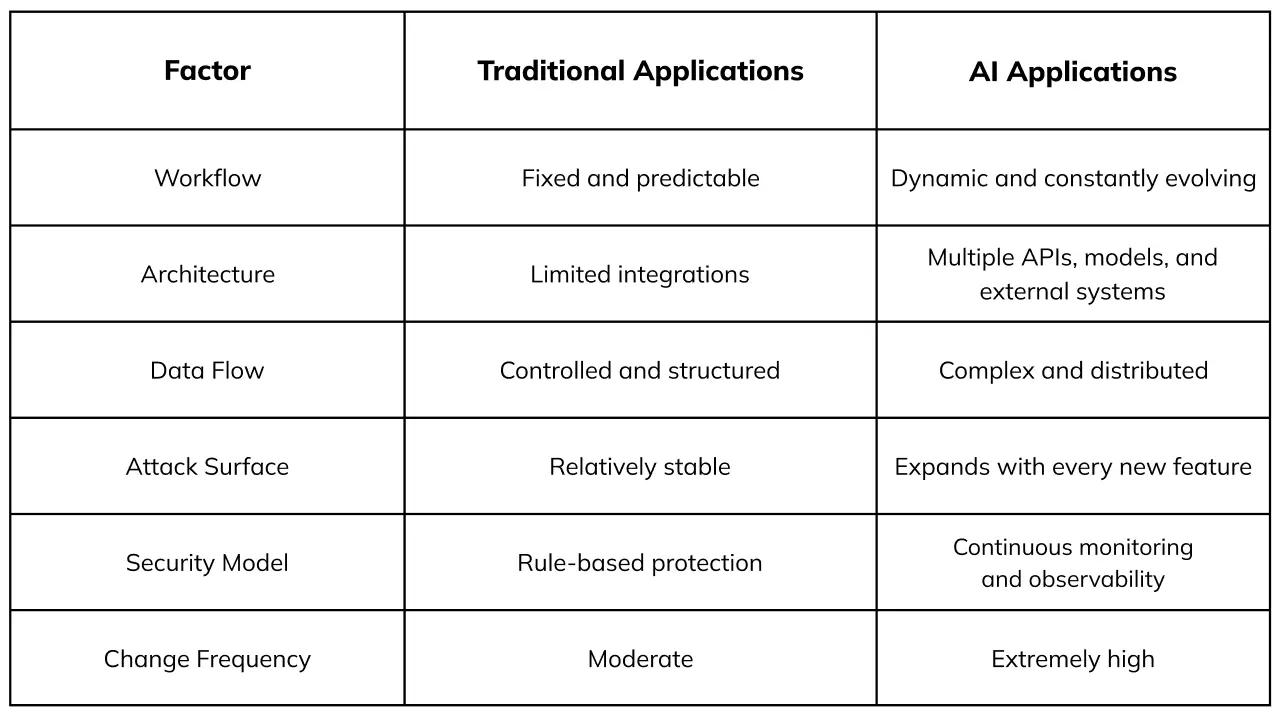
Secure API Development In Traditional Apps Vs AI Applications
A regular web application follows a fixed path. The user logs in, clicks something, and the server responds. Predictable. Security teams have spent two decades building tools around exactly this pattern.
Old security playbooks don't map onto this. AI application security needs its own logic, one built around constant change, not a structure that assumes nothing moves.
How API Risk Creates A Growing AI Attack Surface
Every new AI feature usually comes with new APIs attached to it. Multiply that across a fast-moving product roadmap, and the AI attack surface expands faster than most teams can track manually.
Nobody plans for this. It happens because AI development moves fast, deadlines don't wait for cleanup, and API housekeeping is rarely a priority. The result: more entry points than the team actually knows about. That's a real problem, not a technicality.
The phrase "API visibility" gets used loosely. Here's what it should actually mean: a real, current, accurate picture of every API connected to your AI application, what data each one touches, and who or what is calling it. Not a document last updated six months ago. A live picture.
API Discovery For AI Security Explained
API discovery means finding every API in your environment, not just the ones your team remembers building. That includes the official ones in your architecture diagram, and the ones a developer spun up during a sprint and never removed.
Documentation almost always lags behind reality. Developers move fast, especially on AI projects where testing new integrations is routine. Proper API discovery scans the environment as it exists right now, not the outdated internal wiki nobody has opened in months.
Why API Risk Visibility Needs A Complete API Inventory
An API inventory is the output of discovery work. It should show what each API does, what data flows through it, who can access it, and how often it's used.
Without this, a security team is guessing. They can't set access rules properly. They can't tell if traffic looks abnormal, because they don't know what normal looks like. One recent industry study found 77% of respondents claimed to have a full API inventory, yet visibility into what those APIs actually do has been declining for four straight years. Having a list isn't the same as understanding what's on it. API risk visibility is the baseline requirement, not an audit checkbox.
Common AI API Risks And AI Application Vulnerabilities
APIs are what let AI systems talk to other systems. That's exactly what makes them the most common target. Here's where this shows up in real environments.
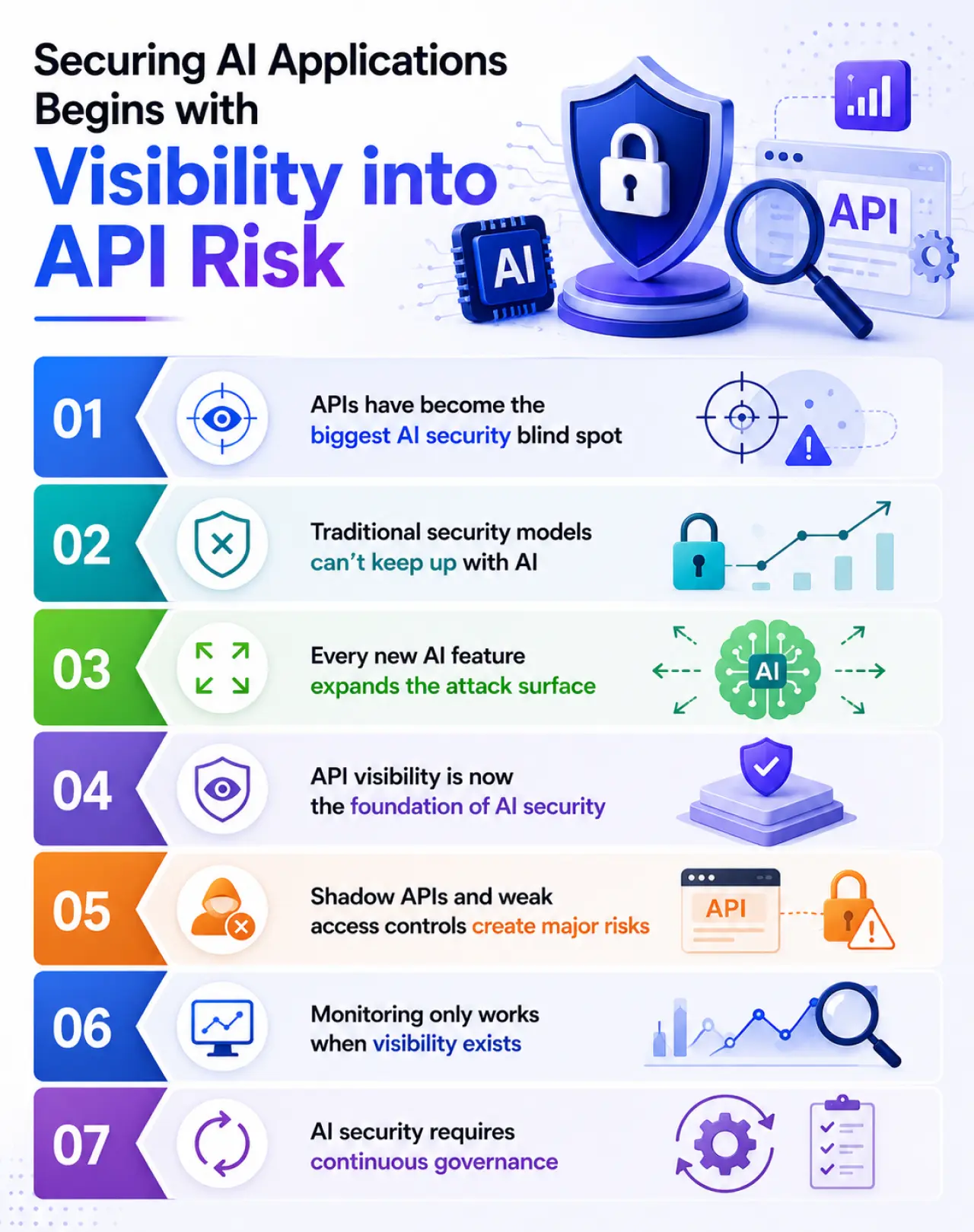
- Shadow APIs: APIs nobody documented and nobody is watching. They usually come from quick testing work or a feature update that shipped and was forgotten. Since they're invisible to the security team, they rarely get patched, making them an easy first target.
- Unauthorized API Access: Weak or missing access controls let people, or other systems, call APIs they were never meant to reach. This leads to stolen data, manipulated AI outputs, or a compromised system that goes unnoticed for weeks.
- Prompt Injection Through APIs: Attackers craft input passed through an API that tricks the AI model into ignoring its instructions or leaking information. This is a real, growing issue in generative AI security, particularly with large language models. One well-documented breach in early 2026 exposed tens of millions of internal chat messages and hundreds of thousands of files through unauthenticated API endpoints, in a matter of hours.
- Sensitive Data Exposure: APIs carry the data a business cares about most: customer records, internal business data, sometimes model training data. If that data isn't encrypted in transit, it's exposed the moment someone intercepts it.
- Broken Authentication: Weak login systems, missing token validation, or poorly configured OAuth and JWT setups let attackers impersonate legitimate users and walk right in.
- Excessive API Permissions: APIs sometimes get more access than they need, often because it was simpler to configure that way. If that API is compromised, the attacker inherits far more access than intended.
Why API Visibility Matters Before AI Cybersecurity Controls
A common mistake: businesses buy security tools first and figure out what they're protecting second. That order doesn't work, and it explains why so many breaches trace back to something nobody was watching.
API Risk Management Starts With Known APIs
Security tools only defend what's inside their scope. If an API isn't in the inventory, it isn't being scanned, tested, or monitored. Breaches involving unmanaged or undocumented APIs are hard to catch through standard monitoring, because nobody is pointing a tool at them in the first place. Attackers don't usually break through the strongest defenses. They find the door nobody remembered was there.
API Monitoring Reduces AI Security Risk
Once visibility exists, API monitoring becomes meaningful. That means watching how APIs behave as it happens, not reviewing logs after the damage is done. If an API suddenly pulls unusual volumes of data or gets called from an unexpected source, the team catches it in the moment instead of during a post-incident review three weeks later.
Observability Strengthens AI Security Framework Response
Monitoring tells you something happened. Observability tells you why. With strong observability across the API layer, a team traces a problem back to its source quickly instead of spending days reconstructing what went wrong. During an actual incident, that time difference is the gap between a contained issue and a headline.
AI API Security Best Practices For Secure AI Applications
Once visibility is in place, apply practices that reduce risk day to day. This is the core of any working AI application security best practices approach, and it doubles as an AI application security checklist for teams starting from zero.
Keep A Live API Inventory:
Update it automatically as APIs are created or removed. A spreadsheet updated once a quarter isn't fast enough for how quickly AI teams ship changes.
Use Strong Authentication Everywhere:
Every API should require verification before granting access. Solid password policies, multi factor authentication where it fits, and secure token handling through OAuth and JWT.
Encrypt Data While It Moves:
Any data traveling between APIs should be encrypted, so intercepted traffic is unreadable.
Apply Least Privilege Access:
Give each API and user exactly the access needed to do the job, nothing more. This limits how much damage a single compromised account or API can cause.
Monitor API Behavior Continuously:
Track normal API patterns over time so unusual activity actually stands out instead of getting buried in noise.
Add Runtime Threat Detection:
Runtime security tools watch for threats while the AI application is live, not just during development testing. This matters for AI agents and automated workflows running continuously without a person checking every step.
Adopt A Zero Trust Model:
No user, device, or system gets automatic trust, even inside the network. Every request gets verified. This one shift closes off a lot of the easy paths attackers rely on.
None of this makes an AI application invincible. It removes the easy wins, and most attacks are opportunistic rather than sophisticated.
The Real Cost Of Ignoring API Risk In AI Applications
Nobody budgets for a breach. That's the problem. Companies plan for feature launches, marketing pushes, hiring rounds. They don't plan for the week an unmonitored API gets found by someone outside the company before it's found by someone inside.
if customer data was involved. But the quieter cost is trust, and trust doesn't come back on a schedule. A customer who finds out their data moved through an API nobody was watching doesn't care how good the model was. They care that the business didn't know its own system. This is exactly why secure AI applications need to be the standard, not the aspiration.
There's also the regulatory layer. Industries with strict AI compliance requirements don't treat an undiscovered API as a minor technical footnote. Regulators treat it as a governance failure, because it usually is one. A missing entry in an API inventory can turn into a much larger conversation with auditors, and that conversation costs more than the fix ever would have.
Teams that get burned by a preventable API issue spend the next six months in reactive mode. Every sprint gets slower because security reviews turn from routine to paranoid. Engineers who were shipping features are now auditing old code. That's time and momentum a company doesn't get back easily.
Compare that to the cost of API visibility work done early.
Where To Start Building API Risk Management This Quarter
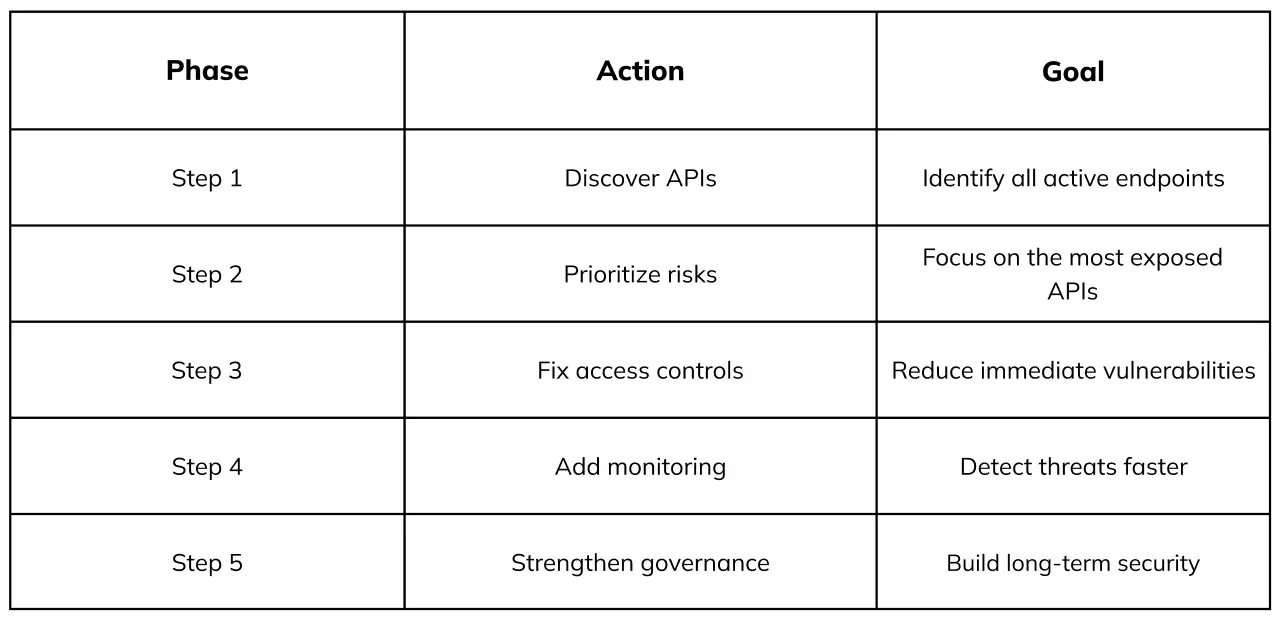
Most teams know they should "do better" on API security. Fewer know what the first move actually is. Before buying another dashboard or scanner, spend a focused sprint on API discovery, finding every API actually running in the environment.
Rank The AI Attack Surface By Exposure
Once that list exists, rank it by exposure, not by how interesting the API is. Which ones touch customer data. Which ones sit closest to the model itself, where LLM security and generative AI security concerns overlap with plain API security. Which ones were built fast for a demo and never revisited. Those go first.
Fix Access Before Anything Else
Then fix access before anything else. Most API risk isn't exotic. It's an endpoint that never should have been reachable without a token, or a permission set that's broader than the job actually requires. Closing those gaps is core secure API development, and it doesn't require new technology. It requires someone actually looking.
Layer In Monitoring Once Visibility Exists
Only after that does API monitoring and runtime detection make sense. Watching traffic only helps once there's a clear picture of what normal traffic even looks like. Skipping straight to alerts and dashboards without doing the visibility work first just means more noise, not more security.
Connect It Back To AI Governance
None of this works as a one-time fix. It has to plug into a broader AI security framework, one where AI governance and AI risk management set the rules for what gets built, reviewed, and approved going forward. That's what turns a handful of good habits into real AI security solutions instead of a one-off cleanup project.
AI Governance And API Security Strategy For Enterprises
Good API security can't sit in isolation. It has to connect to how the business runs its AI programs as a whole, or it becomes another checklist nobody revisits.
AI governance means deciding, clearly, how AI systems get built, who owns their security, what data they're allowed to touch, and how new features get approved before going live. Without this, AI development consistently outruns security, and the gaps created are expensive to close later.
Many industries now require specific AI compliance and data protection standards, especially healthcare, finance, and anywhere personal data is involved. Meeting these standards isn't just about avoiding fines, though those are real. It's also what convinces customers and partners their data is actually safe.
AI risk management isn't a task completed once and filed away. New APIs get added. New models get integrated. New AI agents get connected to internal tools. The AI application security framework needs a regular review cycle, not a once-a-year audit already outdated by the time it's finished.
How CodeAegis Delivers AI Application Security Solutions
Most businesses don't have the internal bandwidth to constantly track every API, manage governance, and stay ahead of new threats, all while shipping features on a deadline. That's where an experienced partner makes a real difference.
Security Built Into Secure AI Applications From The Start
CodeAegis builds AI applications with security considered from day one, not added after launch as a patch job. This includes proper API discovery, secure API development practices, and systems designed around Zero Trust principles from the first line of code.
AI Development Services Across The Full AI Lifecycle
Whether a business needs support through AI Development Services, wants to strengthen its AI Governance approach, or is working through a broader Digital Transformation with AI, the goal stays the same: applications that are useful without becoming a liability later.
Software Development Support Beyond AI Application Security
This work rarely stays isolated to AI alone. Most AI applications sit inside a larger technology environment, which is where Custom Software Development, Enterprise Software Development, and Software Migration Services come in. The same applies to Web Development Services, Mobile App Development Services, and ongoing Software Consulting Services for businesses that want informed, long term technology decisions.
Final Thoughts
AI application security doesn't start with buying more tools. It starts with knowing what's actually running inside the system. Without real API visibility, businesses are making security decisions based on guesswork, and guesswork isn't a strategy.
APIs are what make AI applications function, which is exactly why they're one of the most targeted parts of the system. Businesses that invest in API discovery, ongoing monitoring, and solid governance move from reacting to problems to preventing them.
Security done well doesn't slow innovation down. It's what makes scaling an AI application sustainable, instead of something that eventually catches up with you.
This isn't a project with a finish line. It's an ongoing habit that has to grow alongside the technology itself. Get in touch with us today for a free consultation demo!
Frequently Asked Questions
What Is AI Application Security
AI application security covers the practices, tools, and strategies used to protect AI powered systems from cyber threats. This includes securing the APIs, data pipelines, models, and infrastructure that keep an AI application running.
Why Does API Visibility Matter For AI Security
You can't secure an API you don't know exists. Full visibility lets a business identify every API in its environment, track how each one is used, and catch unusual or risky behavior before it turns into an incident.
What Are Shadow APIs In AI Systems
Shadow APIs are APIs running inside a system without the knowledge of the security or development team. They usually come from testing work or quick updates never cleaned up, and they're one of the most common entry points attackers look for first.
How Do APIs Increase AI Cybersecurity Risks
APIs connect systems, models, and data sources together, which is exactly what makes them risky. A poorly secured or unmonitored API can leak sensitive data, allow unauthorized access, or be manipulated to change how the AI system behaves.
How Can Businesses Secure AI Applications From API Attacks
Start with full API visibility. Add strong authentication, encryption, least privilege access, and continuous monitoring. Pair the technical work with clear AI governance and regular risk reviews, and the security posture gets considerably stronger.
What Is The Difference Between API Security And LLM Security
API security protects the connections and data flows between systems. LLM security protects the language model itself, things like prompt injection, output data leakage, and model manipulation. In most AI applications the two overlap heavily, since the model is usually reached through an API in the first place.
How Often Should An AI Application Security Framework Be Reviewed
At minimum, every time a new API, model, or integration gets added to the system, not on an annual schedule. Given how fast AI features ship, a static yearly review is usually outdated within months.
Can Startups Apply AI Application Security Best Practices Without A Large Team
Yes. Maintaining an API inventory, enforcing strong authentication, and applying least privilege access don't require a large in-house team. They require discipline and the right tooling. This is also where working with an experienced development partner helps, since it avoids the cost of learning these lessons through an actual incident.
What Role Do AI Agents And MCP Servers Play In API Risk Management
AI agents and MCP servers act as control points for autonomous workflows, meaning they often have direct API access with real permissions attached. If one is compromised, an attacker doesn't just get data, they can potentially control the automated actions the agent is authorized to take. This makes them a high priority area for API discovery and monitoring.

Sakshi Aggarwal is the Co-CEO of CodeAegis, a visionary leader with 12+ years of experience in transforming complex business requirements into high-impact technology solutions across industries. Her core contribution lies in architecting the company's customer-centric service delivery model and optimizing cross-functional execution. She has become a driving force for ensuring project success and cultivating a culture of accountability across the software development life cycle.