

How to Choose the Right Mobile App Development Company in 2026 (Complete Buyer's Guide)
Table of Contents
How to Choose Your Mobile App Development Company
Decoding Step One
What Mobile App Development Actually Costs in 2026
5 Factors to Evaluate While Hiring Mobile App Development Companies
What's Actually Happening in Mobile App Development
Why CodeAegis Works Differently for Mobile App Development
Conclusion
Frequently Asked Questions
 Add us as a preferred source on Google
Table of Content
+How to Choose Right Mobile App Development Company 2026
While searching for a mobile app development company, suddenly your screen is filled with agencies promising the world. Award-winning this, Fortune 500 that, cutting-edge technology everything. The quotes range from pocket change to a small fortune. One company says they can ship your MVP in four weeks. Another warns you need six months minimum just to do it right.
The confusion isn't accidental. The mobile app development industry has gotten crowded, and not all of that crowd is transparent about what they actually do or how they actually operate. Google research shows 53% of users will abandon an app that takes more than three seconds to load.
Here's what we know from the market: companies with well-built custom mobile apps see measurable returns. But those returns only happen when you partner with the right mobile app development company.
This guide cuts through that noise. Whether you're a founder launching your first product, a CTO evaluating an app development partner for your enterprise, or a business owner trying to digitize without getting taken to the cleaners, this is a practical framework for making the right decision.
How to Choose Your Mobile App Development Company: A Decision Framework
Here's the thing about picking a mobile app development company. It's not about finding the cheapest quote or hiring whoever has the slickest website.
What you're really looking for is an app development partner who gets your business, can actually execute at the level your project needs, and won't ghost you after the final payment. That's the actual difference between building something that works and building something that becomes a headache.
Know What You Need
Before you start contacting mobile app developers, sit down and figure out your own business goals, who your users are, what platforms matter, which features are actually critical, what you can actually spend, and when you need this thing done. This groundwork stops you from getting sold instead of getting advised.
Evaluate Systematically
Don't just look at their portfolio or check their reviews. Go deeper. Look at their actual experience with custom mobile apps in your space. Check whether they've built Native App Development projects or if they focus on Cross-platform App Development using Flutter and React Native. See who handles UI/UX Design and whether it's a real discipline in their shop or an afterthought. Understand their Mobile App Development Process. Ask about App Testing practices. Dig into how they handle App Maintenance after launch.
Ask The Right Questions
Who owns your code when this is done? Who specifically is working on your project, not just the pitch team? How often will you actually see progress? What happens the day after launch? How do you handle scope changes when they come up, and they always come up? What's their approach to security? Can you talk to past clients or are they going to make excuses?
Notice The Warning Signs
If the price seems absurdly low, there's a reason. If you can't actually download and use their apps, they don't have a real portfolio. If they get vague when you ask about IP ownership or post-launch support, walk away. If they promise everything immediately without asking detailed questions about your project, they're not giving you their honest assessment.
Understand The Technology
You don't need to code, but you need to get why they're recommending Flutter for Cross-platform App Development instead of building separate Native App Development versions for iOS and Android. You need to understand why certain third-party integrations matter for your specific situation and how that affects cost and timeline.
Know The Real Costs
Don't just focus on the initial build price. Think about the full picture. App Development Cost isn't just the development bill. There's cloud hosting, app store fees, third-party services, ongoing updates, maintenance. Get realistic about what you'll actually spend over the first year or two.
Decoding Step One: How to know What Should You Actually Build
Before you reach out to any agency at all, do the internal stuff first. Like actually working it through, not just “plan to plan” if you get what I mean. Most founders skip this part, and then they jump straight to contacting people. And then surprise, sometimes, they end up getting sold instead of getting real advice.
So, what problem does this app really solve?
Not the features. I mean the issue. What is broken, and how does your app fix it, in a plain way? Who lives with that problem every day, and how does life get better when it’s solved? Define success in measurable terms, don’t keep it vague. Is it more user signups? Higher monthly active users? Revenue generated? Cost savings? Better customer satisfaction scores, like improvements that you can point to.
Who exactly are you building this for?
Your users drive nearly every technical and design call you make. An app for healthcare providers will look completely different from an app aimed at teenagers. Even device preferences can go different directions. Network conditions too. Literacy levels, behavior patterns, all that stuff. If you get specific about the kind of user, you’ll end up having a much better conversation with any app development partner, for sure.
Which platform do you actually need?
This part is where confusion tends to pile up.
Android App Development hits the global majority. Android is dominant in Asia, Africa, Latin America, and a lot of developing markets. If your audience is worldwide or just more price-sensitive, Android coverage is basically mandatory.
iOS App Development puts you in front of users with higher average spending power. iOS leads in North America, Western Europe, Australia, and Japan. If you’re building for professionals or premium consumers in these areas, then iOS matters.
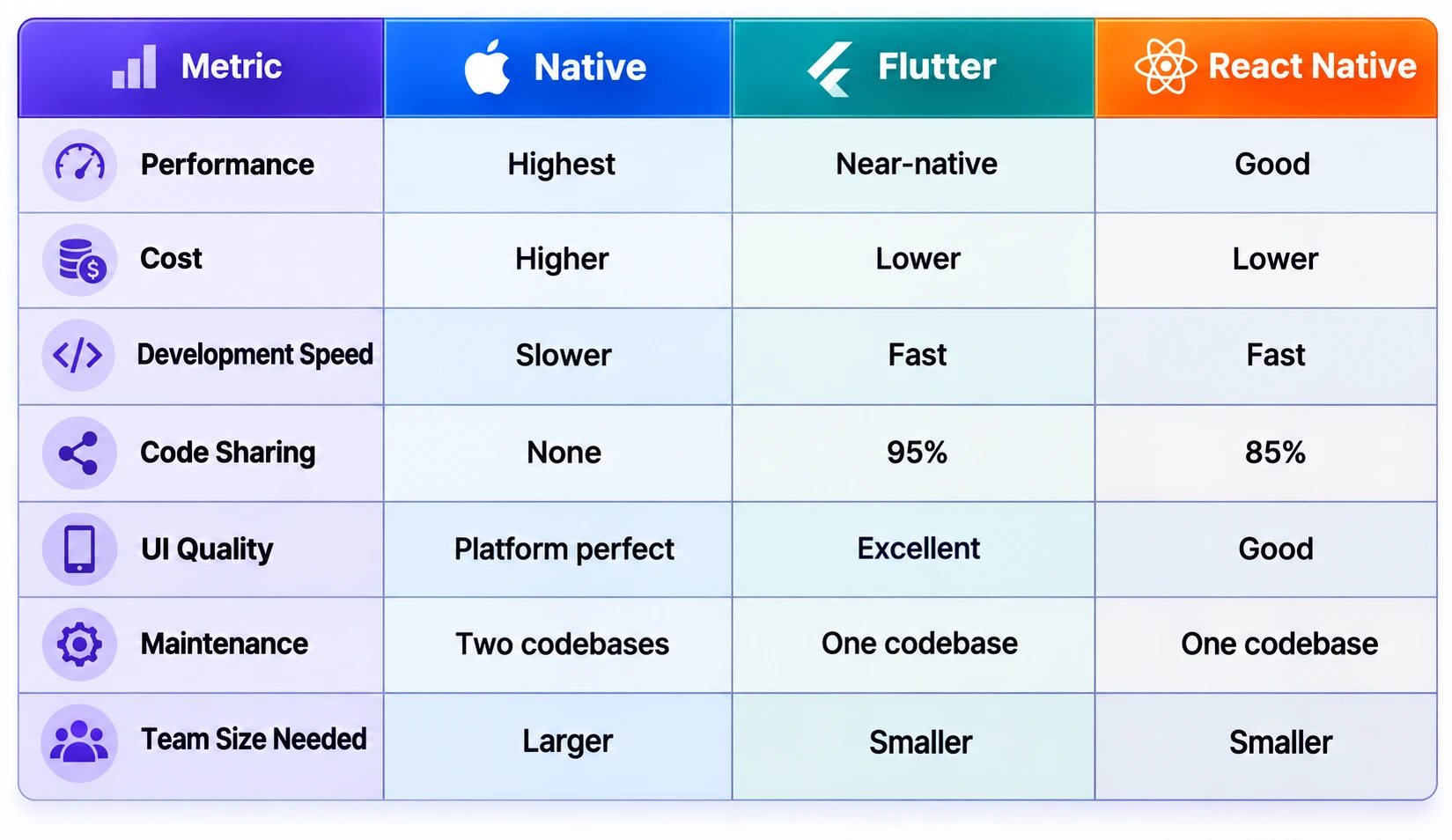
Cross platform App Development with Flutter, or React Native, lets you build once and ship everywhere. You end up with a single code base running on both Android and iOS. It’s quicker to reach users, and costs less than keeping two separate native apps alive. For a lot of startups, this is sort of the practical starting point, whether people say it out loud or not.
What Mobile App Development Actually Costs in 2026
The honest answer: it depends on your project specifics. Any agency quoting a hard number before understanding your requirements is giving you a marketing number, not a real estimate.
What drives cost:
- Complexity and features is the biggest factor
An informational app is fundamentally different from a real-time transactional platform with payments, authentication, notifications, third-party integrations, and complex data relationships.
- Platform choice matters significantly
Building for both Android and iOS natively roughly doubles effort compared to Flutter cross-platform. Cost difference can be 40-70% depending on the project.
- UI/UX design investment is often underestimated
Thorough user research, wireframing, prototyping, and testing before development add upfront time but reduce expensive rework later.
- Third-party integrations add cost
Integrations like (payments, mapping, analytics, CRMs, ERPs) add complexity and cost. Every integration requires development, testing, and maintenance.
- Team location creates significant variation
US and Western Europe command higher rates than equally skilled teams in Eastern Europe, India, Southeast Asia. The key is value (quality, communication, reliability), not just cost.
- Timeline pressure can increase cost
Compressed timelines sometimes require larger teams working in parallel, which increases burn rate.
One thing most founders overlook: the initial build cost is only part of total cost of ownership. Factor in app store fees, cloud infrastructure, third-party subscriptions, ongoing maintenance, and updates over 12-24 months. A realistic total ownership picture is more useful for planning than just the initial build cost.
5 Factors to Evaluate While Hiring Mobile App Development Companies
Go through each one methodically. Don't skip the uncomfortable ones.
1. Industry-Specific Experience
Has this company built apps in your actual industry? This matters more than people realize.
A healthcare app has HIPAA requirements. A fintech app has specific security standards and regulatory constraints. A logistics app needs real-time tracking and fleet management. An e-commerce app needs payment integrations and inventory management.
An agency with relevant experience already knows these constraints. They've solved these problems. They're not learning on your budget. Ask for case studies from your industry specifically, not a generic portfolio.
2. Actual Portfolio Quality
Download their apps. Use them. Check load times. Navigate the flows. Read user reviews on the App Store and Google Play. Look for apps that have been maintained over time, not launched and abandoned.
If you can't independently verify an app, it's not a portfolio. It's a sales presentation.
Pay attention to project complexity. An agency that built informational apps isn't ready for a complex transactional platform.
3. Client Reviews and Patterns
Check Clutch, Google Reviews, LinkedIn. Look for specific, detailed feedback, not generic praise.
Look for patterns. If three different clients mention slow communication after signing, believe them. If multiple reviews say deadlines were missed without proactive updates, that tells you something real.
Ask the agency directly for client references you can call. Agencies with genuinely happy clients connect you with them easily. Agencies that deflect are telling you something.
4. Technical Depth
In 2026, a credible mobile app development company really needs that true kind of know-how across multiple technologies, plus the judgment to say what fits your project, not what’s the simplest for them to sell. This is quite important, right?
Flutter is pretty much the norm now for cross platform app development. It gives near native performance, it’s backed by Google, and the developer community is mature enough to actually solve things without drama.
React Native is still widely used too, especially when teams already speak JavaScript all day, every day.
For iOS, Swift is the usual standard in app development. For Android, Kotlin is the usual standard.
5. Development Process and Pace
The best mobile app development companies use Agile methodology. Short sprints. Working features delivered incrementally. Regular feedback loops.
What this means practically: you should never be in the dark about progress for more than a week. You should see working demos regularly. Your feedback should actually get incorporated before the product launches.
Then watch how they communicate during the sales process. If emails take three days to answer now, expect worse after you sign.
What's Actually Happening in Mobile App Development in 2026
Understanding industry trends helps you evaluate whether your potential partner is current or already falling behind.
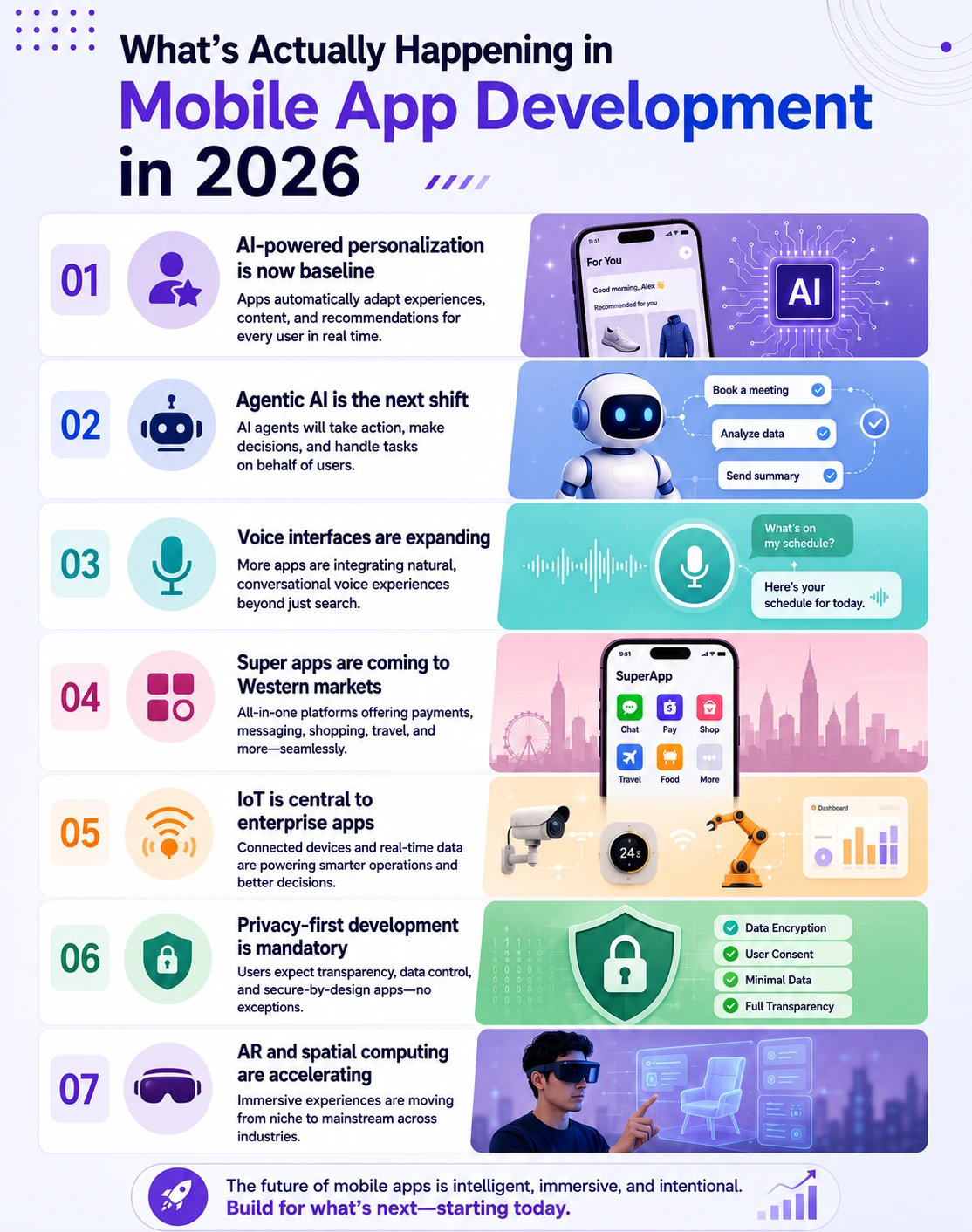
- AI-powered personalization is now baseline
Users expect apps to learn their behavior and adapt. Recommendation engines, predictive content, adaptive interfaces.
- Agentic AI is the next shift
Apps aren't just surfacing information. They're taking actions on behalf of users. Booking appointments. Reordering supplies. Managing schedules. Handling customer service issues. Autonomously, without manual intervention for every step. Companies building this now are creating real competitive separation.
- Voice interfaces are expanding
Beyond smart speakers into everyday apps. Driven by better speech recognition and natural language understanding. Particularly relevant for accessibility and hands-free environments.
- Super apps are coming to Western markets
Multiple services bundled into one platform. Complex to build. Significant UX and operational challenges. Strong business models justify the complexity.
- IoT is central to enterprise apps
Apps that control and monitor connected devices in homes, vehicles, industrial settings, healthcare. Technically complex and growing.
- Privacy-first development is mandatory
EU, US, and growing Asia-Pacific regulations require privacy built into architecture from the start, not bolted on later. Any serious mobile app development company needs genuine competence here.
- AR and spatial computing are accelerating
Particularly in retail, real estate, healthcare, training. The hardware ecosystem has matured enough that these features are viable in mainstream business apps now.
Why CodeAegis Works Differently for Mobile App Development
When someone reaches out to CodeAegis about building a custom mobile app, the conversation doesn't follow the standard script.
Before anyone talks about technology stacks or delivery timelines, the team asks different questions. What's the actual business problem you're solving? Who benefits and how? What does winning look like for you? How are you measuring this?
This approach works for every kind of project. Whether you're doing MVP Development to test an idea with real users, launching a full Startup App Development project, or building Enterprise Mobile Apps for complex operations.
Here's what that looks like day to day:
Get an Experienced Team
Not junior developers with one senior person in the sales meeting. People who actually know Flutter inside and out for Cross-platform App Development. People who can build solid iOS App Development with Swift. People who understand Android App Development and Kotlin.
Transparent Development Process
Two-week sprints. Real demos every sprint. Your feedback doesn't get noted and ignored. It actually shapes what gets built. You're seeing progress constantly. Nobody disappears for three months and delivers a finished product that doesn't match what you needed.
Dedicated Project Team
Your project gets its own team, not a few hours here and there squeezed between five other clients. People who know your product, your goals, your constraints. There's actual continuity. When something needs to happen, decisions move fast because the people making them know your project.
UI/UX Design Matters
Too many mobile app development companies treat design like window dressing. Not here. This is grounded in how real users actually behave, what they need, what frustrates them. It's not templates. It's not a generic pattern. It's thoughtful, deliberate, and tested. Because a sophisticated app nobody wants to use is just expensive infrastructure.
Architecture For Growth
Building for launch day is straightforward. Building so you can scale from a thousand users to a hundred thousand without rewriting the entire foundation is the actual skill. That's what thoughtful Mobile App Development Services look like.
Security From Day One
It's not bolted on later. It's built into how you approach everything from the beginning. Data protection. GDPR compliance. CCPA requirements. Secure authentication. Encrypted data in transit and at rest. These are foundational decisions, not features you add if budget allows.
Post-Launch Support
After launch, updates happen. New OS versions come out. Third-party APIs change. Bugs show up in production. There's a clear process, clear response times, clear ownership. Your app stays current while you focus on running your business.
Conclusion
There are a lot of mobile app developers out there. There are a lot of Mobile App Development companies. What's harder to find is a partner who brings genuine expertise, operates with transparency, and stays committed after launch.
Get these decisions right and you've got a product that works, that scales, that generates the returns you built it for. Get them wrong and you've got months of pain, significant waste, and a product that never quite does what you need.
The difference between those outcomes usually isn't luck. It's a partnership. When you're ready to actually build something that works, the CodeAegis team is ready to help.
Bring your concept. Bring your questions and goals. You'll get an honest assessment of what it takes to build it right, what the actual App Development Cost will be, and a realistic path forward.
That's what it means to choose the right mobile app development company.
Frequently Asked Questions
How do I choose the right mobile app development company?
Get clear on your own requirements first. Define business goals, target audience, platform preference, core features, budget, and timeline. Then evaluate agencies systematically across portfolio quality, client reviews, technical expertise, team structure, communication standards, and post-launch support.
What's a realistic budget for mobile app development in 2026?
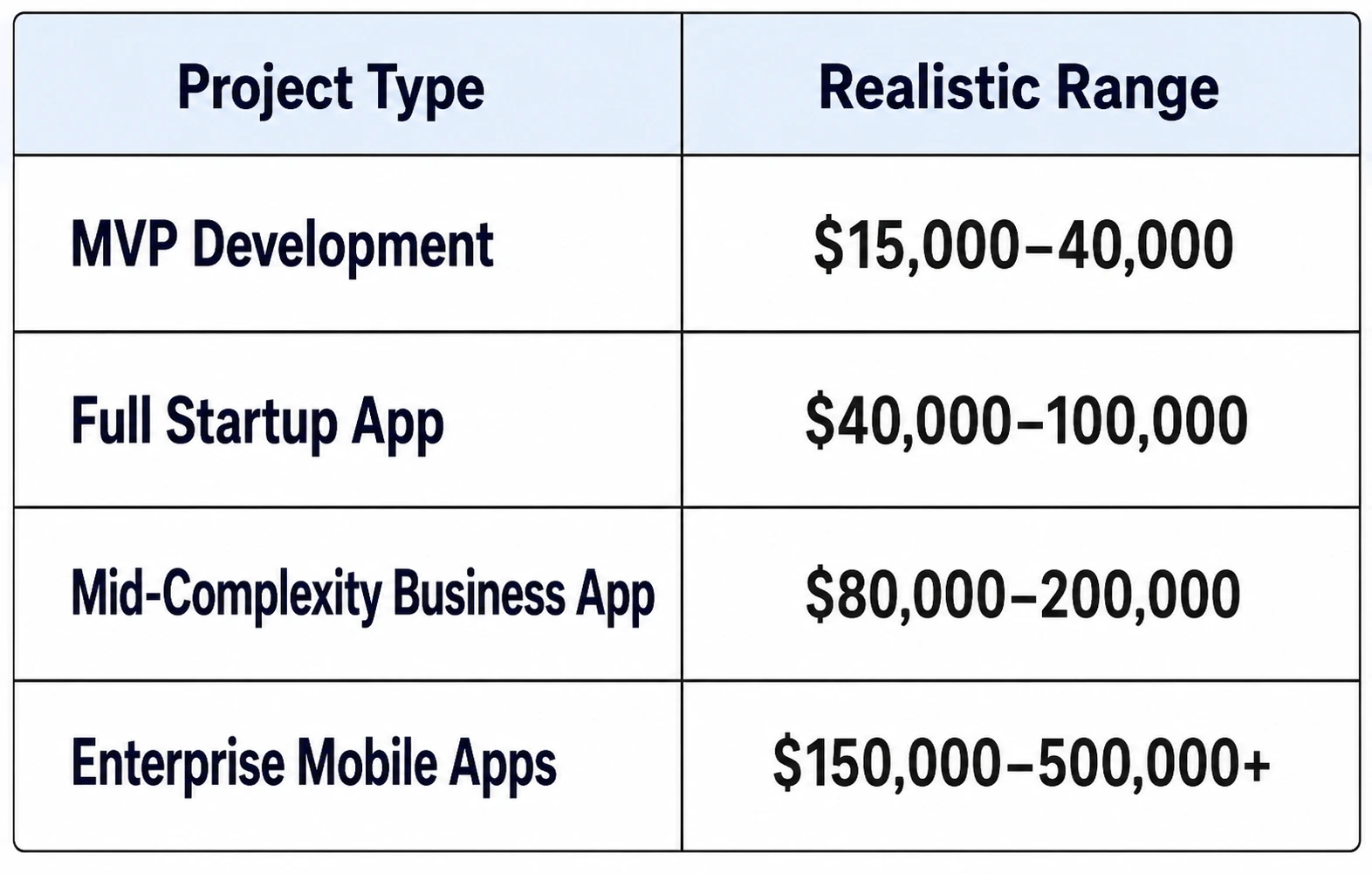
$15,000-40,000 for MVP development. $40,000-100,000 for a full startup app. $80,000-200,000 for mid-complexity business apps. $150,000+ for enterprise mobile apps. Cost depends on features, platforms, tech stack, team location, and timeline.
Is Flutter or native app development better in 2026?
Flutter is the right default for most projects. It delivers near-native performance, shares up to 95% code between Android and iOS, ships faster, and costs less than maintaining two native codebases. Native development is worth the premium only for projects requiring maximum performance, deep hardware integration, or highly platform-specific functionality.
How long does mobile app development take?
MVP development typically takes 2-4 months. Full startup apps take 4-8 months. Mid-complexity business apps take 6-10 months. Enterprise mobile apps can take 9-18+ months depending on scope, integrations, and compliance requirements.
Should startups hire agencies or freelancers?
For most startups, a small to mid-size agency is significantly better. Freelancers are a single point of failure with no QA, design, or project management. Agencies bring full teams, accountability, process discipline, and continuity if an individual team member becomes unavailable.
Which industries benefit most from custom mobile apps?
Healthcare, fintech, retail and e-commerce, logistics, education, real estate, and field services. The common thread is recurring user interaction, complex internal operations, or customer experience that improves meaningfully through a well-designed mobile interface.
What technologies should a credible mobile app development company know?
Flutter and React Native for cross-platform development. Swift for iOS. Kotlin for Android. Cloud backend integration. AI feature implementation. Security-first architecture. Basic competence across all these areas is table stakes.
Do mobile app development companies provide post-launch support?
Reputable ones do, with clear terms in the contract. Confirm what's included in support, response time for critical bugs, how OS updates and API changes are handled, and what ongoing maintenance costs.
How do I protect my app idea before development starts?
Sign an NDA before sharing product details. Confirm explicitly that all intellectual property transfers to you upon completion. For significant projects, have a lawyer review contract language. Most reputable mobile application development companies will sign NDAs without resistance and have clear IP ownership language built into their standard agreements.

With over 12 years of experience, Mansi Garg is the Chief Operating Officer (COO) of CodeAegis, specializing in optimizing business performance and ensuring operational maturity across the technology landscape. Known for designing scalable governance and quality assurance frameworks, she ensured on-time project delivery. Mansi is the true leader behind the successful execution of cutting-edge digital solutions for a diverse global clientele.