

What Is MVP Software Development? Everything Startups Need to Know
Table of Contents
What is MVP development?
MVP vs Full-Fledged
Types of MVPs
Essential Stages of MVP
Technology Stack & Tools for an MVP
Benefits of MVP
MVP Software Development Cost
Challenges in MVP Development
Lessons From Startups
Conclusion
Frequently Asked Questions
 Add us as a preferred source on Google
Table of Content
+What Is MVP Software Development? Everything Startups Need to Know
Do you truly believe that a creative idea and an expert team are sufficient to build a successful app? Well, most startup founders fail to go beyond this thought process. The result? An application launched with unnecessary features on which your team spent countless hours.
Moreover, the user faces engagement difficulties, and the final product looks completely off track from the original idea. However, there is a smart way to skip this struggle and validate your idea without losing money. It's called MVP software development.
But what is MVP software development? An MVP, or Minimum Viable Product, is a simplified version of your software, having only core features and functionalities. Through this, startups can rigorously test their application with real user feedback and iterate on their product accordingly. There’s more to MVP development than a straight definition, “A smart strategy”.
Having said that, are you new to MVP software development and simply launching software only to waste a great idea and lose hard-earned money?
Explore this blog to learn everything about Minimum Viable Product (MVP) software development. You will also get to discover its challenges, benefits, and why this strategy is superior to full-scale development and Proof of Concept (POC).
What is MVP development?
In simple words, MVP (Minimum Viable Product) software development is a light or pilot version of your application that consists only of essential features. The primary objective is to validate the core concept and determine how it actually solves the users’ problems.
While most founders try to make a feature-heavy application, the original idea often starts fading away. Through this strategy, startups can measure, learn, and tailor their product according to user feedback and build their entire product and market strategy around it.
Here’s why MVPs are no longer optional:
- Markets change faster than development cycles.
- Investors expect data, not assumptions.
- AI and automation demand rapid experimentation.
- Users want solutions, not feature overload.
Now, let’s compare the MVP concept with the full development cycle, POC, & prototype.
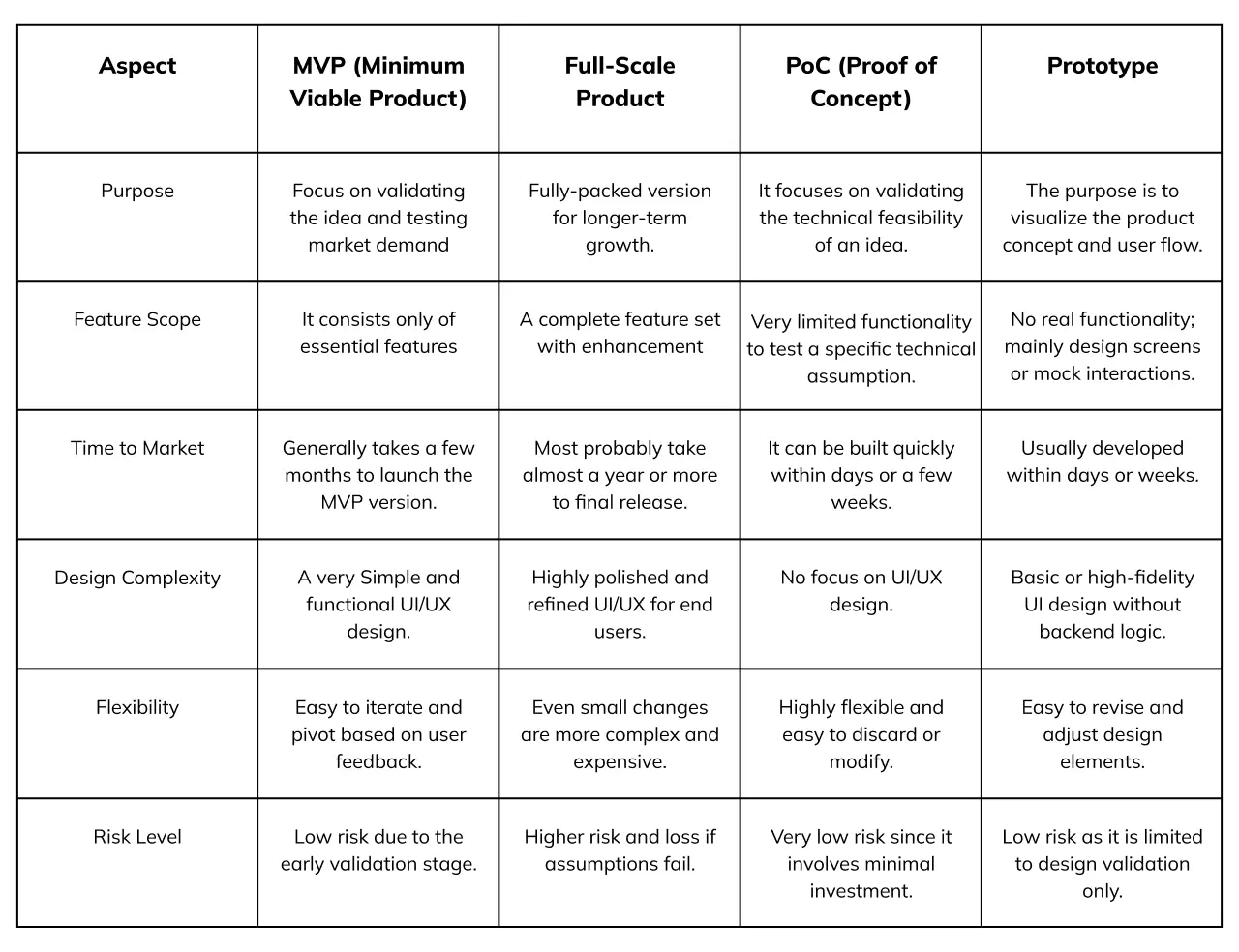
MVP vs Full-Fledged Product Development vs POC vs Prototype
To illustrate the real impact, let's compare MVP software development for startups with a full-scale product strategy.
Short explanation….
In short, choosing an MVP over other strategies is far better than spending endless hours and money on a product that hasn't been validated yet. An MVP lets you launch in months with a simple, functional design, making it much easier to pivot based on real feedback. That means start small and later scale your product sky-high.
5 Key Types of MVPs You Should Know
You have availed an MVP software development service, but don't know which type suits you best for your product idea? The right MVP depends on what you’re trying to validate, how fast you need answers, and how much you’re willing to invest. So let's explore:
Single-Feature MVP
Unlike an MVP packed with all the core features, a single-feature MVP focuses on one core functionality that solves the main user problem. If your idea is clear and you only want to confirm whether users truly care about that one feature, this is the best approach to go for.
Best for: Startups testing a strong, focused idea with limited resources.
Landing Page MVP
The primary goal of the landing page MVP is to test demand before building the actual product. Like any other promotional landing page, it includes a product description, benefits, visuals, and a call-to-action to attract the audience and get early sign-ups or beta testing registrations.
Best for: Early idea validation and audience interest testing.
Concierge MVP
This MVP software development approach works well if you want to understand user behavior and expectations before investing in automation. In other words, the service is delivered manually behind the scenes but feels personalized to users.
Best for: Understanding user needs through direct interaction.
Wizard of Oz MVP
Is your business idea very complicated and carries a high risk of failure? A "Wizard of Oz" MVP looks like a fully automated product from the user’s perspective, while the backend is actually managed manually. It allows you to test user experience and workflow without building complex systems upfront. Once approved, automation can be added later.
Best for: Testing complex product ideas with minimal technical risk.
AI-Powered MVP
From small to large projects, AI is the future that cannot be ignored. An AI-powered MVP utilizes ready-made AI APIs and tools to validate features such as chatbots, recommendations, or automation. This is the best MVP software development approach to integrate AI in 2026.
Best for: Validating AI-driven ideas quickly and cost-effectively.
Essential Stages of MVP Software Development to Ensure Project Success
An MVP guide for startups is incomplete without understanding how an MVP actually comes to life. Many products fail not because the idea was bad, but because the execution skipped critical steps.
1. Idea Validation & Market Research
The first step is to validate your problem and core idea to ensure a product-market fit. As a startup founder, you perform competitor analysis, identify your target audience, and document real user pain points.
2. Define Core Problem and Value Proposition
Once the idea is validated, it’s time to narrow your MVP focus to solve one core problem as effectively as possible. Also, follow one simple, golden rule: avoid every possible extra feature and focus only on the most compelling benefit of your product.
3. Feature Prioritization and Scope Definition
Now it’s time to move forward in the MVP software development by finalizing the core feature set. To do that, ask yourself one simple question: “What must we build to provide value?”
The answer: Only essential features that support the main problem should make it into the MVP. The rest can be saved for the full-scale production phase.
4. UX/UI Design for Early User Adoption
A functional UI/UX design should do justice to the MVP stage. This means that product design in an MVP isn’t about visual perfection; it’s about usability. You must achieve a clean, intuitive interface that helps users understand the product quickly, stay engaged, and navigate around menus.
5. Technology Stack Selection
A robust technology stack is the backbone of any software, which ensures both speed and scalability. But can you work with just any language? A big no. The tools you select should support rapid development while also providing scope for future updates.
An experienced software development company will never compromise on this crucial aspect to fulfill short-term product goals.
No-code tools: Joget, Adalo, or Bubble
Framework: Rails, Django, or React Native
6. Agile MVP Development
MVP software development should be built using Agile methodologies. This ensures a short development cycle with continuous testing and a constant feedback loop. Through this, your core idea and system concept will be strong enough to work flawlessly in the early adoption stage.
7. Testing and Quality Assurance
Immediately drop that MVP development company that doesn’t take the testing stage seriously. Whether it is an MVP or a full-fledged product, you must perform rigorous functional testing to make the app work as expected. Also, early quality checks and bug fixes can reduce your rework time in future development stages.
8. Launch, Feedback Collection, and Learning
Launch your MVP on a cloud infrastructure (such as AWS, Google Cloud, or Azure). After that, the real work begins. Your MVP development partner should monitor how users interact with the app, collect feedback, and track key metrics. This critical data will help you strategize future development and much more.
9. Iteration and MVP Optimization
If you think MVP software development success can be achieved in one release, think again. The final stage is analyzing the gathered insights to refine features, improve usability, and eliminate friction points. Each improvement after launch can bring your product closer to strong product-market fit.
Top Technology Stack & Tools for an MVP Software Development in 2026
The right technology can be a game-changer for your MVP development. Before moving forward with the MVP, kindly finalize a suitable set of technologies to move faster and validate smarter.
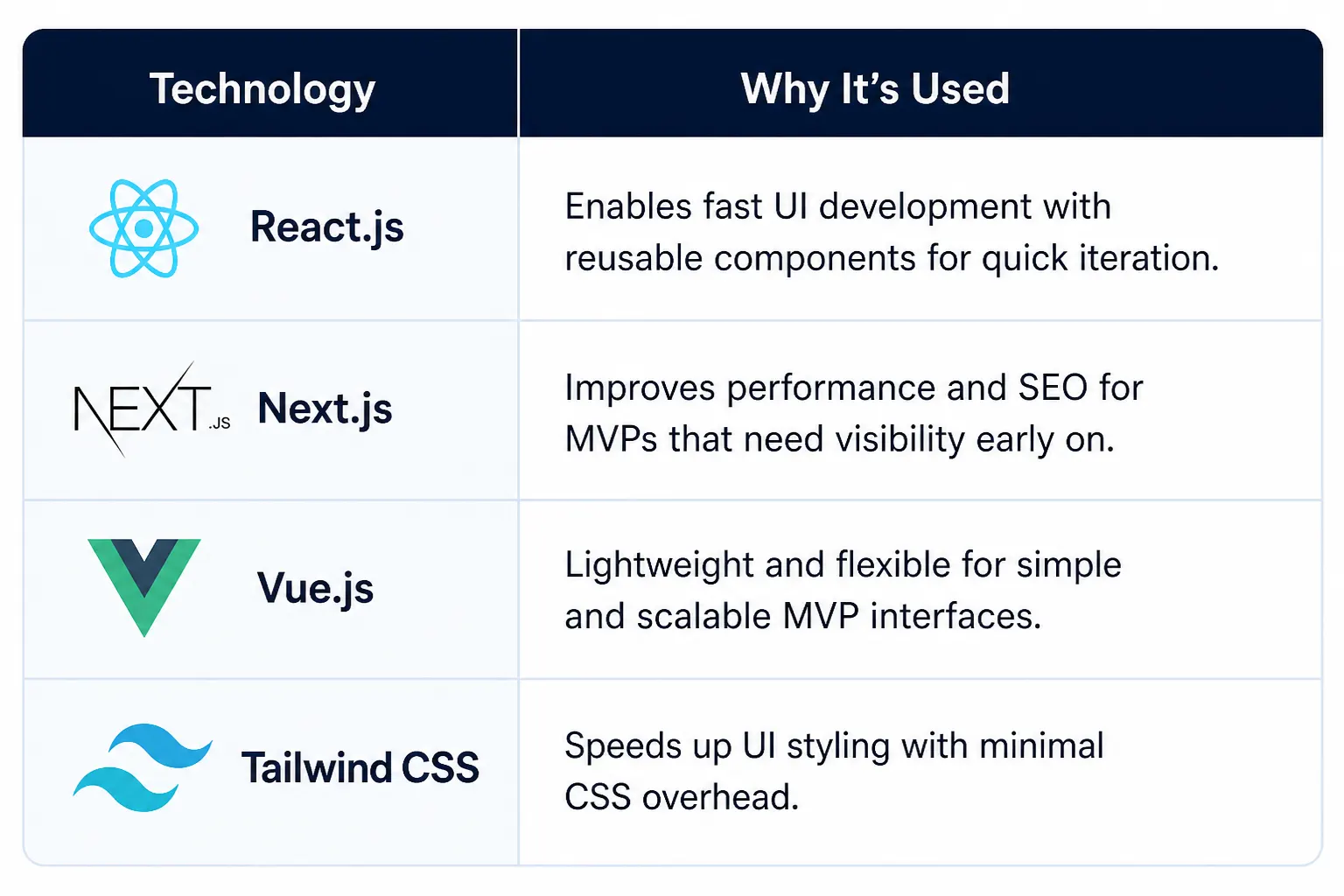
Frontend Technologies for MVP Development
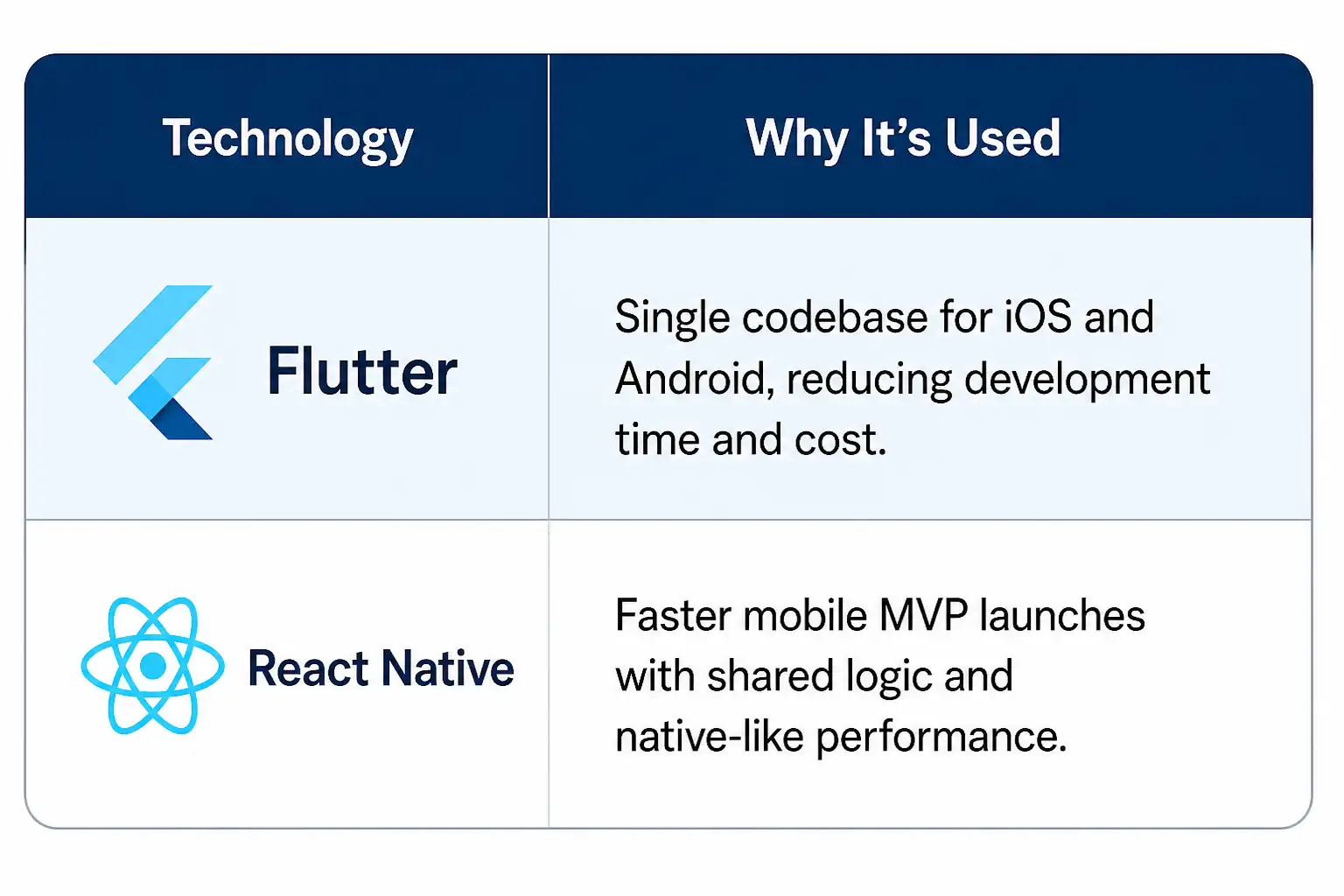
Mobile App Frameworks for Cross-Platform MVPs
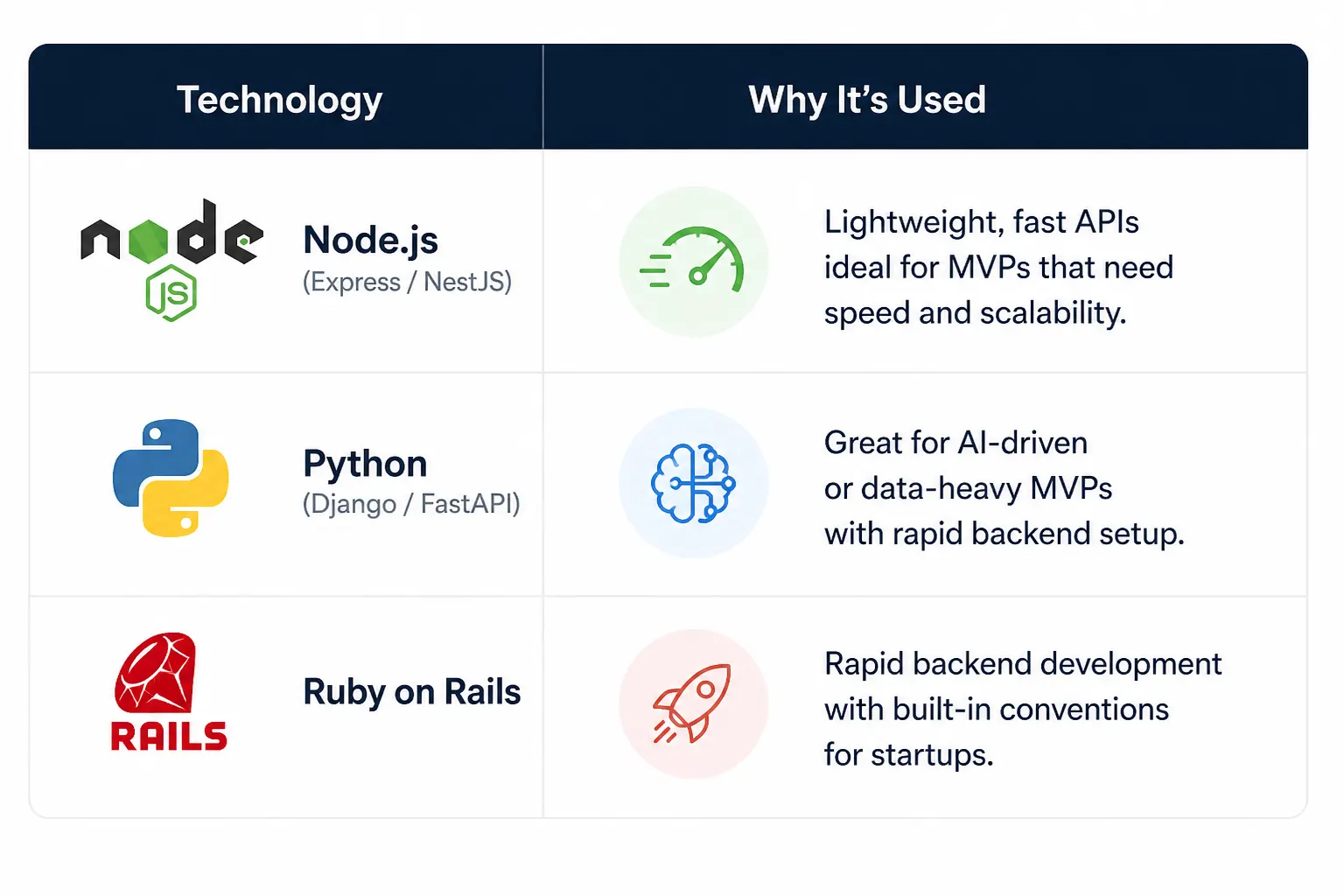
Backend Technologies (Scalable from Day One)
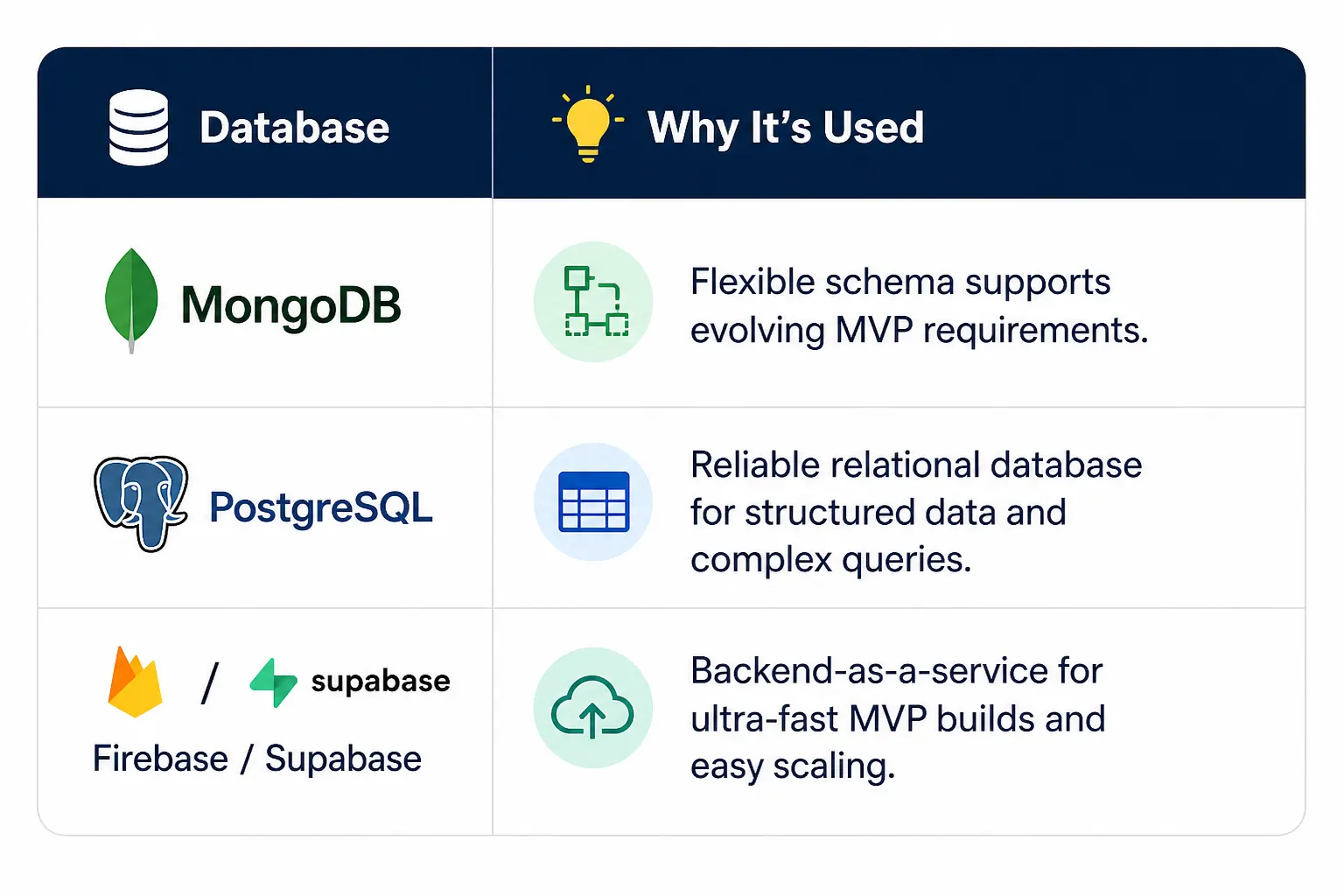
Databases for MVP Development
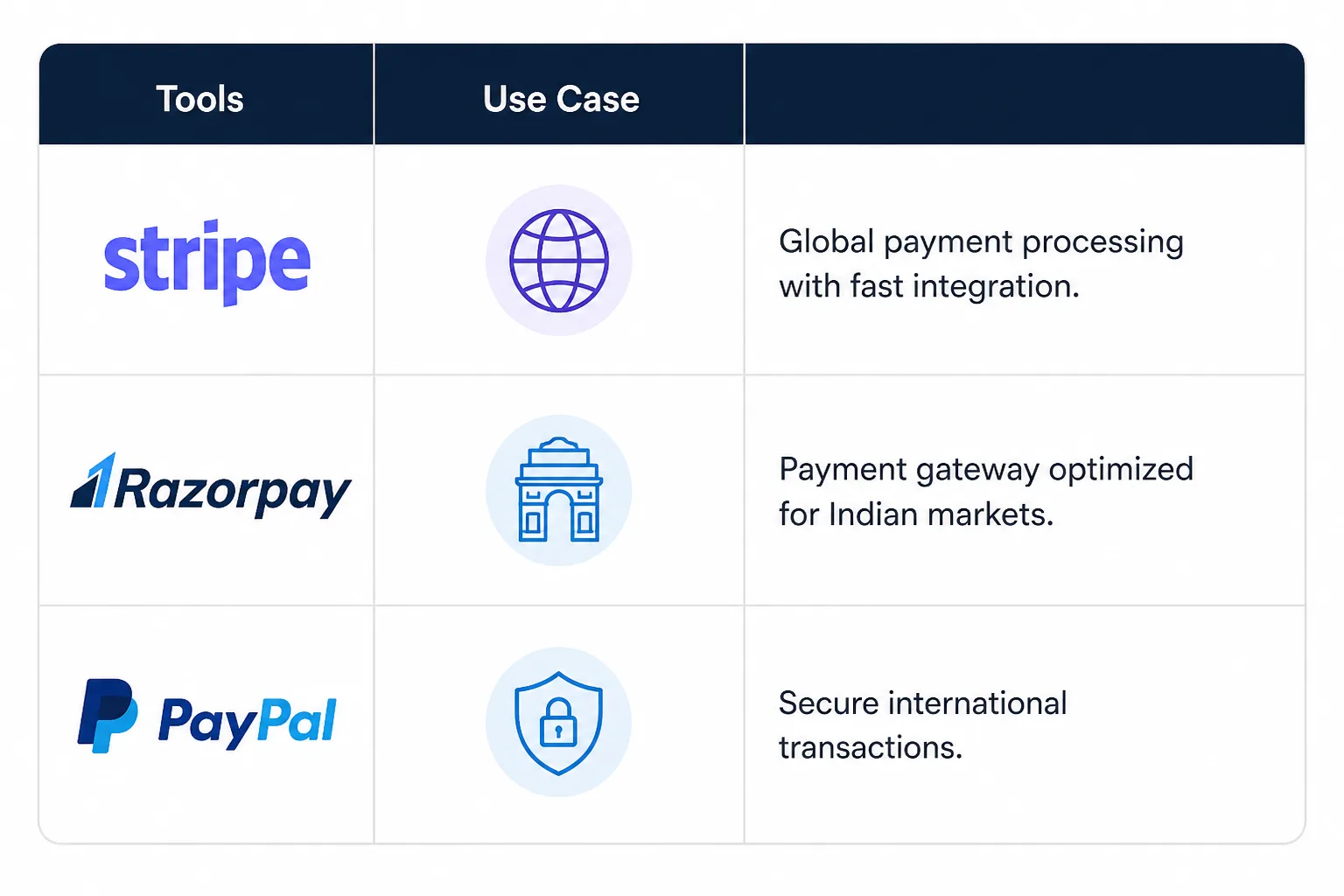
Payment Gateway for an MVP Development
Benefits of MVP Software Development
“Why startups need MVP development?” is one of the most asked questions of modern startup founders. Those who seek the right answers early get a growth roadmap rather than a shortcut to failure.
1. Faster Time to Market
An MVP prevents you from wasting months or years on unnecessary features and allows you to launch your product quickly. As a business owner, you can enjoy a first-mover advantage and help your product become a market leader. Furthermore, getting to market early allows you to test your idea sooner and make feedback-based iterations.
2. Costs Efficient
A full-fledged product requires more investment and a large workforce. On the contrary, MVP software development limits overall costs and prioritizes only what’s absolutely necessary. Consequently, startups and businesses with budget constraints can leverage this technique to validate their ideas without risking substantial financial loss.
3. Early User Feedback and Market Validation
A Minimum Viable Product for startups is very important for early market validation. An MVP puts your product in the hands of real users immediately. Yes, even before the full-fledged version is ready. With this, you can gather genuine feedback based on actual usage rather than assumptions.
4. Reduced Business and Technical Risk
A minimum viable product for startups is very important for early market validation. In fact, an MVP puts your product in the hands of real users immediately. Even before the full-fledged version is ready. With this, you can gather genuine feedback based on actual usage rather than assumptions.
5. Flexibility to Iterate and Pivot
You have launched a fully feature-loaded product, but now you realize half of the features are irrelevant or don't align with the market demand. Will you be able to pivot without hampering usability? The answer is no. That’s why MVPs are designed to be flexible. The software launch gives you feedback on what users truly want. Consequently, you can quickly iterate or pivot without major disruption.
6. Better Focus on Core Value
You often get distracted by secondary features and end up losing focus on the main problem and value proposition. The scenario is different with MVP software development for startups. Instead, an MVP helps you concentrate on delivering what users actually need.
7. Improved Investor Confidence
Winning investors' trust is a tough task. They won't entertain a 'revolutionary' idea unless data backs it. A Minimum Viable Product allows you to tailor your application using real usage data, traction metrics, and user feedback. This demonstrates market fit and helps you build credibility with stakeholders.
8. Scalable Foundation for Future Growth
Software development doesn’t end at launch. In fact, it requires even more attention to transform the application into a scalable solution. When built with the right architecture and technology stack, it can evolve smoothly into a full-scale product. This means that strategic MVP app development leads directly to long-term success.
MVP Software Development Cost in 2026
In 2026, the average cost to build an MVP typically ranges between $10,000 and $80,000+, depending on features, technology stack, and development approach. MVP costs are less about building more features and more about building the right ones. Since multiple factors impact pricing, we’ve also broken down MVP cost drivers, timelines, and budget considerations in detail.
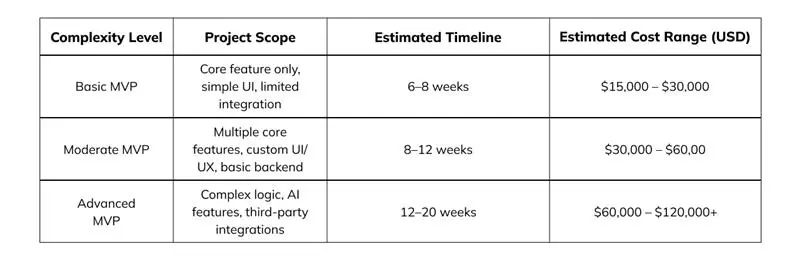
Key Cost Influencing Factors
- Feature complexity and number of workflows.
- Technology stack and AI integration.
- Team size and development location.
- Design depth and user experience needs.
- Post-launch support and iteration cycles.
In 2026, MVP costs are more about accuracy and understanding what users actually want than building more features. In short, a well-planned MVP helps you validate ideas quickly and control spending to make confident scaling decisions.
MVP costs are less about building more features and more about building the right ones. A well-planned MVP helps you validate ideas quickly, control spending, and make confident scaling decisions—without unnecessary financial risk.
For a comprehensive breakdown of MVP development costs, budgeting factors, and hidden expenses, read our detailed guide: How Much Does It Cost to Build an MVP Software Product in 2026?
Common Challenges in MVP Development
MVP software development also comes with its own set of challenges. If you underestimate these challenges, you might end up developing costly software with zero market demand.
1. Overbuilding the MVP
Most startup founders fail to understand the primary objective of MVP software development. It’s not about adding too many features or making it a UI/UX masterpiece. An MVP is meant to validate assumptions, not showcase everything the product could do.
2. Unclear Problem Definition
A successful MVP follows a single direction that focuses on a clearly defined problem. Instruct your tech team not to rush into development without fully understanding user pain points.
3. Choosing the Wrong Technology Stack
The idea for scaling for the future can’t be built on outdated technology or languages. Why? Selecting technologies that don’t support scalability and rapid iteration can limit future growth. An MVP should be built with tools that allow for quick changes and long-term expansion.
4. Ignoring User Feedback
What is the main objective of MVP software development? It's to develop user-centric solutions based on real user feedback. However, most startup founders and teams risk making development decisions based on assumptions rather than evidence.
5. Poor UX and Usability
Smartly built MVPs don’t need a perfect design. Moreover, poor usability can drive users away before meaningful validation happens. Make sure that users don’t struggle to understand the product. Otherwise, the feedback collected may be inaccurate or incomplete.
6. Lack of Clear Success Metrics
The lack of defined metrics can cause serious uncertainty and make it difficult to measure whether the MVP is successful. Consequently, the MVP development company often struggles because it doesn’t know when to iterate, pivot, or move toward full-scale development.
How to Choose the Right MVP Development Company for Startups?
Choosing the right MVP software development company can make or break your product’s success. So it becomes necessary to partner with the company to help you validate ideas and reduce risk. Below are the most important factors to consider when selecting an MVP partner:
Proven MVP and Startup Experience
It's difficult to find the most aligned MVP development company. Look for a team with real experience in building MVPs and working in startup environments. They should be comfortable with uncertainty, evolving requirements, and rapid iteration.
Agile Development and Iteration Mindset
An MVP software development company without an Agile methodology will struggle to stay flexible. This approach allows you to adapt quickly based on user insights and market responses.
Suitable Technology Stack
If you want to build a future-ready solution, the MVP tech stack is going to play a crucial role. The right MVP partner will recommend a technology stack that supports quick development while keeping future scalability in mind.
Transparent Communication
Fragmented communication can create bottlenecks and push development deadlines. To avoid that, choose a software development company that provides regular updates, involves you in decision-making, and explains trade-offs openly.
Post-MVP Support and Growth Readiness
The actual Minimum Viable Product journey starts after the launch. The stage is where you gather all relevant user data to tailor your product accordingly. The right MVP development partner should be able to support post-launch improvements and help you scale toward a full-scale product.
Lessons From Startups That Benefited from MVP Development
These companies started small but achieved massive success by validating early and scaling only after proving real demand.
Dropbox
Dropbox wasn’t built as a full product overnight. On the contrary, the founders created a simple explainer video demonstrating how the product would work. Remarkably, this acted as their MVP software development and helped validate demand instantly.
The user response they got was overwhelming. They ended up getting 75,000 sign-ups overnight. Dropbox then built the whole product confidently based on real user interest.
Why did it work? They tested the idea before building the product and used real user signals to guide development.
Airbnb
The idea of Airbnb’s MVP development was very basic and easy to implement. A smooth website that allowed users to rent out air mattresses in their apartments. At the initial stage, they didn’t try to add complex features, polished designs, or automation.
They started testing their MVP at local events and received validation from people who were willing to pay for short-term home stays. The next step was simple. Just shape the product accordingly based on that validation.
Why did it work? They validated both demand and willingness to pay using a minimal, real-world MVP.
The definition of Facebook hasn’t been the same since 2004. It began as a simple, closed MVP called “TheFacebook.” Mark Zuckerberg and his roommates launched it exclusively for Harvard students with only a few core features. (user profiles, friend connections, and a basic news feed).
Initially, Facebook’s MVP software development started with a small audience group. Later, the founders were able to observe real user behavior, refine features, and improve engagement for a global expansion.
Why did it work? Facebook validated strong user engagement and social behavior early, allowing it to scale gradually based on real-world usage rather than assumptions.
Startups That Suffered Without MVP Development
Learn from the mistakes of companies that invested heavily up front without proper validation.
WeWork
WeWork was able to validate coworking early and skipped MVP software development validation for its rapid expansion and technology claims. Moreover, the company invested heavily up front rather than testing sustainability and unit economics.
What went wrong: WeWork skipped necessary MVP validation for growth and scalability.
Quibi
Launched in 2020, Quibi received massive funding and a fully built product focused on short-form premium video content. However, it failed to identify whether the users wanted this content format on mobile or not. As a result, the platform shut down within months.
What went wrong: They skipped MVP software development validation and assumed user behavior without testing.
Webvan
Webvan entered the market with heavy investment, especially in logistics infrastructure for online grocery delivery. However, they didn’t pay enough attention to building a functional MVP and validating customer behavior or demand.
Why it failed: Massive upfront investment with no real validation caused one of the largest dot-com crashes.
When to Move from MVP Software Development to Full-Scale Product?
This MVP guide for startups also helps you determine when to transition from MVP software development to a full-scale product. Just like scaling too early is a substantial risk, waiting for too long is equally fatal.
Consistent User Adoption and Engagement
If users start accessing your MVP repeatedly, using core features, and recommending it to others, congratulations! It’s a strong sign of real market demand. This consistent engagement is proof that your product actually solves a user's problem.
Core Assumptions Are Validated
As a startup founder, you had some assumptions (target audience, value proposition, and willingness to pay) before launching your MVP. Once your MVP has confirmed these key assumptions, you must consider investing in full-scale development.
Clear Product Roadmap Backed by Data
The MVP software development should collect real user data, not guesses. When feedback starts pointing out which features to build next, scaling becomes easy.
Technical and Business Readiness
An MVP architecture and financial backing are a powerful combination for scaling your application and winning a larger market share. So, if both technology and operations are ready, you're good to go for a full-fledged product.
Conclusion
In 2026, founders are still searching for "What is MVP development?" However, strategic MVP software development is the foundation for any startup founder. Take any tech giant as an example, and you will find one thing in common: a fully validated MVP. Why? Minimum viable products offer a smarter, faster, and more cost-effective way to bring ideas to life. So building software without validation is a risky decision.
Moreover, partnering with the right software development company is equally crucial. It should have deep technical expertise. At last, after implementing all the necessary validation steps, you significantly increase your chances of long-term success.
Frequently Asked Questions
What are the most cost-effective tools for MVP development for startups?
The most cost-effective tools for MVP development are Bubble, Glide, and Webflow. They are both affordable and quick. Additionally, platforms such as Firebase and React Native offer robust cross-platform development options for developers.
What are the 3 basic objectives of MVP software development?
- Validate demand by testing core hypotheses with real users.
- Minimize risk by reducing upfront investment in unproven ideas.
- Gather feedback to guide future development based on actual user behavior.
How long does it take to develop a custom MVP?
The actual MVP software development time depends on various factors such as product complexity, the tech stack, and the team's size. However, the average development timeline for an MVP typically ranges from 3 to 4 months.
How much does custom MVP development cost?
The cost of developing a minimum viable product mostly depends on the level of customization you choose. For example, a pre-built template might cost between $10,000 and $20,000, while a fully custom-coded solution can range from $40,000 to $100,000 or more.

Sakshi Aggarwal is the Co-CEO of CodeAegis, a visionary leader with 12+ years of experience in transforming complex business requirements into high-impact technology solutions across industries. Her core contribution lies in architecting the company's customer-centric service delivery model and optimizing cross-functional execution. She has become a driving force for ensuring project success and cultivating a culture of accountability across the software development life cycle.