

MVP App Development for Startups in the USA: Validate Your Idea Before Investing Millions
Table of Contents
MVP App Development in USA Has Become Startup Playbook
Validate the Problem Before You Build the Product
Signs Your Startup Idea Is Ready for MVP Development
What Should an MVP Actually Include
MVP to Product-Market Fit: What Happens After Launch
Cost of Skipping MVP Validation
Right MVP Development Company in USA
Why Founders Work With CodeAegis
Final Thoughts
Frequently Asked Questions
 Add us as a preferred source on Google
Table of Content
+MVP App Development for USA Startups | Validate Ideas Fast
Somewhere right now, a founder is about to spend eight months and their entire seed round building a full app nobody asked for. It happens more than people admit, and it's rarely the code that's the problem.
The venture landscape isn't making that mistake cheaper either. Investors heading into 2026 have shifted firmly toward capital efficiency and proven business models, with product-market fit expected before the next round even gets discussed, rather than growth-at-all-costs pitches.
That shift changes the calculus for founders. Building first and hoping the market agrees later isn't just risky anymore, it's a harder story to fund.
CB Insights analyzed startup post-mortems and found that 42 percent of startups fail because they built something the market didn't want. Not a funding problem on its face. Not a hiring problem. A demand problem, and one that existed before a single line of code got written. In nearly every documented case, the information needed to avoid the failure was available before the product was built. Founders just didn't ask the right people the right questions early enough.
This is exactly the gap MVP app development in the USA exists to close. An MVP isn't about building less because you're cutting corners. It's about building just enough to find out if you're right, before the money's already spent finding out the hard way.
Why MVP App Development in the USA Has Become the Startup Playbook
In the United States, startups operate at breakneck speed because of that very market. Startups accelerate validation efforts ahead of funding rounds, not afterward. Competitors are releasing updates on a weekly basis, and a year’s worth of delay may mean that another startup has already validated your solution for you, even if this wasn’t their intention.
The Lean Startup approach, which was made popular by Eric Ries, changed the way founders developed software products. Rather than developing a complete product that would take up to a year of development in isolation, teams start with a minimum viable version that validates a single hypothesis, learning from actual user behavior. This approach has become standard practice among accelerators, venture-funded teams, and self-funding founders.
A few forces are pushing MVP software development further into the mainstream this year:
Investors increasingly want evidence of demand baked into the pitch, not just a compelling deck and a founder's conviction
The US startup market has gotten more crowded across nearly every category, which raises the cost of building the wrong thing first
Rapid iteration cycles let founders course-correct within weeks instead of discovering a mistake a year into development, once runway is already thin
- Product discovery has become cheap enough, through landing pages, waitlists, and lightweight testing tools, that skipping it is now a choice rather than a necessity
Validate the Problem Before You Build the Product
This is the part most founders skip, and it's the part that matters most.
Validation isn't a survey sent to friends who don't want to hurt your feelings. It's testing whether strangers, people with no reason to be nice to you, actually feel the pain point badly enough to change their behavior over it.
Talking To Real Customers First
The process of customer discovery begins with interviews, with an average of 15-20 interviews with customers who fit into your target market. The idea here is not to sell your idea; it's to listen to how people are solving this problem now, what bugs them about it, and whether they've ever paid for a solution. Not many people have tried to solve their own problems because that indicates there's no real pain.
Testing Demand Before Building Anything
A landing page describing the product, with a single call to action, tells you a lot before a developer touches a keyboard. So does a waitlist, which filters out polite interest from people who'll actually hand over their email for early access. Concierge MVPs go a step further: the founder manually delivers the service by hand, no software involved, just to confirm people will pay for the outcome itself.
Fake-door tests and smoke tests work similarly, measuring how many people click through to a feature or product that doesn't exist yet. It's a blunt but effective way to separate real demand from founder optimism.
A Scenario Worth Sitting With
Picture a founder convinced their app idea is strong. Before writing code, they run a smoke test, a single page describing the core feature with a "join the beta" button. Two weeks later, the signups trickled in, but nowhere near what they expected. That's not proof the idea is dead. It usually means the framing, audience, or problem statement needs work before a developer gets involved. That two-week test costs almost nothing. Skipping it and finding out after six months of development costs everything the startup has.
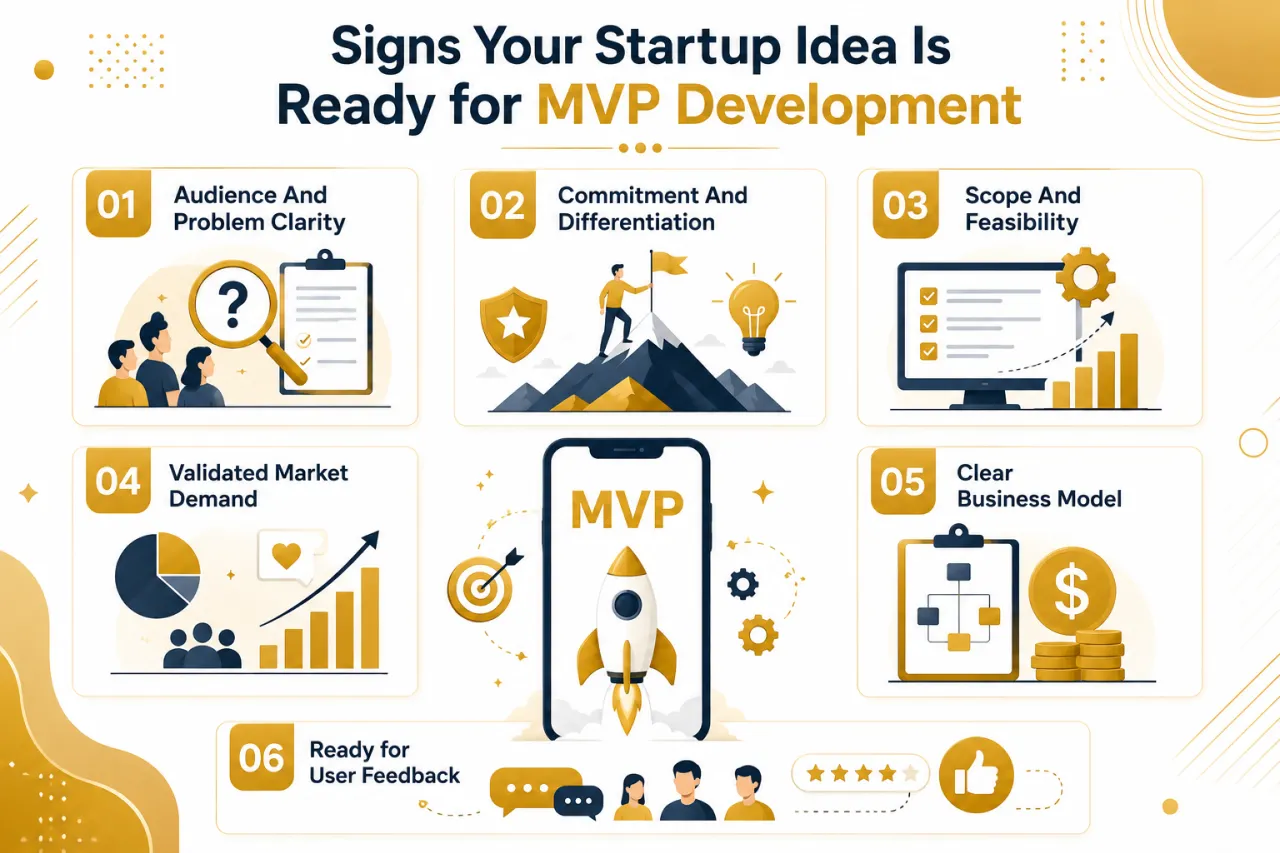
Signs Your Startup Idea Is Ready for MVP Development
Not every idea is ready to build, even a small version of it. A few signals tend to separate ideas that are ready from ones that need more discovery first.
Audience And Problem Clarity
Ready Ideas have a specific target market, "not everyone, but something very precise that the founder can define in one sentence." The idea also has a validated problem, which means having real conversations as opposed to assumptions of what people might be struggling with.
Commitment And Differentiation
The fact that people are willing to pay or commit in some other way, such as by joining a waitlist or pre-order, is much more important than just politeness and interest. Also, there has to be an explanation as to why people choose this particular product in contrast to a messy Excel sheet they already use.
Scope And Feasibility
There has to be one core function that the product simply needs to have. The criteria of success also have to be defined beforehand so that the team understands what "success" means for this product, and the technical feasibility has to be evaluated as opposed to being assumed.
Having a problem with more than one or two things from this list is not a reason to despair. This is a reason to invest more time into the product discovery phase before spending money on the development itself.
What Should an MVP Actually Include? (Probably Less Than You Think)
Most first-time founders overbuild their MVP. It's an easy trap. Every feature feels essential when you're the one who dreamed it up.
Prioritization That Actually Works
The fix is brutal prioritization. MoSCoW is a useful framework here: Must-have, Should-have, Could-have, Won't-have for now. An MVP only includes the "must-haves," the features without which the product doesn't solve the core problem at all. Everything else waits for a later version, once there's actual evidence it's worth building.
Why Feature Creep Kills Momentum
Feature creep delays MVPs before they even launch. Every extra feature adds development time, adds bugs to fix, and postpones the point where a team actually learns something from real users. A product that does one thing exceptionally well beats a product that does five things adequately, every single time at the validation stage. The user journey matters more than the feature count on a landing page.
| Comparison Factor | Full Product | MVP |
|---|---|---|
| Feature count | 20+ features | 3-5 core features |
| Timeline | Long, often 6-12+ months | Fast, often 8-16 weeks |
| Investment | Higher, harder to reverse | Lower, controlled risk |
| Audience | Broad, general market | Specific, early-adopter segment |
| Goal | Scale and retain | Learn and validate |
The MVP column isn't a lesser product. It's a different kind of product entirely, one built to answer a question rather than capture a market on day one.
From MVP to Product-Market Fit: What Happens After Launch?
Launch day isn't the finish line. It's the start of the real validation process, and a lot of blogs on MVP software development stop right here, which leaves founders unprepared for what actually comes next.
The central aspect of the Lean Startup approach is the "build-measure-learn" cycle, where each release is an experiment to prove a hypothesis. A team builds a minimal viable feature, collects data about its usage from users, makes decisions based on the findings to find out what to do next, and so forth many times.
Analytics show how people actually use the product, not what they have promised to do during an interview. Feedback systems create a framework for collecting feedback by using in-application surveys or contacting the early adopters. Iteration of the feature depends on its actual usage, not opinions about the importance of certain features inside the team.
A/B testing is a technique that allows us to compare two variations of a feature to find out which of them is better. Retention metrics are more important than signup numbers because while everyone can have a single time user, retention means something else. Activation metrics reveal how new users experience the product and reach the point of getting its value.
Product-market fit is not a destination that startups achieve once and forever. It's a state that keeps getting re-earned as the user base grows and assumptions get tested against a wider, less forgiving audience. Startups that treat launch as "done" tend to stop learning right when learning matters most.
Cost of Skipping MVP Validation: Lessons from Real Startup Mistakes
Picture two founders with the same idea. One spends three months validating, running interviews, testing a landing page, adjusting the pitch twice based on what they hear. The other jumps straight to development, convinced they already know exactly what users want.
Six months in, founder two has a fully built app. Founder one has a validated MVP with real early users and actual usage data behind every decision. Founder two is now trying to figure out why signups have stalled, sitting on a product that's expensive to change because it was built around assumptions instead of evidence.
This pattern repeats constantly across the startup product development world, and it usually comes down to a familiar set of mistakes. Founders build too many features before anyone's confirmed the core idea even works. They fall in love with their own solution instead of staying attached to the problem it's meant to solve. Customer interviews get skipped because they feel slow or uncomfortable to run.
Developers get hired too early, before there's anything worth building at real scale. The budget runs out before validation even happens, because the money went toward development first. And too often, teams chase internal conviction instead of evidence gathered from actual users.
None of these mistakes are about talent or effort. They're about sequencing. Build first, validate later is backwards, and reversing it once a product has already shipped is expensive in ways that are hard to undo cleanly.
Choosing the Right MVP Development Company in the USA
Once an idea is validated and ready to build, the next decision matters just as much: who actually builds it.
What To Look For Beyond Code
A strong MVP development company USA founders can rely on bringing more to the table than developers who can write functioning code. Product discovery expertise matters, the ability to help refine what the MVP should actually include instead of just building whatever gets handed over. Startup experience matters too, since teams that have worked with early-stage founders before understand tight budgets and tighter timelines in a way larger enterprise-focused shops often don't.
Process And Communication
Agility implies making visible progress within weeks, not spending months in anticipation of some major event at the end of the process. UX skills are no less important than backend expertise, because a usable but well-coded MVP will be rejected by its users anyway. Scalable product engineering helps avoid the costly process of redoing everything once the traction becomes apparent, and clear communication, even if it includes the hard truths a startup founder may dislike hearing, usually differentiates quality partners from opportunistic vendors.
Post Launch Support
Post-launch support makes the difference between an MVP that silently passes away immediately after launch and a product that grows out of it. Once the app is ready to go live, an absent development partner leaves entrepreneurs to solve all the problems of iteration on their own.
Why Founders Work With CodeAegis For MVP Development
CodeAegis approaches MVP app development as a validation exercise first and a build second, which is a different starting point than most development shops take.
Product Discovery Before Development
Before any code gets written, the team works through the same discovery questions covered above: who the audience actually is, what the core assumption is, and whether the idea has enough early signal to justify building at all. This isn't a sales step, it's a filter that saves founders from spending on the wrong build.
Engineering Built To Scale
CodeAegis structures MVPs with product engineering services in mind from day one, meaning the codebase isn't a disposable prototype that needs a full rebuild the moment a startup gets traction. That distinction matters enormously once a founder is trying to raise a Series A off real usage numbers and can't afford six months of technical debt cleanup in the middle of a fundraise.
A Partner Through Iteration
The relationship doesn't end at launch. Post-launch iteration, based on the same analytics and feedback loops covered earlier, continues with the same team that built the MVP, rather than handing a founder off to a support queue. For startups navigating the shift toward capital-efficient, evidence-based fundraising, having a technical partner who understands both product engineering and startup product validation tends to matter more than picking the cheapest quote in the room.
Final Thoughts
Don't build because you're excited. Build because you've gathered evidence.
An MVP isn't the destination. It's the fastest, cheapest path to learning what the market actually wants, before that lesson costs a year of runway and a team's morale along with it.
If you're sitting on an idea and trying to decide whether to validate first or build first, that decision alone is worth a conversation. Talk to CodeAegis about your startup idea before committing to full-scale development. It's a lot cheaper to have that conversation now than after the money's already spent.
Frequently Asked Questions
What is MVP app development?
Building the smallest working version of a product that lets founders test whether real users actually want it, before investing in a full feature set.
How much does MVP app development cost in the USA?
Costs vary by complexity, but most MVPs land in a leaner range than a full product build, since the entire point is a focused, minimal-scope launch rather than a complete platform.
How long does it take to build an MVP?
Most MVPs take 8-16 weeks depending on scope, compared to 6-12+ months for a full product build with the complete feature set.
What is the difference between an MVP and a prototype?
A prototype demonstrates an idea, often without working functionality behind it. An MVP is a real, functioning product that real users can actually use and, ideally, pay for.
How do I validate a startup idea before building an app?
Customer interviews, landing page tests, waitlists, concierge MVPs, and smoke tests are the standard tools, all built to test demand before development begins.
What are the biggest mistakes startups make before launching an MVP?
Overbuilding features, skipping customer interviews, hiring developers too early, and running out of budget before real validation ever happens.
When should a startup move from MVP to a full product?
Once there's clear evidence of product-market fit, consistent retention, and a validated reason to invest further beyond the core feature set.
Why should I hire an MVP development company in the USA?
A partner with real startup experience helps avoid the technical debt and scope mistakes that quietly turn a lean MVP into an expensive rebuild a year later.

With over 12 years of experience, Mansi Garg is the Chief Operating Officer (COO) of CodeAegis, specializing in optimizing business performance and ensuring operational maturity across the technology landscape. Known for designing scalable governance and quality assurance frameworks, she ensured on-time project delivery. Mansi is the true leader behind the successful execution of cutting-edge digital solutions for a diverse global clientele.