


Top 10 Benefits of MVP App Development for Startups 2026
Table of Contents
What Is MVP App Development?
Why Is MVP Important for App Development
Top 10 Benefits of MVP App Development for Startups
MVP vs Full Product Development
Why CodeAegis for MVP App Development?
Conclusion
Frequently Asked Questions
 Add us as a preferred source on Google
Table of Content
+MVP App Development for Startups: Top 10 Benefits in 2026
You spend months coding, designing, and perfecting an app. You launch. And then… nothing.
No traction. No users. No revenue. Just a very expensive lesson.
This is not a rare story. In 2026, the benefits of MVP app development are more relevant than ever. According to CB Insights 43% of startups fail because there is no market need for their product. One major reason is investing too much money into products customers never wanted.
The startups that survive?
Most of them have one thing in common. They didn't try to build everything at once. They tested fast and learned from real users before betting everything on assumptions.
That's exactly what MVP app development is about. Development costs are rising. AI is accelerating competition. Investors are demanding proof before writing checks. And users have zero patience for apps that don't solve their actual problems.
If you're a startup founder thinking about why you should build an MVP for your app instead of going straight to a full product — this guide is for you.
What Is MVP App Development?
MVP stands for Minimum Viable Product.
It's not a prototype. It's not a proof of concept. And it's definitely not a half-finished app.
An MVP is the simplest version of your product that still delivers real value to real users. It has just enough features to work and to teach you something. The goal isn't to impress people. It's to learn as fast as possible with as little waste as possible.
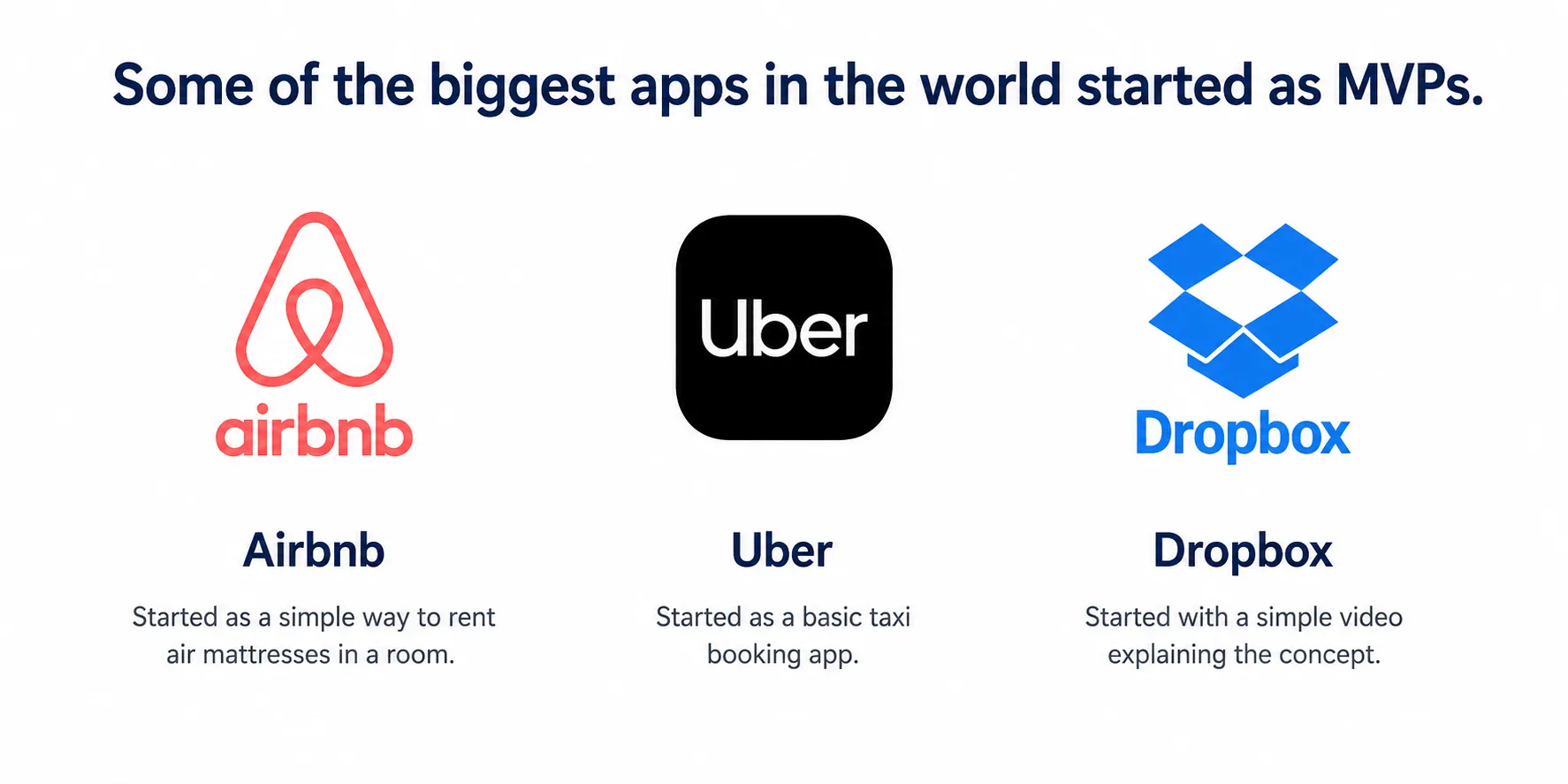
This idea comes from Eric Ries and the Lean Startup methodology. If you haven't read The Lean Startup, put it on your list.
The core idea is build → measure → learn.
Here's a quick breakdown of how an MVP differs from similar concepts:
- Proof of Concept (PoC): Tests whether the technology is feasible. Usually internal only.
- Prototype: A demo to visualize the idea. Not functional in a real sense.
- MVP: A live, functional product that real users can actually use and that you can learn from.
That's the minimum viable product app thinking in action. And it works.
Why Is MVP Important for App Development in 2026?
The startup landscape has changed dramatically over the last few years. Building a full-featured app without market validation is now considered a high-risk strategy.
In 2026, startups face several challenges:
- Rising app development costs
- AI-driven competition
- Faster market shifts
- Shorter user attention spans
- Investor pressure for traction and validation
This is why MVP for startups has become a preferred development model.
Instead of spending huge budgets upfront, startups can release a lightweight product, study user behavior, and improve features based on real feedback.
According to Harvard Business Review, companies using lean startup methodologies and iterative product validation often reach product-market fit faster than businesses relying on traditional development methods.
This also explains why investors now prefer startups with validated MVPs instead of just ideas.
The benefits of MVP app development shows:
- Proof of demand
- User engagement
- Scalability potential
- Market validation
Another important factor is the debate around MVP vs full product development.
In the past, startups often spent years building complete applications before launch. Today, markets move too quickly for that approach. Customer needs change fast, and competitors can appear overnight.
An MVP allows startups to adapt quickly without wasting resources.
Top 10 Benefits of MVP App Development for Startups
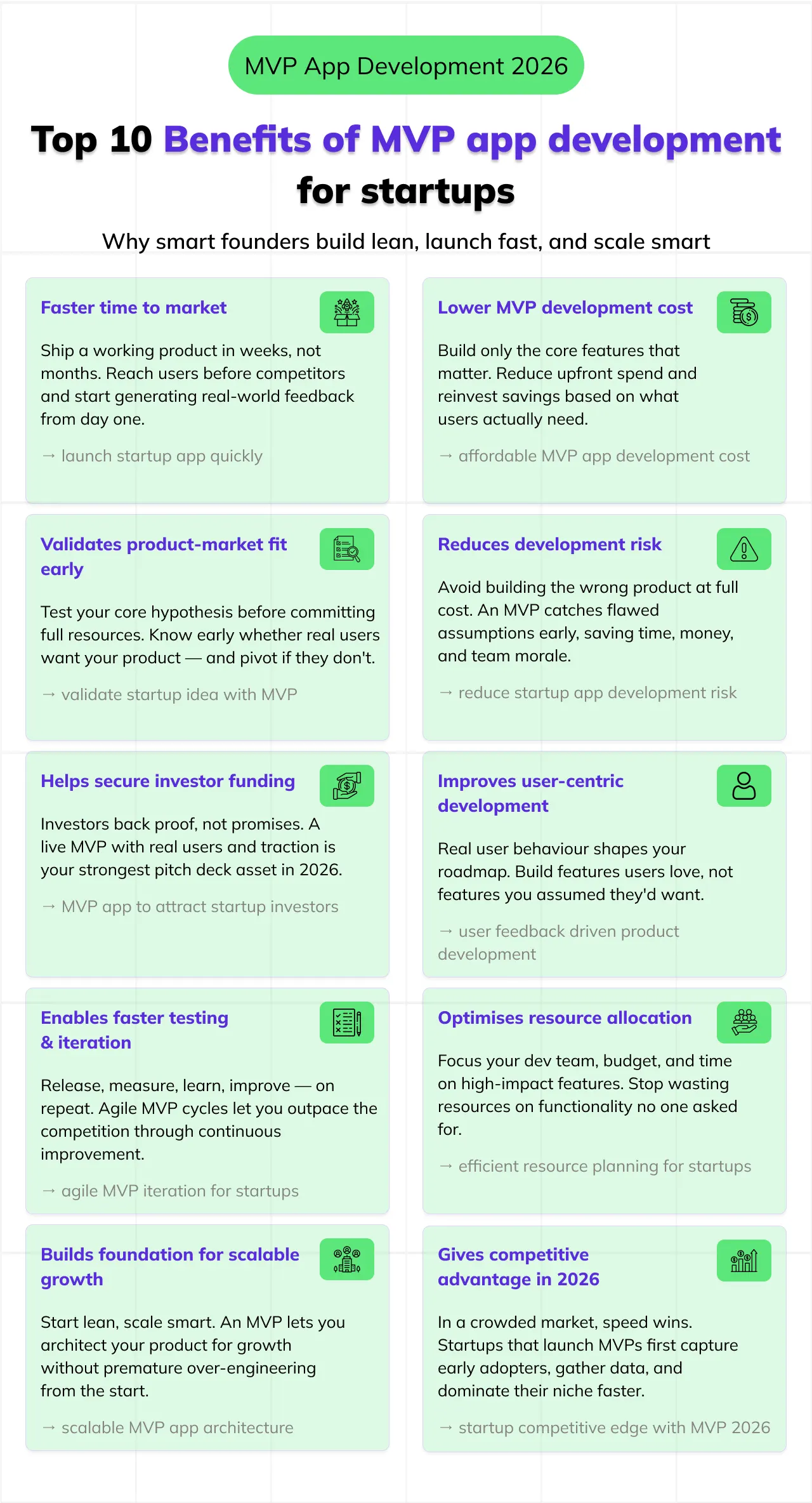
1. Faster Time to Market
One of the biggest benefits of MVP app development is speed.
Instead of spending 12–18 months building a complete platform, startups can launch their core product within weeks or months. This allows businesses to enter the market faster and start attracting users early.
In highly competitive industries, speed matters. If your idea solves a real problem, launching quickly gives you an advantage before competitors catch up.
MVP mobile app development focuses only on essential features. This reduces unnecessary complexity and shortens development timelines significantly.
For example, instead of launching with:
- Advanced analytics
- Multiple integrations
- AI automation
- Premium dashboards
You can start with:
- User registration
- Core service functionality
- Basic payment system
- Feedback collection
One of the biggest advantages of building MVP before full app development is that businesses can start learning from users immediately instead of relying on assumptions.
2. Lower MVP Development Cost
Budget is one of the biggest concerns for startups. Building a full-featured app from day one can cost tens or even hundreds of thousands of dollars.
This is why lower MVP development cost is one of the most valuable minimum viable product benefits.
By focusing only on core functionality, startups avoid spending money on features users may never use.
According to Statista Software Development Data, global software development spending is projected to exhibit a steady annual growth rate of 4.67% from 2026 to 2030.
An MVP helps businesses:
- Reduce initial investment
- Control development expenses
- Prioritize essential features
- Improve budget allocation
Instead of hiring large teams immediately, startups can begin with smaller agile teams and scale gradually. It is one of the smartest ways to balance innovation and financial sustainability in modern startup ecosystems.
3. Validates Product-Market Fit Early
Product-market fit means your product solves a real problem for a real group of people and they actually want to pay for it (or use it regularly). Without product-market fit, growth is nearly impossible. With it, almost everything else becomes easier.
The problem is, you can't know if you have product-market fit by thinking about it. You can't know from surveys. You can't know from a landing page with email signups. You find out when real people use your real product and choose to come back.
An MVP gets you there faster than anything else.
Remember — CB Insights reports that 43% of startups fail due to lack of market need.
That means nearly half of all startup failures could have been caught early if the founders had validated their assumptions before scaling.
MVP app development for startups is essentially a way to make the market tell you the truth before you've spent everything. If the product resonates, you know what to double down on. If it doesn't, you can pivot without catastrophic losses.
Real feedback from real users is how MVP reduces app development risk at its most fundamental level.
4. Reduces Development Risks
Every software project carries risk. Technical risks. Business risks. Market risks. Full product development means carrying all of those risks simultaneously for 12–18 months. If something goes wrong you find out late, when changing course is expensive.
The benefits of MVP app development reduce this exposure dramatically.
On the technical side, you're building less, which means fewer integration points, fewer potential failure modes, and a cleaner codebase. When you do find bugs or architectural issues, they're in a smaller system that's easier to fix.
On the business side, you're testing your core assumptions before they become expensive commitments. Does the core workflow actually make sense to users? Does the onboarding convert? Is the problem painful enough that people will pay to solve it?
These are questions you can only answer with a live product and it's far better to answer them when you've invested $30,000 than when you've invested $300,000.
MVP development benefits include risk reduction not just financially but strategically. When you need to pivot and most successful startups pivot at least once which is far cheaper and faster.
5. Helps Secure Investor Funding
Investors are far more cautious today than they were a decade ago.
A simple idea or pitch deck is rarely enough to secure serious funding. Investors want evidence that customers actually want the product.
This is why one of the major benefits of a minimum viable product for investors is validation.
An MVP gives founders real metrics to present, including:
- User signups
- Retention rates
- Customer feedback
- Revenue potential
These insights create stronger investor confidence.
MVP for startups also improves fundraising conversations because founders can discuss real product performance instead of hypothetical projections.
In many cases, startups with validated MVPs receive better valuations because the investment risk becomes lower.
6. Improves User-Centric Development
Here's a truth that most development teams don't want to admit: they're not the user.
What developers think is intuitive, users often find confusing. What founders think is the most important feature, users often ignore. What seems obvious from the inside is frequently invisible from the outside.
An MVP forces you out of that bubble early. When you release a minimum viable product app and watch real users interact with it, you learn things no amount of internal discussion could surface.
This kind of feedback shapes better products. Not because you're guessing better — but because you've replaced guessing with observation.
MVP app development creates a natural feedback loop. You ship. You watch. You talk to users. You improve. You ship again. Each cycle produces a product that's better aligned with what real people actually need.
7. Enables Faster Testing and Iteration
Modern startups must move quickly.
Customer preferences change fast, and businesses that fail to adapt often struggle to survive.
One of the biggest MVP development benefits is the ability to test and improve products continuously.
An MVP allows startups to:
- Run A/B tests
- Measure feature performance
- Track user engagement
- Optimize conversion funnels
Tools like Google Firebase Analytics make this even more accessible. You can track user sessions, drop-off points, conversion events, and engagement patterns without a data science team.
The iteration speed that comes from MVP development is a genuine competitive advantage. While a competitor is still in month eight of their full product build, you've already shipped four versions of your core feature, tested two pricing models, and increased your day-30 retention by 20%.
That kind of learning is only possible when you're in the market. And you can only be in the market if you shipped something. MVP gets you there.
8. Optimizes Resource Allocation
Startups usually operate with limited resources.
Managing budgets, teams, and timelines carefully is essential for survival.
This is another area where MVP app development creates major value.
Instead of building large teams immediately, startups can work with smaller focused teams that prioritize essential functionality first.
This lean approach reduces:
- Operational costs
- Hiring expenses
- Infrastructure complexity
- Management overhead
One of the important reasons why build an MVP for your app is resource efficiency. Founders can allocate resources strategically based on market validation instead of assumptions.
9. Build a Foundation for Scalable Growth
Some founders believe benefits of MVP app development are temporary with no long-term value. In reality, well-built MVPs often become the foundation for scalable platforms.
Instead of rebuilding products from scratch later, startups can improve gradually based on user demand.
This is one of the biggest differences in MVP vs full product development.
When your MVP gains traction, scaling becomes a process of expansion, not rebuilding. You add features based on what users are asking for. You expand to new platforms or markets based on real demand signals. Your product roadmap is driven by data, not by what someone in a boardroom thought users might want.
MVP vs full product development isn't really a debate about quality. It's a debate about sequence. Full product development front-loads everything. MVP development staggers investment based on validated learning. One is a bet. The other is a process.
10. Gives Competitive Advantage in 2026 Markets
We're operating in a market where the speed of learning is the real competitive moat.
AI tools have dramatically lowered the cost of building software. That means more people can build. More startups are entering more markets. The barrier to launch has never been lower.
In that environment, the startups that win aren't necessarily the ones with the best initial product. They're the ones that learn fastest, adapt quickest, and stay closest to their users.
MVP mobile app development is perfectly suited to this environment. You ship fast. You learn. You ship again. While others are still in planning, you're on version three.
The benefits of MVP app development in a crowded, AI-accelerated market go beyond just saving money or time. An MVP mindset is a competitive philosophy. You're betting on learning, not on being right.
MVP vs Full Product Development — Which Is Better for Startups?
If you're still on the fence, here's a direct comparison.
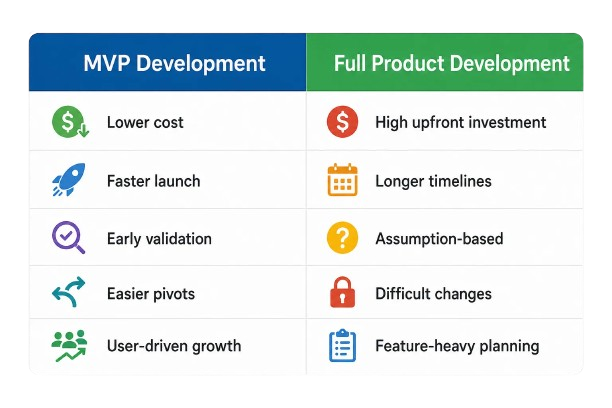
Many founders struggle with the decision between MVP vs full product development.
The answer depends on business goals, budget, and market conditions, but for most startups, MVP development offers lower risk and better flexibility.
Why CodeAegis for MVP App Development?
Most MVP projects do not fail because the startup idea was weak. They fail because the product was overbuilt, poorly scoped, or launched too late.
At CodeAegis, the approach to MVP app development is built around speed, validation, and long-term scalability. As an experienced MVP app development company, CodeAegis helps startups launch lean products faster while creating a strong technical foundation for future growth.
Startup-Focused MVP Strategy
Every startup has limited time, budget, and runway. That is why CodeAegis focuses on building only the features that truly matter in the early stage. Instead of trying to launch a “perfect” product, the team helps founders validate their idea with a lean and focused MVP strategy.
These tailored MVP development services for startups help businesses reduce waste, test market demand faster, and improve product-market fit from the beginning. The goal is to launch quickly, learn from real users, and scale with confidence.
Sprint-Based Product Discovery Process
Before development begins, the team runs a structured discovery and planning phase to define product priorities clearly. This process identifies the core problem the product solves, the most important user journeys, and the essential features required for launch.
By separating must-have functionality from future enhancements, startups avoid feature overload and unnecessary MVP development costs. This lean planning approach also allows the agile MVP development team to move faster during execution and deliver better outcomes.
Rapid MVP App Development
Speed matters in modern startup ecosystems. CodeAegis follows an agile MVP app development process that helps startups move from idea to launch quickly without compromising quality.
Most core MVP projects are delivered within a focused 10–14 week timeline, depending on complexity and integrations. Faster launches allow startups to validate ideas, attract early adopters, and gather real-world feedback sooner.
Businesses looking to hire MVP developers often choose CodeAegis because of its ability to combine rapid execution with startup-focused product thinking.
Scalable Tech Stack from Day One
A good MVP should not feel temporary. CodeAegis builds scalable minimum viable product applications using modern technologies like React Native, Flutter, Node.js, Laravel, and AWS to support long-term growth.
As a reliable MVP app development company, the focus is not just on launching quickly but also on building scalable architecture that supports future features, user growth, and product expansion without major rebuilds.
Agile Development and Faster Iterations
One of the biggest benefits of MVP app development is flexibility. The CodeAegis agile MVP development team follows iterative workflows that allow startups to test, improve, and update products continuously.
Instead of waiting months for large feature releases, startups can launch updates faster, respond to user feedback quickly, and improve customer experience through continuous iteration cycles. This agile process helps startups stay adaptable in competitive markets.
Post-Launch MVP Support
Launching the app is only the first step. CodeAegis continues supporting startups after launch by analyzing user behavior, monitoring product performance, and prioritizing future improvements.
These ongoing MVP development services for startups help founders make smarter product decisions using real user data instead of assumptions. From feature optimization to scaling support, the team helps startups turn early MVP traction into sustainable long-term growth.
We Get You Real Validation Outcomes & Growth
One recent B2B SaaS startup in the logistics industry launched its MVP and started onboarding paying customers within 12 weeks. During the validation process, the team discovered that the company’s original pricing model was not aligned with customer expectations. Because the issue was identified early through MVP testing, the startup was able to adjust its pricing strategy before scaling further.
CodeAegis works with startups across fintech, SaaS, healthtech, logistics, edtech, and eCommerce industries. The focus is always on helping founders launch faster, validate smarter, and scale with confidence.
Conclusion
Building a startup is already challenging. Building the wrong product makes it even harder. That is why the benefits of MVP app development are more important than ever for modern startups.
At its core, MVP app development is about learning before making large commitments. Instead of spending huge budgets building every possible feature, startups can validate ideas early, gather user feedback, and improve products step by step.
In today’s startup ecosystem where development costs are increasing, AI competition is growing rapidly, and funding environments are becoming more selective.
That is exactly why MVP development benefits continue to shape how successful digital products are built in 2026.
A successful MVP is not a shortcut or an incomplete product. It is a smart business strategy designed to reduce risk, validate demand, and create a strong foundation for growth.
If you are looking for an experienced MVP app development company, connect with CodeAegis to discuss your product idea and get a clear MVP roadmap tailored to your startup goals.
Frequently Asked Questions
1- What are the biggest benefits of MVP app development for startups?
The biggest benefits of MVP app development include lower development costs, faster time to market, early product validation, better investor confidence, and reduced business risk. MVPs also help startups focus on building features users truly need instead of relying on assumptions.
2- How much does MVP app development cost in 2026?
MVP development cost depends on factors like app complexity, features, integrations, platforms, and development timelines. A basic MVP mobile app development project costs significantly less than building a fully featured application because it focuses only on core functionality required for launch and testing.
3- How does MVP reduce app development risk?
One of the biggest MVP development benefits is risk reduction. Startups can test ideas with real users before making large investments. This helps identify weak business assumptions, usability issues, low-demand features, and technical problems early in the process.
4- What is the difference between MVP vs full product development?
MVP vs full product development mainly differs in scope and purpose. An MVP focuses on launching quickly with essential features for validation, while full product development includes advanced functionality, complete infrastructure, and large-scale feature sets. MVP development is usually the smarter option for early-stage startups.
5- How long does MVP mobile app development usually take?
Most MVP mobile app development projects take around 8–16 weeks depending on the feature set, technology stack, integrations, and complexity. Leaner MVPs with focused functionality can often launch much faster.
6- What are the benefits of minimum viable product for investors?
The benefits of minimum viable product for investors include lower investment risk, proof of market demand, early user traction, and measurable product validation. Investors are more likely to fund startups that already have working MVPs and customer feedback instead of just ideas or presentations.
7- Can an MVP become a full-scale product later?
Yes. Many successful startups began with a minimum viable product app before expanding into full platforms. A properly planned MVP app development strategy creates a scalable foundation that can support future features, larger user bases, and long-term business growth.
8- Which industries benefit most from MVP app development?
Industries like fintech, healthtech, SaaS, logistics, AI, eCommerce, and edtech benefit the most from MVP app development because these sectors evolve quickly and require continuous testing, validation, and rapid iteration.
9- Why are startups choosing MVP app development for startups 2026?
Startups in 2026 are choosing MVP app development because markets are changing faster, development costs are rising, and investors want validation before funding growth. MVPs allow startups to launch lean, adapt quickly, and make smarter product decisions using real user data.

Sakshi Aggarwal is the Co-CEO of CodeAegis, a visionary leader with 12+ years of experience in transforming complex business requirements into high-impact technology solutions across industries. Her core contribution lies in architecting the company's customer-centric service delivery model and optimizing cross-functional execution. She has become a driving force for ensuring project success and cultivating a culture of accountability across the software development life cycle.