


iOS App Development Cost in 2026: Complete Pricing Guide & Calculator
Table of Contents
Cost of iOS App Development in 2026?
iOS App Development Cost Calculator Formula
Key Factors That Affect iOS App Development Cost
iOS App Development Cost Breakdown by App Features
iOS App Development Cost by Industry-Based Complexity
Country-wise iOS Developer Rates in 2026
Hidden Costs Nobody Tells You About
How to Reduce iOS App Development Cost by 40%
iOS vs Android App Development Cost & Comparison
Why Businesses Still Invest in iOS in 2026
Why Choose CodeAegis for iOS App Development?
Frequently Asked Questions
 Add us as a preferred source on Google
Table of Content
+iOS App Development Cost in 2026: Pricing Guide & Calculator
The world experiences app downloads every moment which occurs in various locations. Revenue from global mobile applications will exceed $600 billion by 2026. Apple Inc. generates a significant portion of its revenue from its ecosystem because iPhone users spend more money, use their devices for longer periods, and achieve better results than users of other platforms.
The existence of iOS apps has created a competitive environment which drives startups, small and medium-sized businesses, and large organisations to develop their products.
People encounter their main challenge when searching for iOS app development cost information on Google, as they receive search results that provide a price range of $10,000 to $500,000. The statement provides no meaningful information about the actual expenses associated with developing your application.
The total expenses for creating an iOS application depend on two essential features which determine the development process. Your development costs will change if you modify any of those four elements.
Our team has assisted numerous companies in developing and releasing iOS applications, which include both basic MVPs and complete enterprise solutions.
Here's exactly what you'll find inside:
- Real iPhone app development price ranges broken down by app type, feature, and industry
- A cost calculator formula you can actually use
- Hidden costs most agencies won't mention upfront
- Practical ways to cut costs without sacrificing quality
- How to pick the right development partner for your budget
How Much Does iOS App Development Cost in 2026?
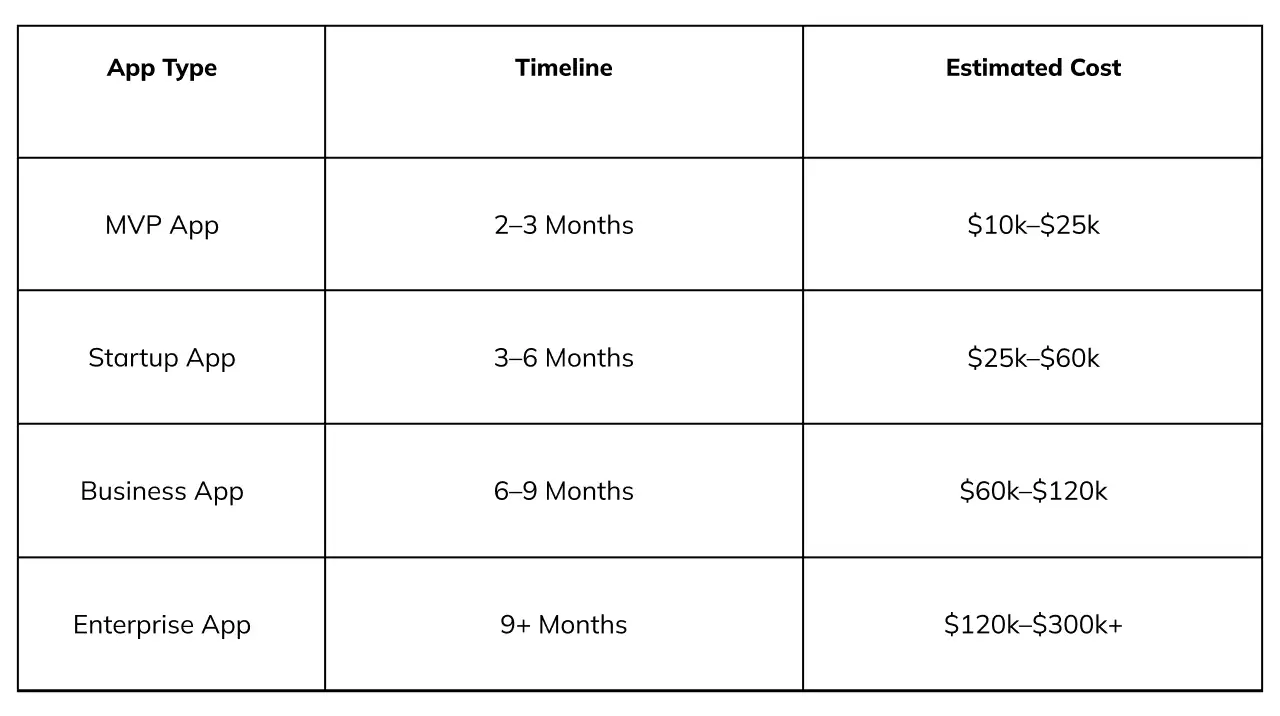
The average iOS app development cost in 2026 falls somewhere between $10,000 and $300,000+ — and yes, that's still a wide range. But unlike the vague guides you've probably already read, here's what actually sits at each price point.
A few things worth noting here:
MVP Apps
These are the simplest versions of your idea. If you’re a startup, this is usually the smartest way to begin. You build only the core features, test the market, and improve later.
Startup & Business Apps
These include more polished UI, better performance, and integrations like payments, APIs, or analytics. This is where most businesses land.
Enterprise Apps
These are complex systems with advanced backend infrastructure, high-level security, and multiple integrations. Naturally, the iOS application development cost here is much higher.
Why does pricing vary so much?
Because every app is different.
The final iPhone app development price depends on:
- Number of features
- Design complexity
- Backend infrastructure
- Third-party integrations
- Development team location
- Type of custom iOS app development services you choose
So instead of focusing only on averages, the smarter approach is to understand what drives the cost—which we’ll cover next.
iOS App Development Cost Calculator Formula
Before you talk to any agency or freelancer, it helps to have a rough number in your head. Whether you're asking for an iPhone app development quote or planning internally, this simple formula gives clarity.
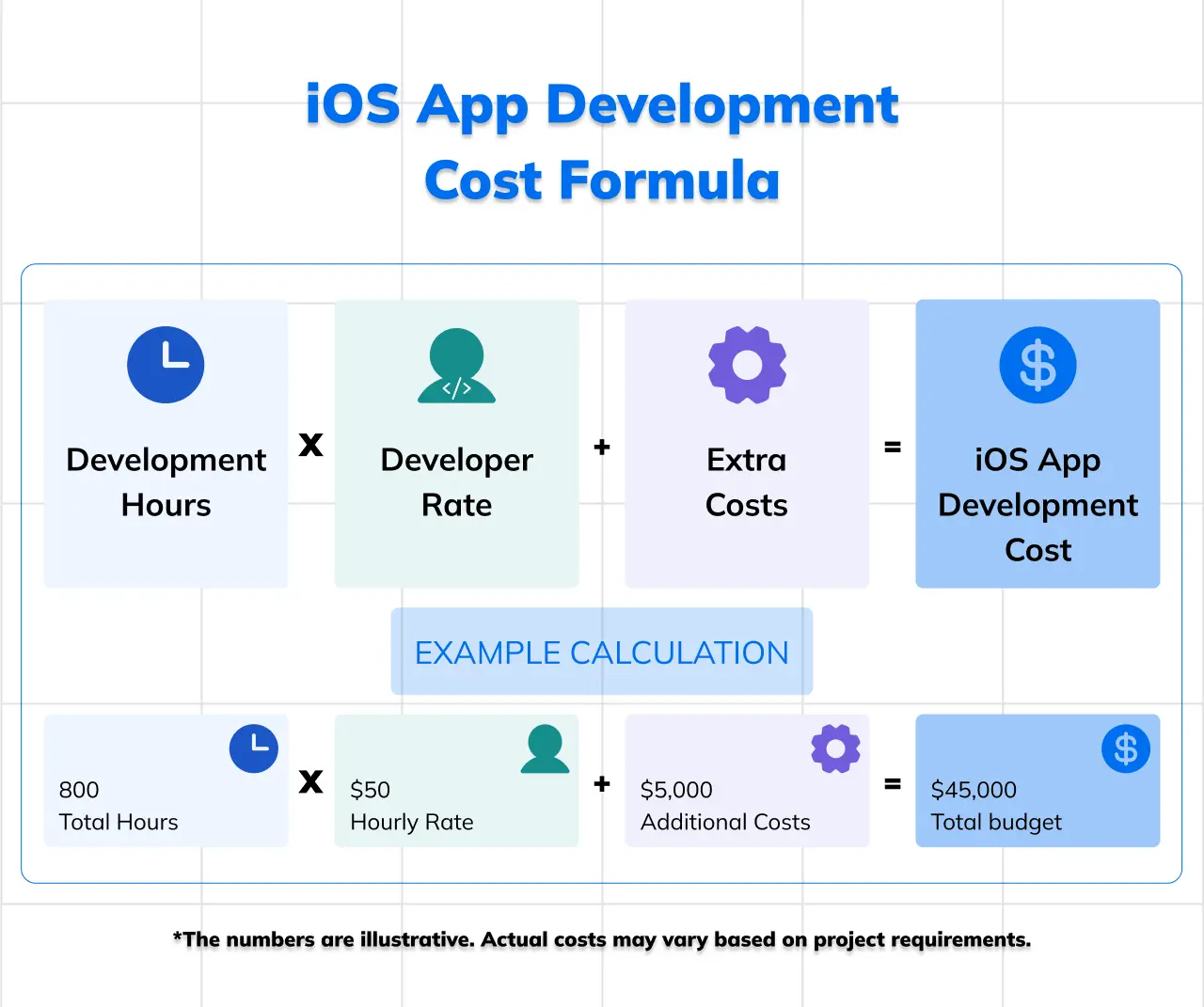
Total Cost = (Development Hours × Hourly Rate) + UI/UX Design + QA & Testing + Deployment + Ongoing Maintenance
Example Breakdown (Realistic Scenario)
Let’s say you’re building a mid-level fitness app:
- 800 development hours × $45/hour (India-based team) = $36,000
- UI/UX Design = $5,000
- QA & Testing = $4,000
- App Store submission & setup = $500
- Maintenance (annual) = ~$6,000
Estimated Total: ~$45,500
This is a fairly typical app development estimate for iOS when you're outsourcing to a cost-efficient region.
What to keep in mind,
More features = more hours = higher cost
Key Factors That Affect iOS App Development Cost
The cost of iOS app development isn’t random—it’s driven by a specific set of variables. Once you understand these, you can control your budget much more effectively.
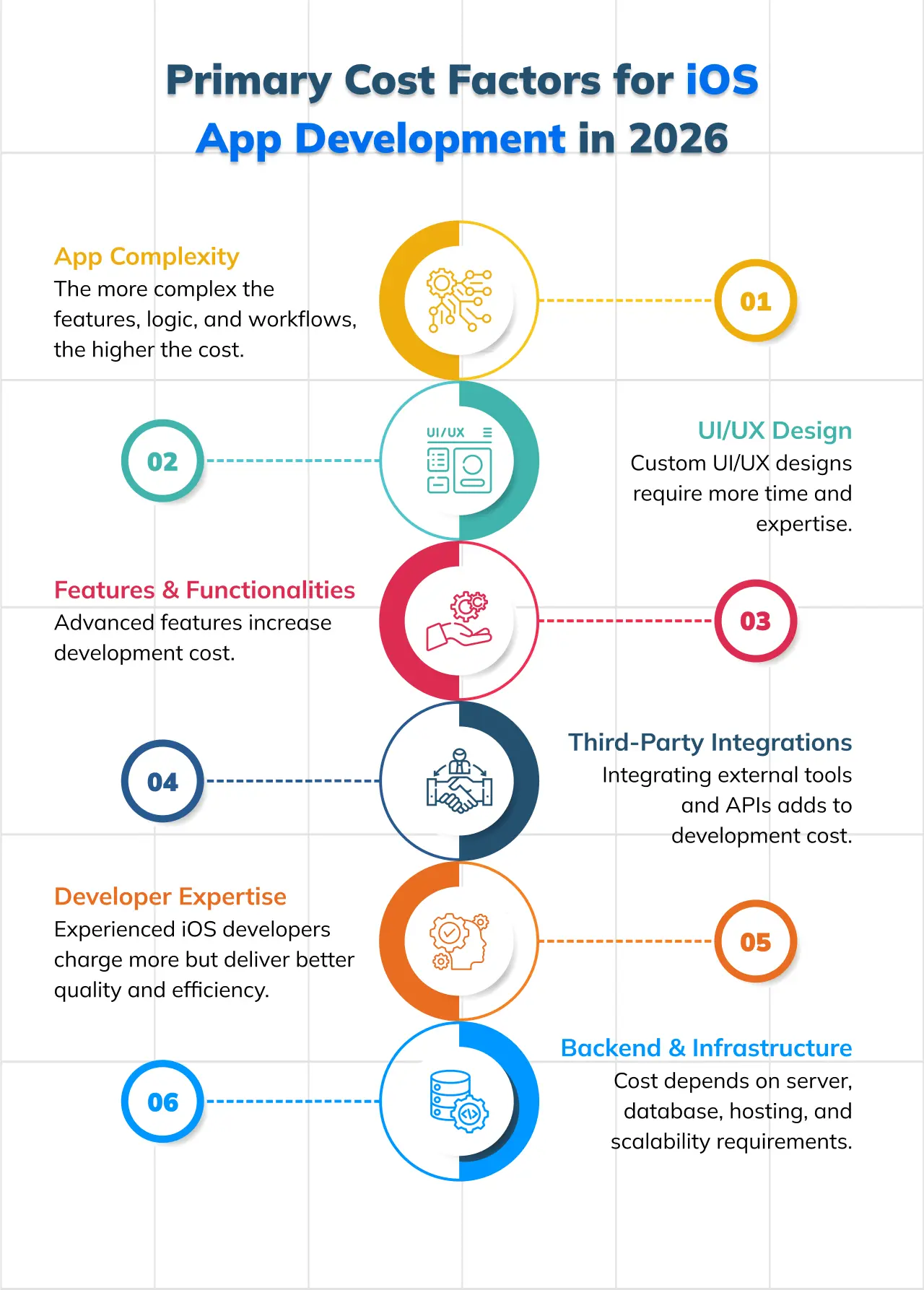
App Complexity
This is the biggest factor in iOS app development costs.
Simple Apps ($10k–$25k)
Basic UI, limited screens, no backend. Think informational apps or simple tools.
Medium Complexity ($25k–$80k)
Includes user accounts, APIs, dynamic content, and integrations.
Complex / Enterprise Apps ($80k–$300k+)
Real-time features, advanced logic, multiple user roles, and possibly AI.
UI/UX Design Quality
Design isn’t just about looks—it directly impacts user retention.
- Basic (template-based): $2,000–$5,000
- Custom design: $5,000–$15,000
- Premium/animated UI: $15,000–$30,000+
Here’s the reality: poor UI is one of the top reasons apps get uninstalled. Saving $3,000 on design might cost you tens of thousands in lost users and revenue later.
Features & Functionalities
Every feature you add increases your iOS mobile app cost.
For example:
- Login system
- Payment integration
- Chat functionality
- GPS tracking
Even in Swift app development, feature complexity is a major cost driver. The next section will break down feature-level costs in detail.
Backend Infrastructure
Your backend determines how your app stores data, scales, and performs.
- Simple backend (like Firebase)
- Faster and cheaper to set up
- Custom backend (Node.js, Django, etc.)
- More control but higher development cost
- Cloud infrastructure (AWS, GCP)
- Adds ongoing operational costs
If your app handles real-time data or large user volumes, backend costs can grow quickly.
Third-Party Integrations
Most modern apps rely on external services and each one adds cost.
Common integrations:
- Payments via Stripe or PayPal
- Maps and location services
- Messaging APIs
- Analytics tools
Each integration requires development, testing, and ongoing maintenance so they’re not “plug-and-play” as often assumed.
Development Team Location
Where your team is based has a huge impact on cost.
A US-based developer might charge $80-$100+/hour, while a skilled developer in India might charge $25–$60/hour. That’s a massive difference—often the single biggest cost lever.
We’ll break this down in detail in the country-wise pricing section.
Maintenance & Updates
Building the app is just the beginning.
Apple releases regular updates to iOS, and your app must stay compatible. On top of that, users expect constant improvements.
Typical iOS app maintenance cost: 15–20% of initial development cost per year
This includes:
- Bug fixes
- Performance improvements
- Feature updates
- OS compatibility
Ignoring maintenance is one of the most common (and costly) mistakes businesses make.
Real iOS App Development Cost Breakdown by App Features
When estimating your custom iOS app development cost, features are where your budget is really decided.
When you sit down with a development agency and go through your feature list, each item on that list gets its own time estimate, its own build complexity, and ultimately its own price tag. Here's what those numbers look like in 2026.
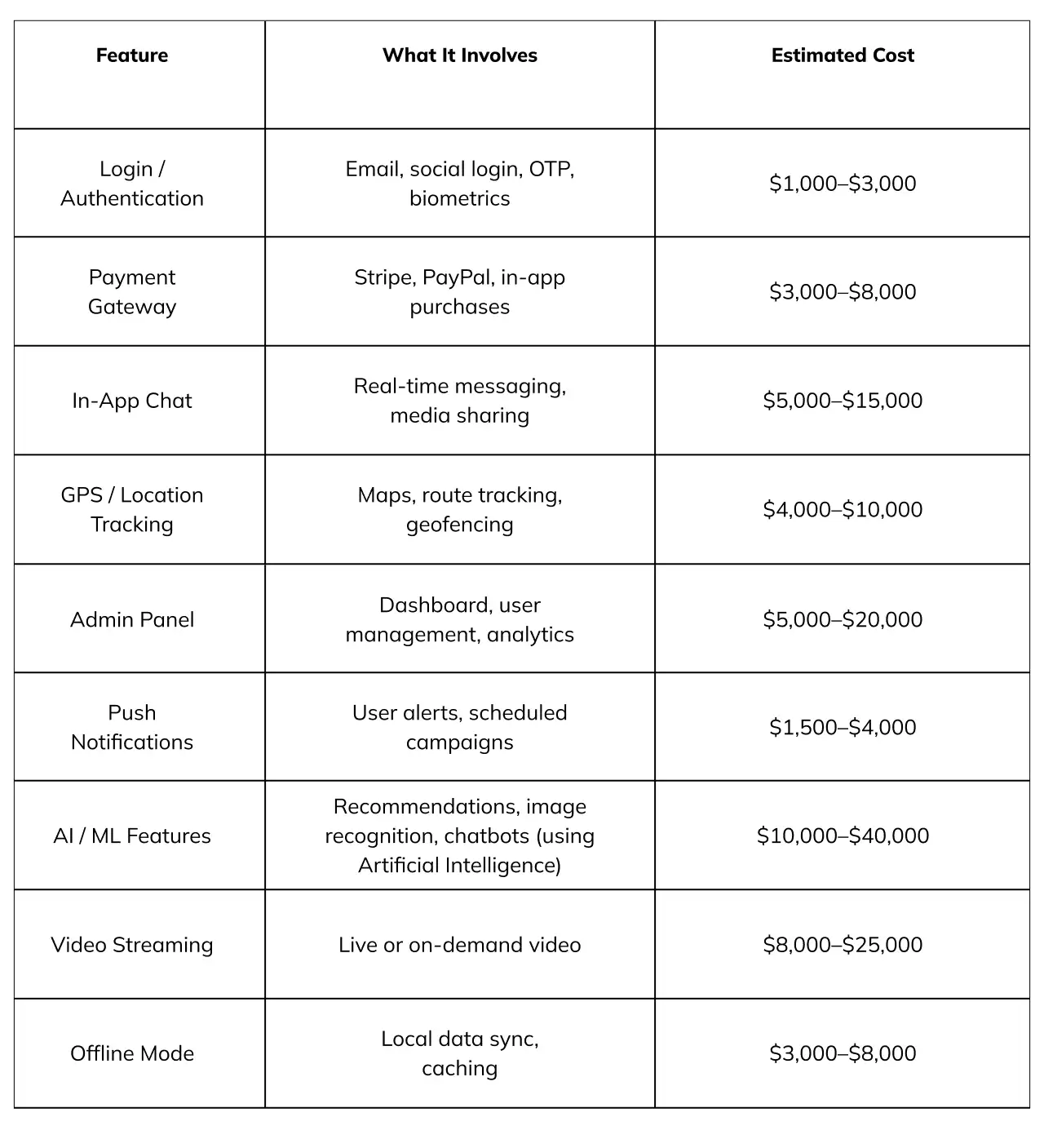
Here's how it happens.
You start with a solid MVP scope — login, a product feed, basic checkout.
Then someone says "can we add chat?" Sure. Then "what about GPS tracking?" Okay. Then "we need an admin panel and push notifications too." And suddenly your $35,000 project is a $90,000 project because each feature adds hours. Every feature also creates dependencies. Adding real-time chat means you now need a more robust backend.
The discipline that saves budgets: Lock your v1 feature list and don't touch it until you're post-launch. Build what validates your core idea. Add everything else based on what users actually ask for.
That’s why many successful apps start small and scale gradually instead of building everything at once.
iOS App Development Cost by Industry-Based Complexity
The cost of an app also depends heavily on the industry you’re building for. Different industries require different levels of security, compliance, and features, which directly affects pricing.
A "medium complexity app" for a fitness startup looks nothing like a "medium complexity app" for a hospital network. All of that affects cost.
Here's what you're actually paying for across six major industries.
Healthcare App
Healthcare apps are among the most complex to build.
- Require strict compliance (like HIPAA)
- Secure patient data handling
- Often include telemedicine or wearable integrations
Estimated Cost: $50,000–$200,000+
Fintech App
When money is involved, security becomes critical.
- End-to-end encryption
- Secure authentication
- Payment integrations
- Fraud detection systems
This is why iOS fintech app pricing is usually higher.
Estimated Cost: $60,000–$250,000+
Ecommerce App
A typical iOS ecommerce app cost depends on features like:
- Product catalog
- Shopping cart
- Payment gateway
- Order tracking
Estimated Cost: $30,000–$150,000
Social Media App
These apps are feature-heavy and require real-time systems.
- User profiles
- News feeds
- Real-time chat
- Media uploads
Estimated Cost: $50,000–$200,000
Education App
EdTech apps are growing fast but vary widely in cost.
- Video streaming
- Learning management systems (LMS)
- Progress tracking
Estimated Cost: $25,000–$120,000
Travel App
Travel apps rely heavily on integrations.
- Booking systems
- GPS and maps
- Third-party APIs
Estimated Cost: $30,000–$150,000
Country-wise iOS Developer Rates in 2026
Here's the simplest way to think about this: the feature list determines your hours. The location of your team determines what those hours cost. The same app can cost 2–3x more depending on where your team is based.
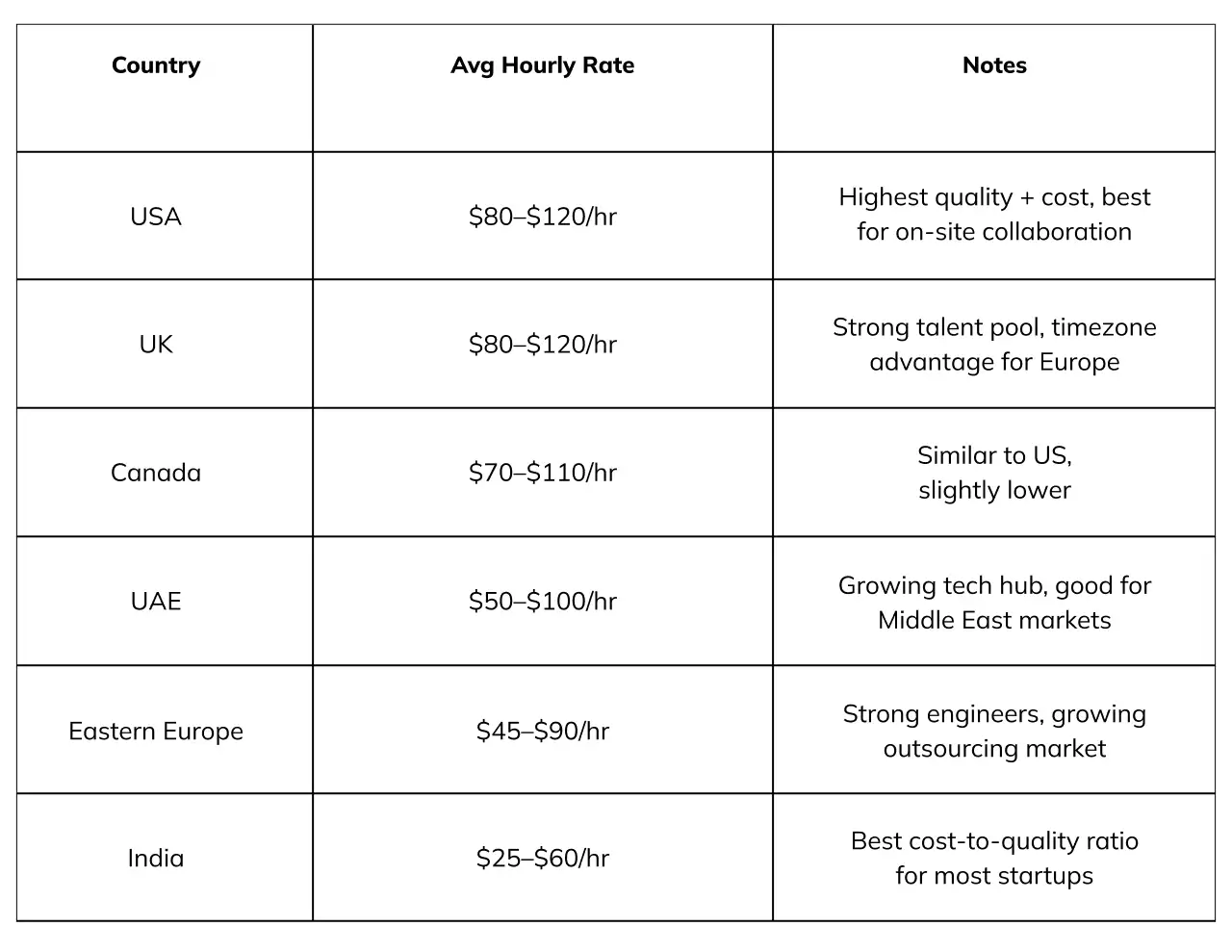
An 800-hour iOS project at US rates ($120/hr) = $96,000 in development cost alone. The same 800 hours with an India-based team ($40/hr) = $32,000.
That's $64,000 saved on the same deliverable — which is why outsourcing to India is the most common cost-reduction strategy serious founders use.
Now, the obvious question: does cheaper mean worse?
Not if you hire right. India has a deep, mature pool of iOS developers who've been building Swift apps for years. The key is vetting properly — check their portfolio, speak to past clients, look at App Store products they've shipped, and make sure they communicate clearly. A well-run India-based iOS team delivers the same output as a Western agency at a fraction of the cost.
If time zone is a concern, many India-based agencies offer overlapping working hours with US and UK clients, with daily standups and async communication built into their workflow. It's a solved problem for experienced teams.
Hidden Costs Nobody Tells You About
You've budgeted for development. You've accounted for design and testing. You think you know your number.
Then reality hits.
Here are the costs that catch most first-time app builders completely off guard and that most agencies conveniently forget to mention during the sales conversation.
- Apple Developer Program:
$99/year You cannot publish anything on the App Store without this. It's not a one-time fee — it's annual. Miss the renewal and your app gets pulled from the store until you pay. Small cost, but worth knowing upfront.
- Third-party API subscriptions
Most APIs that power your app's features — maps, messaging, payments, analytics — have usage-based pricing. It starts cheap or free, then scales with your user base. Google Maps API, Twilio, Stripe transaction fees, SendGrid — these are real ongoing costs that grow as your app grows.
- Cloud hosting
Your backend needs to live somewhere. AWS, Google Cloud, and Azure all charge based on usage — storage, compute, data transfer. A new app might spend $50–$200/month here. A scaled app with heavy traffic can run $2,000–$10,000+/month. Budget for where you're going, not just where you're starting.
- iOS App Maintenance Cost
Apple drops a major iOS update every September. Your app needs to be tested against it, patched for compatibility, and resubmitted. That's a minimum annual maintenance cycle regardless of whether you're adding features.
As mentioned earlier: budget 15–20% of your build cost per year for maintenance. It's not optional if you want to stay live and functional.
- OS version compatibility patches
Separate from standard maintenance when Apple deprecates old APIs or changes system behaviour, specific parts of your app may need to be rebuilt. This is rarer but real, and it can be expensive when it happens.
- Marketing and launch budget
This one is the most commonly forgotten. You spent $60,000 building a beautiful app. You allocated $0 to tell anyone it exists. Downloads = 47. A realistic launch budget includes App Store Optimization (ASO), paid acquisition, PR outreach, and possibly influencer or content marketing.
- Analytics tools
Understanding how users actually use your app where they drop off, which features they ignore, what drives retention requires proper analytics. Tools like Mixpanel, Amplitude, or even advanced Firebase Analytics have free tiers, but meaningful scale costs $200–$2,000+/month depending on event volume.
- Legal, privacy policy, T&Cs, GDPR compliance
Apple requires a privacy policy to publish on the App Store. If you're targeting EU users, GDPR compliance isn't optional. Getting this done properly by a lawyer costs $500–$3,000 depending on complexity.
How to Reduce iOS App Development Cost by 40%
Good news: there's a real, proven playbook for cutting iOS app costs significantly — without cutting corners on quality. Here's what actually works.
1. Build an MVP first, not the full product
This is the highest-impact decision you can make. An MVP (Minimum Viable Product) strips your idea down to its 3–5 core features and gets it in front of real users as fast as possible.
You spend $15,000–$30,000 instead of $100,000, and you find out within 60–90 days whether users actually want what you're building. If they do, you build on validated ground. If they don't, you haven't lost your entire budget on a product nobody uses.
2. Explore cross-platform frameworks where they make sense
If your app doesn't need deep iOS-native features like ARKit, Face ID hardware access, or custom Apple Watch integration, then building with React Native or Flutter can reduce development cost by 30–40% because you're writing one codebase that runs on both iOS and Android instead of two separate native apps.
3. Outsource to the right team in the right location
As the rate table above shows, working with a reliable India-based iOS team can cut your per-hour cost by 60–70% compared to US rates. The key word is reliable — vet portfolios, check references, and look at live App Store products they've shipped. Done right, this single decision saves more money than any other strategy on this list.
4. Prioritise features ruthlessly before a single line of code is written
Most cost overruns don't happen because development is slow. They happen because the feature list keeps growing after the project starts. Scope creep is expensive — retrofitting features mid-development costs 3–5x more than planning them upfront.
Before you sign any contract, categorise every feature as Must Have, Should Have, or Nice to Have. Only the first category goes into v1. Everything else is a future sprint, funded by your early revenue or next funding round.
5. Work in Agile sprints
Agile development breaks your project into 2-week cycles with working software delivered at the end of each one. This means problems get caught early — in sprint 2 — rather than discovered at launch. A bug found in sprint 2 costs a fraction of what it costs to fix post-launch. Agile also gives you natural checkpoints to reprioritise features if your budget needs to flex.
6. Use reusable components and pre-built modules
Experienced iOS agencies have libraries of pre-built, tested components — authentication systems, payment flows, notification handlers, user profile structures. Using these instead of building from scratch cuts development hours significantly on standard features.
Ask any agency you're evaluating: "What pre-built modules do you use, and how does that affect my timeline and cost?" The answer tells you a lot about how efficient their development process actually is.
iOS vs Android App Development Cost & Comparison (2026)
If you’re deciding between platforms, understanding the cost of developing a mobile app for iOS vs Android is essential. At a glance, both seem similar—but in practice, there are key differences that affect time, budget, and complexity.
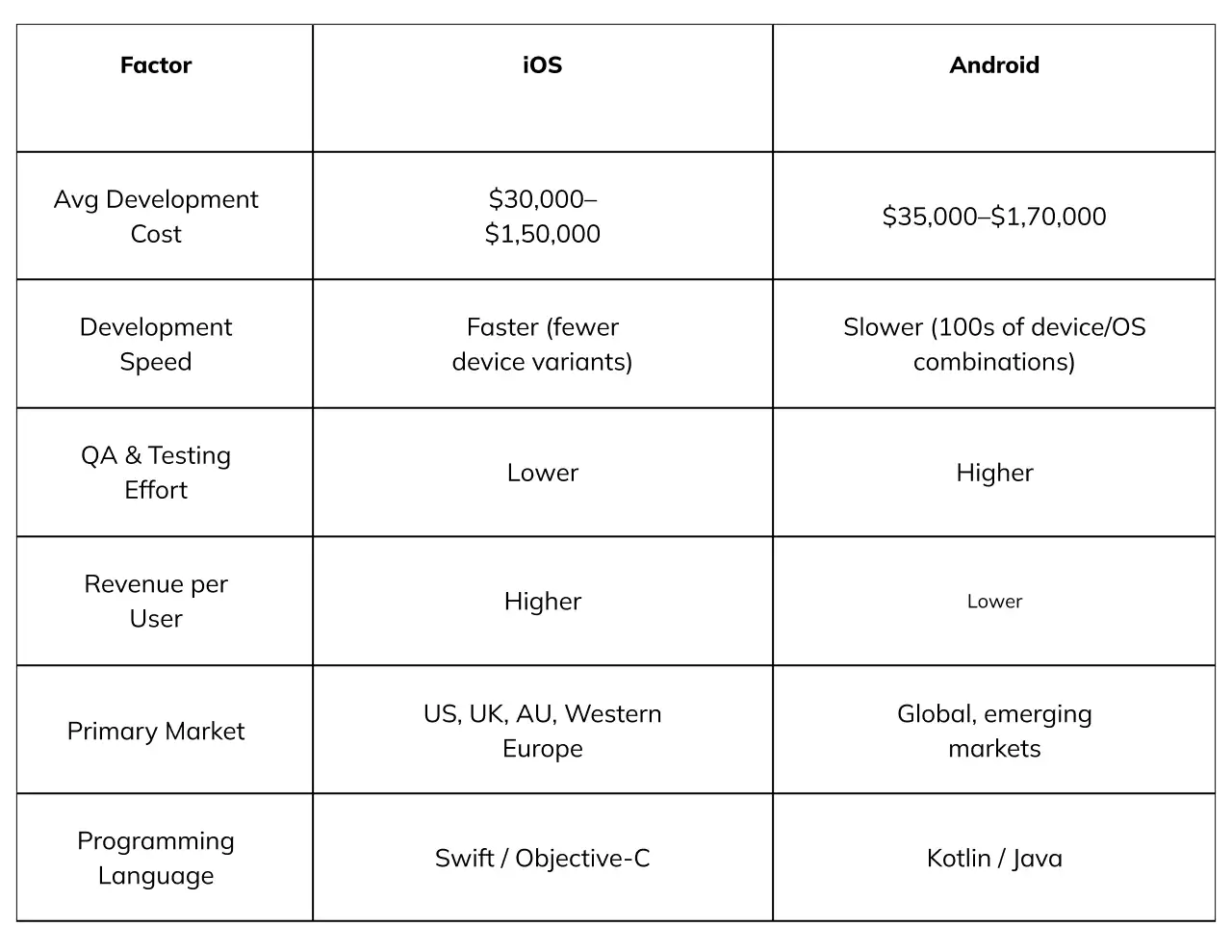
If your priority is speed, quality, and ROI, iOS is often the better starting point. Android becomes important when you want to scale globally across diverse markets.
Why Businesses Still Invest in iOS in 2026
Despite Android’s larger global market share, businesses continue to prioritize iOS—and for good reason.
1. Premium User Base
iOS users are more likely to spend on apps, subscriptions, and in-app purchases. This directly impacts your revenue potential and justifies higher native iOS app development pricing.
2. Higher ROI
Even if the initial investment is similar, iOS apps often generate better returns due to:
- Higher conversion rates
- Better engagement
- Stronger monetization
3. Strong Ecosystem by Apple Inc.
Apple’s ecosystem is tightly integrated devices, software, and services all work seamlessly. This consistency makes development smoother and user experience better.
4. Better Security
iOS is known for stricter app review policies and strong data protection standards. This builds trust with users especially important for fintech, healthcare, and enterprise apps.
5. High Retention Rates
iOS users tend to stay loyal to apps longer. Better UI standards and performance expectations lead to higher retention and lifetime value.
6. Strong US & Western Market Penetration
If your target audience includes the US, UK, or other high-income markets, iOS is often the dominant platform. That’s where most premium customers are.
Why Choose CodeAegis for iOS App Development?
Choosing the right development partner matters just as much as the iOS app development cost itself. With so many options offering iOS app development services, what really makes the difference is how transparently and efficiently your project is handled.
At CodeAegis, the focus is simple: help you build the right app, without wasting time or budget.
Transparent pricing
No hidden charges or surprise invoices. You get clear, fixed-scope or milestone-based pricing so you always know where your money is going.
Experienced iOS team
A team that has delivered apps across industries like fintech, ecommerce, and healthcare—so you’re not starting from scratch.
NDA & full IP ownership
Your idea stays yours. From day one, you retain complete ownership of the code and product.
Agile delivery process
Work is broken into bi-weekly sprints, so you can track progress, give feedback, and stay in control throughout the project.
Post-launch support
Every project includes a 90-day bug-fix warranty, with options for ongoing support and upgrades.
Real-world impact
CodeAegis recently built a fintech MVP within a ~$45k budget that successfully onboarded over 10,000 users in just 60 days—proving that the right execution matters more than just spending more.
Frequently Asked Questions
1- How much does it cost to build an iOS app in 2026?
The iOS app development cost usually ranges from $10,000 to $300,000+. Simple apps cost less, while complex apps with advanced features cost significantly more.
2- How long does iOS app development take?
Most iOS apps take between 2 to 9+ months. MVPs are faster to build, while feature-rich apps require more time for development and testing.
3- Is iOS app development more expensive than Android?
Not necessarily. iOS apps are often quicker to build due to fewer devices, while Android may cost more because of higher testing and fragmentation.
4- Can I build an MVP under $20,000?
Yes, a basic MVP can be built within $10k–$20k. You’ll need to focus only on core features and avoid unnecessary complexity.
5- What is the yearly maintenance cost?
The iOS app maintenance cost is typically 15–25% of the initial development cost. It covers updates, bug fixes, and performance improvements.
6- What factors affect iOS app development cost?
Key factors include app complexity, features, design, backend, and developer location. Each of these directly impacts the overall budget.
7- How can I reduce iOS app development cost without affecting quality?
Start with an MVP and focus only on core features. Use experienced but cost-effective teams and follow an agile approach. Avoid overbuilding in the initial version.
8- Is it better to build a native iOS app or use cross-platform development?
Native apps offer better performance and user experience. Cross-platform options can reduce cost and time if you’re targeting both iOS and Android. The choice depends on your budget and long-term goals.
9- Do I need to pay separately for app design and development?
In most cases, yes. UI/UX design is usually a separate cost from development. However, some agencies bundle it into a complete package.
10- How much does it cost to update an existing iOS app?
Costs vary based on the scope of updates. Minor updates may cost a few thousand dollars, while major upgrades can be much higher. Regular updates are essential to keep the app competitive.

Sakshi Aggarwal is the Co-CEO of CodeAegis, a visionary leader with 12+ years of experience in transforming complex business requirements into high-impact technology solutions across industries. Her core contribution lies in architecting the company's customer-centric service delivery model and optimizing cross-functional execution. She has become a driving force for ensuring project success and cultivating a culture of accountability across the software development life cycle.