

How to Develop an NFT Marketplace: A Complete Guide for Entrepreneurs & Businesses
Table of Contents
What is NFT Marketplace Development?
Why Businesses Should Invest in NFT Marketplace
Types of NFT Marketplace Platforms You Can Build
Essential Features of NFT Marketplace Development
Step-by-Step Process to Develop an NFT Marketplace
Best Blockchain Networks for NFT Marketplace Development
NFT Marketplace Development Cost Breakdown
How to Choose the Right NFT Marketplace Development Company
Why Choose CodeAegis as Your NFT Marketplace Development Partner
Case Study: Multi-Chain NFT Marketplace for a Gaming Startup
Future Trends in NFT Marketplace Development
Conclusion
Frequently Asked Questions
 Add us as a preferred source on Google
Table of Content
+How to Develop an NFT Marketplace | Complete Business Guide
The NFT market is growing faster than most people realize. Global NFT transaction volume is projected to reach $3.2 billion by 2026, with enterprise adoption accelerating across gaming, art, real estate, and creator economies. NFT marketplace development started as speculation and has evolved into real infrastructure.
If you're considering an NFT marketplace development company, you need three foundational things. First, the right blockchain architecture for your user base. Second, battle-tested smart contracts that have survived security audits. Third, a team that understands both the technology and the market dynamics that drive actual adoption.
This guide walks you through exactly what launching a successful NFT marketplace development solution looks like, from initial planning through scaling to profitability.
What is NFT Marketplace Development?
An NFT marketplace operates as a decentralized or semi-centralized platform which enables users to create non-fungible tokens and conduct buying and selling and trading activities. The platform functions as an eBay marketplace which uses blockchain technology to replace physical item storage with permanent ownership document storage on an unchangeable digital record system.
How it works:
- The process begins when users connect their cryptocurrency wallets to the system
- Creators mint NFTs (convert digital assets into blockchain tokens)
- Buyers place bids or purchase at fixed prices
- Smart contracts handle escrow, royalties, and fund transfers
- All transactions are recorded on-chain, creating permanent proof of ownership
Real-world examples:
- OpenSea operates as the largest multi-chain NFT marketplace which supports Ethereum and Polygon and Solana and other blockchains
- Rarible functions as a platform dedicated to creators which offers governance tokens for its users
- Magic Eden operates as the primary NFT marketplace for Solana which specializes in fast transactions and low-cost services
- Foundation operates an art-specific marketplace which requires creators to undergo a verification process
Why Businesses Should Invest in NFT Marketplace Development in 2026
1. Creator monetization is shifting
Creators are tired of platforms taking 30% cuts. NFT marketplaces give them programmable royalties which enable them to earn a percentage every time their work gets resold. Musicians, artists and game developers currently use this business model.
2. Digital asset economy is maturing
People have established ownership rights for digital items which now exists as a standard practice. Gaming companies are launching in-game NFT marketplaces. Fashion brands are creating limited-edition digital collectibles. Real estate platforms are tokenizing property ownership.
3. Brand loyalty programs need innovation
Traditional loyalty points fail to create any lasting impression. NFT-based rewards are tradeable, verifiable, and actually have perceived value. Brands using NFT rewards see 40% higher engagement rates than traditional programs.
4. Gaming and metaverse demand is real
The gaming NFT segment is expected to exceed $2.1B by 2026, making it one of the strongest commercial opportunities for NFT platforms. Players want to own their assets which they want to trade between different games while they play the game. NFT marketplaces exist to meet this requirement.
5. Revenue opportunities are substantial
Marketplace operators take transaction fees (typically 2-5%), membership fees, and premium listing fees. High-volume marketplaces generate 6-7 figure monthly revenues.
6. Competitive advantage matters now
Every major industry like fashion, sports, music, real estate is experimenting with NFTs. If your competitor launches first, they own the market narrative in your vertical.
Types of NFT Marketplace Platforms You Can Build
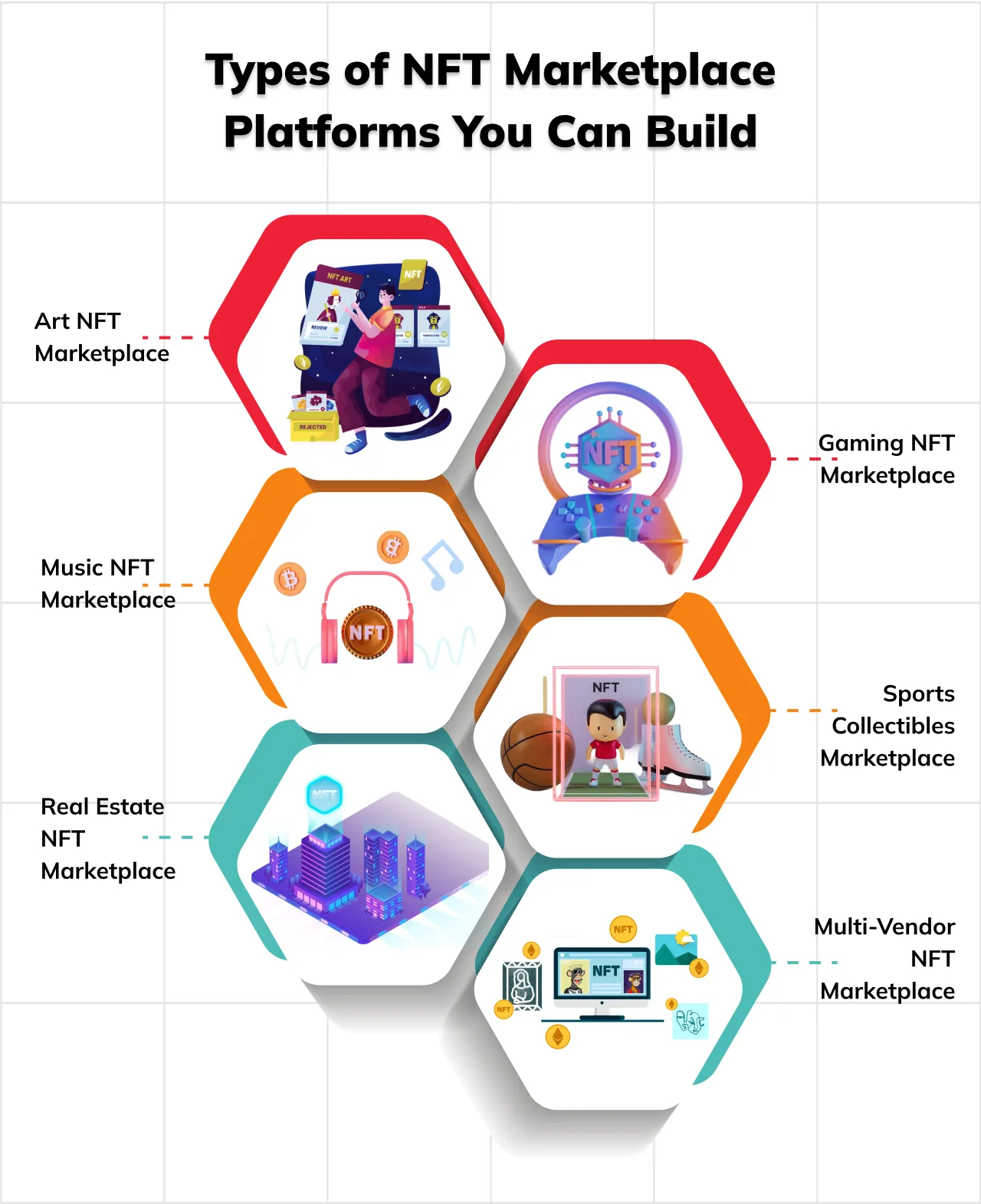
Art NFT Marketplace
For digital artists, photographers, and illustrators. Features: portfolio display, artist verification, auction mechanics, social proof (followers, likes). Examples: Foundation, SuperRare.
Gaming NFT Marketplace
For in-game assets, weapons, skins, characters. Requires: inventory management, rarity systems, cross-game integration. Examples: OpenSea Gaming, Magic Eden.
Music NFT Marketplace
For music NFTs, albums, royalty shares. Features: streaming integration, split payments, artist analytics. Examples: Royal, Sound.xyz.
Sports Collectibles Marketplace
For athlete cards, moments, memorabilia. Requires: authentication, rarity tiers, licensing compliance. Examples: NBA Top Shot (Flow), Sorare.
Real Estate NFT Marketplace
For tokenized property, land, virtual real estate. Features: deed verification, fractional ownership, legal compliance. Examples: Propy, Unreal Estate.
Multi-Vendor NFT Marketplace
Open to all creators and asset types. Most complex. Requires: robust moderation, diverse asset support, liquidity pools. Example: OpenSea.
Essential Features of NFT Marketplace Development Solutions
A. User-Facing Features
When you develop an NFT marketplace, users expect certain features as standard. Here's what drives adoption and retention:
User Registration and Profiles
- Email login, social authentication, and KYC verification depending on jurisdiction
- Profile customization capabilities with custom bios and social links
- Follow and unfollow functionality for community building
- Verification badges that distinguish authentic creators from impersonators
- Activity feeds showing user history and purchases
Wallet Integration
- MetaMask, WalletConnect, and Phantom wallet support at minimum
- Multi-wallet compatibility ensures users aren't forced into choosing between wallets
- Hardware wallet support serves security-conscious users
- Balance display functionality helps users understand their current assets and available funds
- Real-time token price displays
NFT Minting Capabilities
- Lazy minting defers blockchain costs until someone purchases an NFT, lowering creator barriers
- Batch minting lets creators launch collections with hundreds of items simultaneously
- Custom metadata allows creators to define royalty rates, specific properties, and asset descriptions
- Collection creation turns individual NFTs into coherent themed groups
- Bulk upload functionality for large collections
Search and Discovery
Advanced filters narrowing by price range, rarity scores, blockchain network, and creator
Trending collections that surface what's actually gaining traction
Recommendations algorithm similar to Netflix suggesting NFTs based on user behavior
Full-text search making finding specific items possible
Category browsing for different asset types
Auction and Bidding Mechanics
- Fixed-price sales let creators set a price and sell immediately to the first buyer
- Dutch auctions that start at high prices and descend until someone purchases
- English auctions letting multiple bidders compete with prices rising
- Timed auctions restricting bidding to specific windows
- Offer systems letting potential buyers propose lower prices for consideration
Payment Infrastructure
- Multiple blockchain payment options accepting Ethereum, Solana, and Polygon tokens
- Stablecoin support using USDC and USDT to reduce volatility stress
- Native token payments letting platforms launch their own cryptocurrency
- Fiat on-ramps converting regular currency to crypto for users unfamiliar with crypto
- Instant payment confirmation systems
B. Admin and Operations Features
Behind every marketplace, admin features run the actual business and keep operations running smoothly.
Admin Dashboard
- Real-time analytics showing transaction volumes, user growth, and marketplace health
- Revenue tracking and commission calculations
- Traffic analytics and user behavior patterns
- Marketplace performance metrics and KPIs
User Management Tools
- Account creation and verification workflows
- Account suspension and dispute resolution
- Fraud detection and account restriction capabilities
- User communication and notification systems
Collection Moderation
- Listing approval workflows determining which assets appear
- Creator verification processes
- Content filtering and inappropriate asset removal
- Fraud prevention and duplicate detection
Commission and Fee Settings
- Adjustable transaction fees by collection or creator type
- Royalty percentage configuration
- Payment routing automation to correct recipients
- Revenue split calculations
Fraud Monitoring and Prevention
- Wash trading detection where users artificially inflate volumes
- Suspicious activity alerts and pattern recognition
- Report mechanisms for user complaints
- Blacklist management for bad actors
Analytics Engine
- Sales volume trends and historical analysis
- User acquisition costs and retention metrics
- Collection performance tracking
- Blockchain gas analytics and cost optimization
Step-by-Step Process to Develop an NFT Marketplace
Step 1: Define Your Business Model
Defining your complete business model before a single line of code is written for NFT marketplace development is very necessary. What can you ask yourself concretely?
- Are you planning any kind of transaction fee on individuals all through the sale, and if so, what percentage?
- Can premium listings add extra revenue for creators?
- Can membership fees for the creator accounts help at all, do they even stand a fair bit in the market?
- Are partnerships or sponsorships of businesses meant to generate money for you in your revenue strategy?
- How do you balance the cost of acquiring the user with their lifetime value?
Have the answers for these so that some features that nobody will pay for are not built and opportunities for revenue are not completely overlooked.
Step 2: Choose Your Niche and Target Users
Ask yourself who, exactly, your target users are, knowing that almost every technical point made later depends on such people. Are these users collectors who will buy and hold it for long periods. At the end of the day, will they love the attributes that you want to offer to them. Or they simply do not actually care or find it useful?
Step 3: Consider Scale Ambitions and Geography
Your scale ambitions matter during architecture design. Are you launching regionally first, planning to expand later? You will target global users from your first operational day. Your choice between two infrastructure options depends on your user base size requirements.
Geographic considerations include:
The regulatory environment exhibits major differences across various jurisdictions. Some regions welcome crypto businesses while others restrict them. Some locations do not support fiat on-ramps. KYC requirements differ substantially. The tax treatment of NFTs differs between countries.
Step 4: Select Blockchain Network
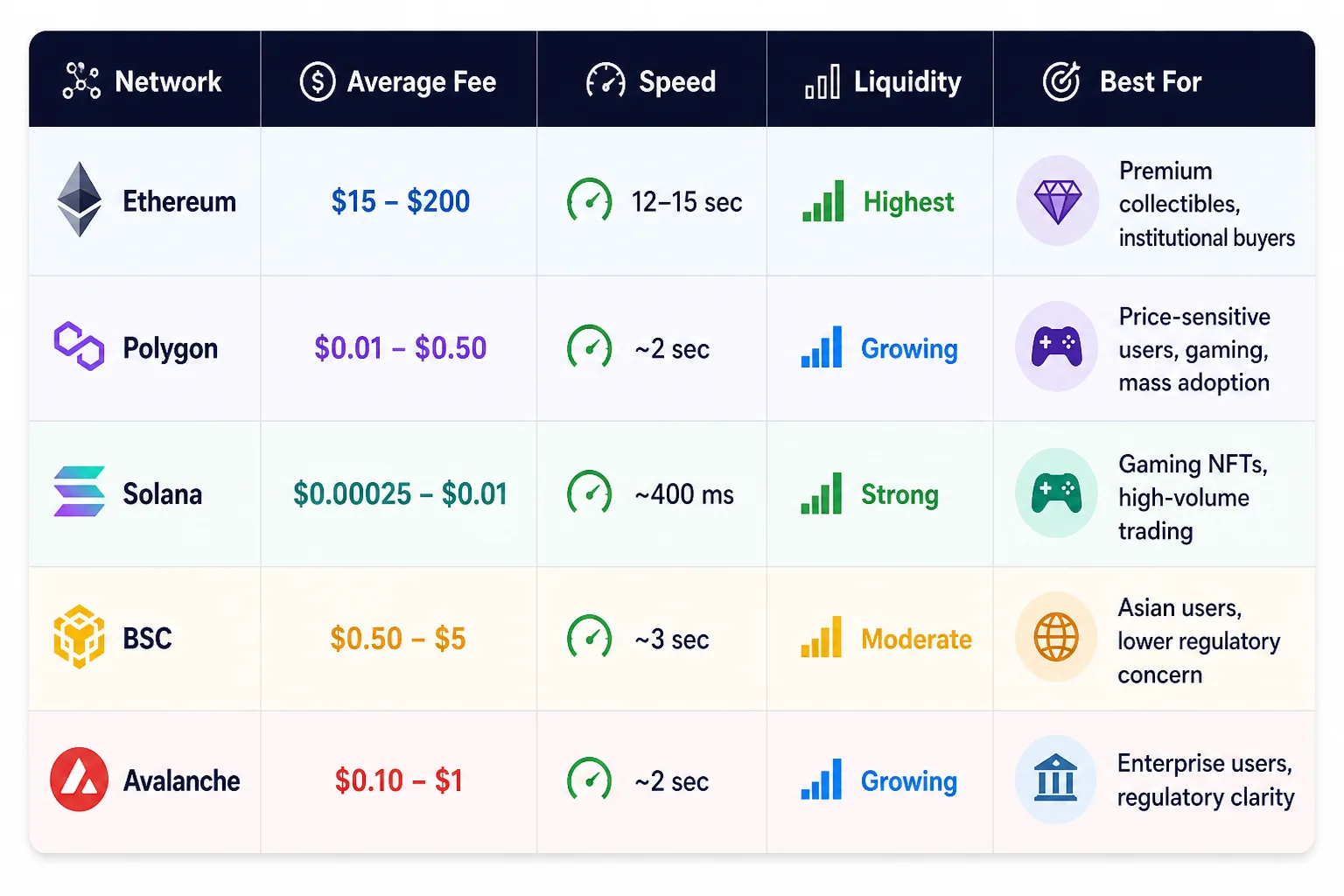
The selection of a blockchain system determines both transaction expenses and the stage of development for its operational framework. The following major networks exhibit distinct operational characteristics:
Choose blockchain based on your actual users, not marketing hype. Ethereum's 50-dollar gas fees destroy your business model because your price-sensitive collectors buy 50-dollar artworks. Your target audience should be institutional buyers who value Ethereum's liquidity and regulatory clarity over transaction expenses.
Step 5: Design User Interface and Experience
UI and UX design determines whether users actually use your platform or abandon it immediately. Critical design work includes:
Hire designers with blockchain product experience. They understand wallet flows and crypto UX patterns in ways traditional designers don't.
Step 6: Develop Smart Contracts
Smart contract development is where security actually matters because bugs mean stolen funds. Most NFT marketplace development requires standard contracts:
Standard Smart Contracts Needed:
- ERC-721 tokens representing individual unique NFTs
- ERC-1155 tokens handling batch minting and fungible combinations
- Marketplace contract handling buying, selling, and royalty distributions
- Auction contract managing timed bidding mechanics
- Payment splitter contract routing fees and royalties to correct recipients automatically
Step 7: Build Backend and Frontend
Backend and frontend development happens simultaneously. Production-ready development realistically takes 3 to 6 months. This includes architecture design, coding, testing, and optimization.
Here's what each layer requires:
Backend Infrastructure
- REST APIs for marketplace operations and data retrieval
- Indexing service for fast search and filtering
- Wallet interaction middleware managing user authentication
- Payment processing and transaction routing
- Off-chain database storing user data and listings
Frontend Development
- React or Next.js for responsive interfaces
- WebSockets for real-time updates
- Wallet provider integration for authentication
- Image optimization for NFT thumbnails
- Analytics tracking and user behavior monitoring
Step 8: Testing and Security Audits
Testing and security auditing happens before launch and is non-negotiable. Run testnet for a minimum of 2 weeks. Real users will find bugs you missed in testing labs.
Best Blockchain Networks for NFT Marketplace Development
Choosing the right blockchain network is one of your most important technical decisions. Each network offers different tradeoffs around cost, speed, liquidity, and ecosystem maturity. Here's how major networks compare:
Multi-Chain Strategy
Most serious marketplaces now support 3 to 5 chains simultaneously. This requires bridge infrastructure but captures liquidity across different ecosystems. Users can trade the same NFTs on different chains, maximizing your total addressable market.
Blockchain Selection Based on User Type
- Art collectors prefer Ethereum for highest liquidity and security
- Price-sensitive creators prefer Polygon or Solana for affordable minting
- Gaming communities prefer Solana for speed and low fees
- Enterprise customers prefer Ethereum for regulatory clarity and institutional adoption
- Asian markets respond better to Binance Smart Chain
NFT Marketplace Development Cost Breakdown
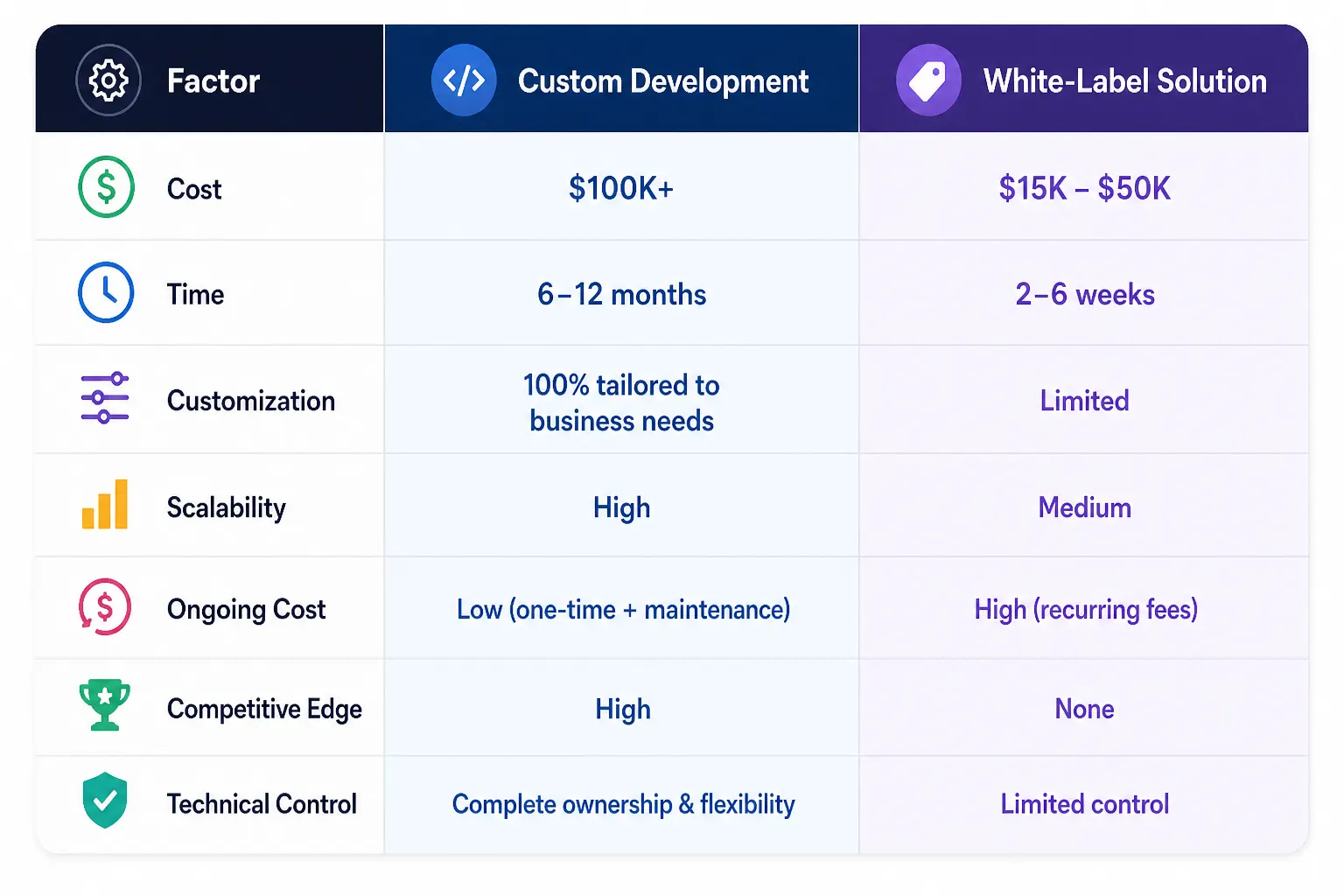
Costs vary wildly based on complexity, but here's realistic pricing. Your actual costs depend on feature complexity, blockchain selection, custom design requirements, smart contract sophistication, and security audit scope.
You have two fundamental paths: custom development building exactly what you need, or white-label solutions that are ready to launch immediately.
How to Choose the Right NFT Marketplace Development Company
Selecting the right partner determines your project's success or failure. Here's what to evaluate:
Red Flags to Avoid Completely
- "We can build it for 5,000 dollars" indicates either lies or terrible quality
- No security audit experience means they don't understand risk
- Portfolio limited to basic websites not blockchain projects
- Vague about blockchain expertise and smart contract knowledge
- No post-launch support commitment leaving you stranded
Green Flags Indicating Quality
- Blockchain Expertise: Developers who've built and audited smart contracts, not just integrated APIs. Ask for specific project examples.
- Portfolio Quality: Show previous NFT and blockchain projects. References from past clients you can actually call.
- Security-First Approach: Detailed conversations about audits, testing, and threat modeling before discussing code.
- Transparent Pricing: Clear cost breakdown with no hidden fees. Fixed price contracts preferred over time-and-materials.
- Scalability Experience: Have they handled growth? Do they understand infrastructure for millions of users?
- Post-Launch Support: Who maintains it after launch? What's the SLA (service level agreement)?
- Clear Communication: You understand their technical decisions, not just trusting blindly.
Why Choose CodeAegis as Your NFT Marketplace Development Partner
CodeAegis brings end-to-end blockchain expertise that most agencies simply don't possess. Our approach to NFT marketplace development company services differs fundamentally from generic software shops.
Blockchain Development Services
We don't just integrate APIs. Our team designs and audits smart contracts from scratch. We've built tokenomics models, implemented complex auction mechanisms, and handled multi-chain deployments. Our Blockchain Development Services include custom protocol design, not just implementation of existing standards.
Custom NFT Marketplace Solutions
Every marketplace we build gets tailored to your business model, not a cookie-cutter clone. Whether you're building gaming NFT marketplace solutions, art platforms, real estate tokenization, or music royalty systems, we understand the nuances each vertical requires.
Previous projects include:
- Gaming NFT marketplaces handling in-game asset trading
- Art platforms with creator verification and authentication
- Real estate tokenization with legal deed integration
- Music NFT platforms with automated royalty splits
Experienced Development Team
Our team includes specialists in every required area. We build for growth. Marketplaces we've launched handle millions in transaction volume. Our infrastructure scales automatically as liquidity increases. We use proven patterns from platforms processing billions in transactions.
Maintenance and Support
Launch isn't the end. We provide:
- 24/7 monitoring and uptime alerts
- Smart contract upgrades when needed
- Performance optimization as volume grows
- Security patches and vulnerability fixes
- Analytics and reporting dashboards
Security as Standard
Our clients have processed over a million dollars in NFT transactions without a single smart contract breach. All our NFT marketplace development includes:
- Formal code audits with top-tier security firms
- Automated vulnerability scanning
- Regular penetration testing
- Compliance review for your jurisdiction
- Incident response planning
Case Study: Multi-Chain NFT Marketplace for a Gaming Startup
Overview
A fast-scaling gaming startup approached CodeAegis to build a multi-chain NFT marketplace capable of handling in-game asset trading across ecosystems. The objective was to enable seamless minting, trading, and interoperability of NFTs across different blockchain networks while maintaining low latency and strong security guarantees.
Timeline
Week 1–2: Requirement analysis, architecture planning, and tokenomics design
Week 3–6: Smart contract development (minting, auctions, royalties)
Week 7–10: Marketplace backend + frontend development
Week 11–12: Multi-chain integration (bridges + wallet support)
Week 13–14: Security audits, testing, and deployment
Total Delivery Time: ~14 weeks
Technology Stack
Blockchain Layer:
Ethereum
Polygon
Binance Smart Chain
Smart Contracts:
Solidity
Open standards: ERC-721, ERC-1155
Backend & Infrastructure:
Node.js
IPFS
Cloud-based microservices architecture
Frontend:
React
Web3 wallet integrations (MetaMask, WalletConnect)
Key Challenges
Cross-Chain Interoperability
Ensuring NFTs could move seamlessly across chains without duplication or loss required robust bridge logic and validation mechanisms.
Gas Fee Optimization
Balancing user experience with cost efficiency, especially on high-fee networks like Ethereum.
Scalability Under Load
The platform needed to handle spikes from gaming events, drops, and tournaments without performance degradation.
Security Risks
Smart contracts and cross-chain bridges are prime attack vectors, requiring rigorous audits and fail-safe mechanisms.
Solutions Implemented
Built custom cross-chain bridge contracts with verification layers
Integrated lazy minting to reduce upfront gas costs
Designed modular microservices architecture for horizontal scaling
Conducted multi-stage audits and implemented upgradeable contracts
Results
Processed $12M+ in NFT transactions within the first 8 months
20,000+ registered users within 90 days
99.98% uptime post-launch
Increased in-game asset liquidity by over 70%
Takeaway
This project demonstrates how a properly architected multi-chain NFT marketplace can move beyond collectibles into high-frequency, utility-driven ecosystems like gaming. The combination of scalability, interoperability, and secure smart contract design was critical to achieving sustained transaction volume and user growth.
Future Trends in NFT Marketplace Development
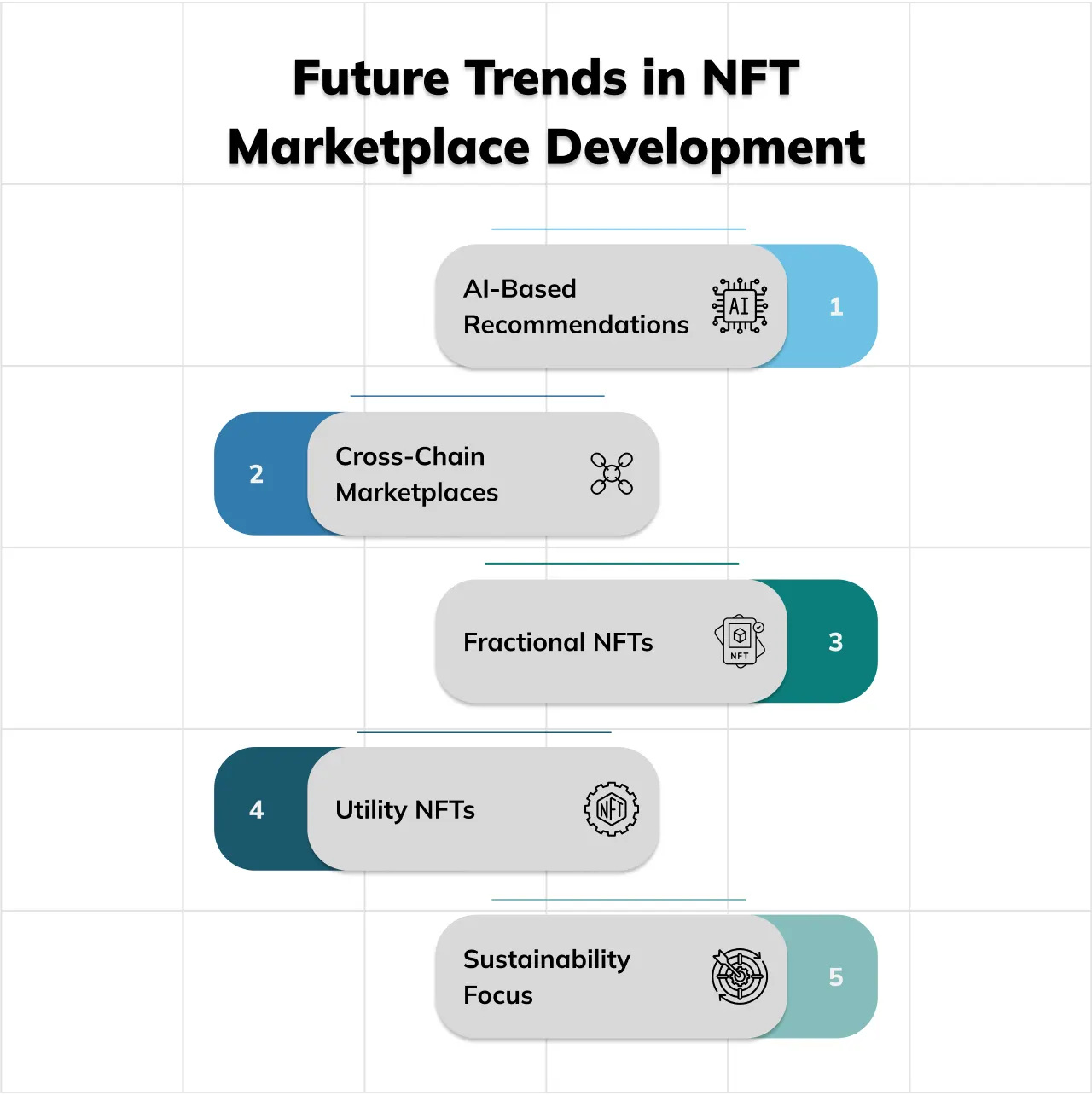
The NFT marketplace landscape continues evolving rapidly. Understanding where the market is heading helps you build platforms that remain competitive long-term.
AI-Based Recommendations
Next-generation marketplaces use machine learning to recommend NFTs based on purchase history, portfolio composition, and market trends. This increases conversion rates by 30 to 40% compared to basic browsing. Implementing recommendation engines requires data science expertise and substantial historical data.
Cross-Chain Marketplaces
Users don't want to move assets between chains constantly. Future marketplaces have seamless cross-chain liquidity pools, letting collectors trade across Ethereum, Polygon, and Solana from a single interface. This requires bridge technology and complex smart contract architecture.
Fractional NFTs
Instead of owning an entire 1 million dollar digital asset, users own 0.1% of it. This democratizes access and massively increases market size. Fractional ownership requires DAO governance and complex smart contracts splitting ownership.
Utility NFTs
NFTs that actually do something become standard. They grant access to exclusive content, enable gaming features, or provide services. These are way more valuable than purely collectible NFTs with no function.
Sustainability Focus
Proof-of-stake blockchains like Polygon and Solana become the default. Energy concerns become dealbreakers for institutional adoption. New marketplaces launch exclusively on low-energy networks from day one.
Conclusion
Building an NFT marketplace isn't just about minting tokens and facilitating trades. It's about creating infrastructure for a new digital economy where creators own their value chain, collectors verify authenticity, and developers can build on top of open ecosystems.
The market is past hype. Serious companies are competing intensely right now. From fashion brands to gaming studios, enterprises are already investing heavily in NFT marketplace development solutions. If you're waiting for NFTs to "prove themselves," you're behind schedule.
Ready to build your NFT marketplace?
CodeAegis specializes in NFT Marketplace Development Services that combine technical excellence with market strategy. We've built marketplaces from concept through millions in transaction volume.
If you're considering Blockchain Development Services or custom NFT marketplace development solutions, let's discuss your vision. We'll walk you through realistic timelines, costs, and technology decisions specific to your market.
Reach out today to schedule a consultation with our blockchain experts. We'll help you build infrastructure for your industry's digital future.
Frequently Asked Questions
Q: How much does NFT marketplace development cost?
A: MVPs range from 33,000 to 73,000 dollars. Advanced multi-chain marketplaces cost 95,000 to 205,000 dollars. Enterprise-grade deployments hit 200,000 to 1 million dollars or more. Cost depends on blockchain complexity, custom features, and security audit scope. Get a detailed quote after understanding your specific requirements and target market.
Q: How long does it take to build an NFT marketplace?
A: A production-ready marketplace takes 6 to 12 months from concept to launch. This breaks down to 3 months of planning and design, 3 to 6 months of development, 1 to 2 months of testing and audit, and 1 to 2 months of staging and optimization. White-label solutions launch faster at 2 to 6 weeks but lack differentiation.
Q: Which blockchain is best for NFT marketplace development?
A: It depends on your users entirely. Ethereum has the most liquidity but highest fees. Polygon costs 100 times less than Ethereum. Solana is fastest with sub-cent fees. Binance Smart Chain suits Asian markets. Most serious marketplaces support 2 to 4 chains to maximize liquidity and user reach.
Q: Can I build a custom NFT marketplace with specific features?
A: Yes, absolutely. Custom development lets you build exactly what your market needs. Specific auction mechanics, unusual royalty structures, gaming asset bridges, fractional ownership models, and unique features create competitive advantage. Custom costs more upfront but provides long-term differentiation.
Q: Why hire an NFT marketplace development company instead of building in-house?
A: Blockchain development requires specialized knowledge that takes years to build. Bad smart contracts lose user funds. Bad infrastructure loses users to downtime. A specialized team costs 150,000 to 300,000 dollars annually. Outsourcing to experts reduces risk and accelerates time-to-market significantly.
Q: What's the difference between minting and listing NFTs?
A: Minting creates the NFT on blockchain, storing metadata and assigning ownership while costing gas fees. Listing puts it for sale on the marketplace. Users can mint without listing and hold in their wallet, or list and sell immediately.
Q: Do I need a security audit for my smart contracts?
A: Yes, without exception. A 30,000 dollar audit is insurance against a 1 million dollar exploit. Every major platform has been hacked because developers skipped audits. This is non-negotiable.

With over 12 years of experience, Mansi Garg is the Chief Operating Officer (COO) of CodeAegis, specializing in optimizing business performance and ensuring operational maturity across the technology landscape. Known for designing scalable governance and quality assurance frameworks, she ensured on-time project delivery. Mansi is the true leader behind the successful execution of cutting-edge digital solutions for a diverse global clientele.