


Cost to Develop an NFT Marketplace
Table of Contents
What is an NFT Marketplace?
Cost Factors of NFT Marketplace Development
Essential Features of an NFT Marketplace
Development Cost in 2026
Cost Summary Table
Hidden/Additional NFT Marketplace Costs
Tips to Reduce the Cost
Conclusion
FAQs
 Add us as a preferred source on Google
Table of Content
+How Much Does It Cost to Develop an NFT Marketplace in 2026?
The estimated cost of developing an NFT marketplace ranges from $30,000 to $1,20,000, depending on the level of customization your business needs. Further…
According to Statista’s report, the global NFT market is expected to reach US$479.1 million in revenue by 2026. This forecast indicates a significant and sustained market valuation.
In reality, the sector has not been built overnight. Top NFT Marketplaces, such as OpenSea and Rarible, contributed billions in transaction volume and established market liquidity along with others over the years.
If you want to buy/sell fungible tokens or invest in NFT marketplace development, then one question deserves a detailed answer: “How Much Does It Cost to Develop an NFT Marketplace in 2026?”
Considering the high demand and complexity of modern blockchain infrastructure, it becomes very obvious to go with a strategic cost planning.
Moreover, developing an NFT marketplace is not as simple as it looks. So, keep reading if you want to know every little to crucial detail on the costing of an NFT marketplace.
What is an NFT Marketplace? Know the Fundamentals
An NFT marketplace is a digital platform where users can mint, buy, sell, trade, and manage non-fungible tokens by leveraging blockchain and smart contracts. Think of it as an e-commerce platform or crypto exchange, designed to trade digital assets known as Non-Fungible Tokens (NFTs).
These assets include artwork, music, virtual land, gaming items, memberships, or even tokenized real-world assets.
Moreover, the platform doesn’t deal in fiat currency. The platforms use cryptocurrencies, primarily Ether (ETH) or its wrapped version (WETH), and other blockchain-specific tokens like Solana (SOL).
Hence, the future of the NFT marketplace is exponential, and so is the multi-million dollar investment opportunity.
Now, let’s uncover some cost-influential factors.
Factors That Influence the Cost of NFT Marketplace Development in 2026
The cost of developing an NFT marketplace in 2026 isn’t a one-size-fits-all number. Explore some of the key factors that significantly influence its costing.
1. Choice of Blockchain Network
Your chosen blockchain network can dramatically change the cost of NFT marketplace development. The Ethereum blockchain platform offers robust security with higher gas fees. At the same time, Polygon and Solana are cheaper, faster, and reliable options.
So choosing Ethereum is clearly a strategic option if you don't want to compromise your platform’s security, despite the high cost, but it increases the overall cost.
More complex chains → higher dev hours → higher cost.
Quick Tip: Always prefer an experienced IT partner who offers comprehensive blockchain development services.
2. Core Features You Want to Build
The basic NFY marketplace consists of core features or functions, as minting, listing, buying, selling, and user dashboards. For more reliability and advancements, add extras like:
- Multi-chain compatibility.
- Royalty automation.
- AI-driven NFT recommendations.
- Advanced bidding systems.
Remember, due to more complex features, the NFT marketplace development cost in 2026 will be higher.
3. Smart Contract Complexity
Smart contracts are self-executing programs that decide how NFTs are minted, traded, and secured. The smart contract development cost is significantly higher because it involves implementing custom logic for advanced features such as fractional NFTs, dynamic NFTs, and cross-chain transfers.
4. Level of Customisation
Customization is important, yet costlier. That means a pre-built template lowers the NFT platform development cost but offers limited functionality and minimal scope for unique branding.
In contrast, a fully custom marketplace, built from scratch with tailored, branded workflows, is more expensive upfront but is significantly more scalable and future-proof.
5. Complex UI/UX Requirements
2026 is not just about functionality anymore, as users now expect Web2-level smoothness in Web3 products. Therefore, moving forward with Clean interfaces, fast load times, and intuitive workflows requires experienced designers and front-end developers. In short, both timeline and cost will increase.
6. Third-Party Integrations
Third-party integrations such as wallet support (MetaMask, WalletConnect, Phantom), KYC/AML tools, analytics dashboards, and payment gateways add more value while also increasing the development costs. Now, let's take a quick tour of must-have NFT marketplace features.
Essential Features of an NFT Marketplace in 2026 You Must Include
A fully customised ecosystem built with advanced features is all you need to utilise the power of the NFT marketplace in 2026. Below are the features that modern marketplaces can’t afford to skip.
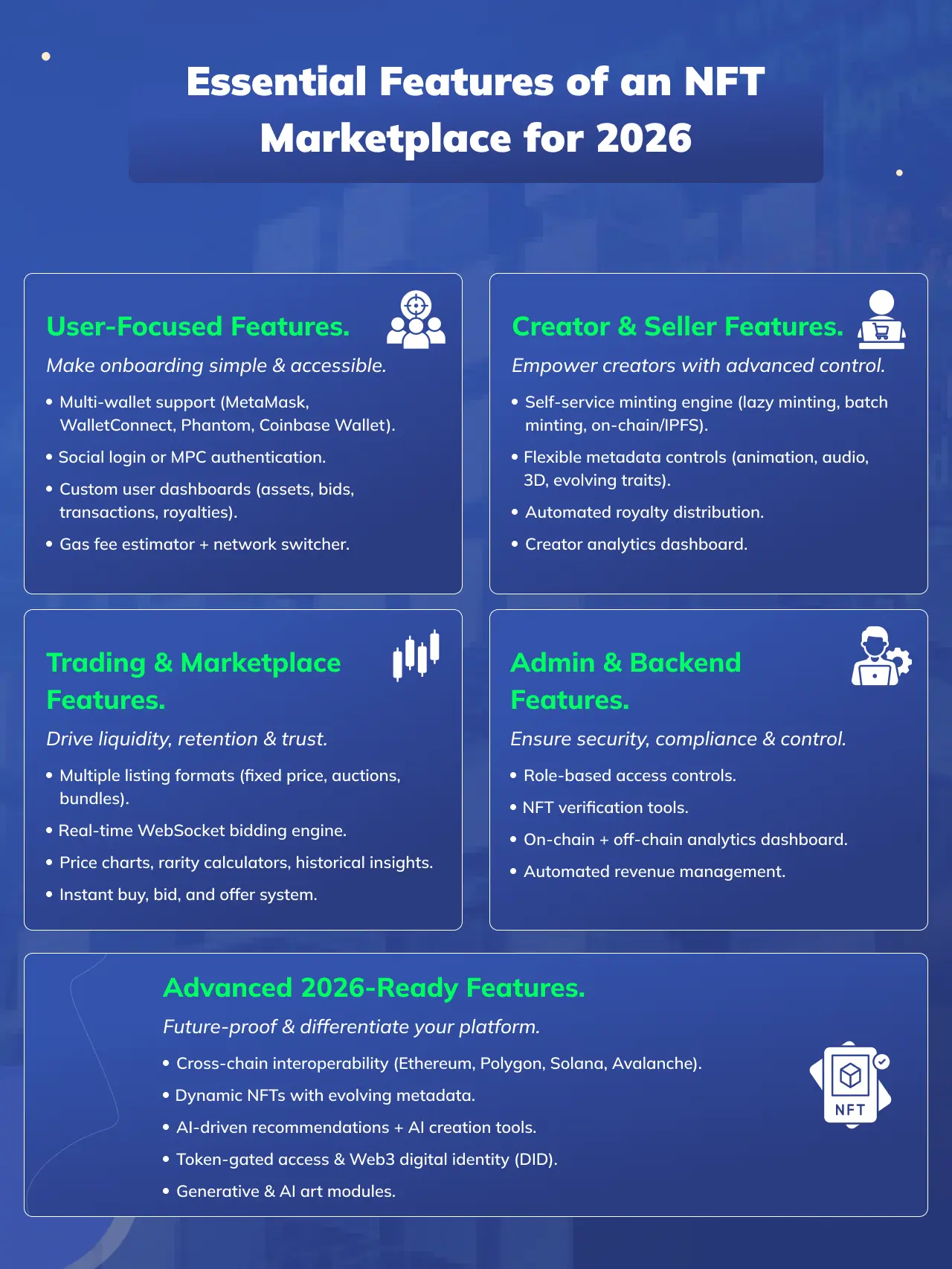
User-Focused Features
The cost of NFT marketplace development shouldn’t force you to cut down on essential user-focused features. To succeed, your NFT platform must avoid forcing users to struggle with complex wallet setups, confusing network settings, or excessive blockchain jargon. This means your platform must prioritise accessibility and a streamlined onboarding flow.
Key features include:
- Multi-wallet support (MetaMask, WalletConnect, Phantom, Coinbase Wallet) for easy sign-in.
- Social login or MPC-based authentication for users new to crypto.
- Custom user dashboards displaying assets, bids, transactions, and royalties.
- Built-in gas fee estimations and network switchers for smoother navigation.
Creator & Seller Features
Most NFT creators expect more technical tools than just basic mining. These features determine how comfortably artists, brands, and developers can manage collections without manual oversight.
Essential modules:
- Self-service minting engine (lazy minting, batch minting, on-chain or IPFS metadata).
- Flexible metadata controls for animation, audio, 3D files, or evolving traits.
- Automated royalty distribution is pre-coded into smart contracts.
- Advanced creator dashboards for analytics, drops, and collection management.
Trading & Marketplace Features
Trading/exchange is the primary function that shouldn’t be affected by the NFT marketplace development cost in 2026. With a smoother and faster trading engine, you get better liquidity, user retention, and platform credibility.
Core trading capabilities:
- Multiple listing mechanisms (fixed-price, auctions, bundles).
- Real-time bidding system using WebSockets.
- Price charts, rarity calculators, and historical trading insights.
- Instant buy, bid, and offer systems built for high-performance execution.
Admin & Backend Features
Admin and backend features play a crucial role in the NFT platform, keeping the marketplace compliant and secure. Also, these backend tools empower admins to have absolute control over the platform’s technical, operational, and financial processes.
Hence, these essential features must be included when evaluating the cost of NFT marketplace development.
Important backend/admin tools:
- Role-based permissions for moderators, ops teams, and finance teams.
- NFT verification tools to curb scams or counterfeit collections.
- Analytics dashboards combining on-chain + off-chain insights.
- Automated revenue management (fees, commissions, royalties).
Advanced Features for 2026
Your NFT marketplace deserves future-proof, advanced features that win you a major competitive edge. Now, user demand is dynamic, interoperable, and AI-enabled digital experiences that compel you to hire an NFT marketplace developer or company.
Advanced capabilities include:
- Cross-chain interoperability for seamless transfers between Ethereum, Polygon, Solana, Avalanche, etc.
- Dynamic NFTs that update metadata based on gameplay, events, or AI inputs.
- AI-driven NFT recommendations and in-platform creation tools.
- Token-gated access, memberships, and Web3 digital identities (DID).
- Generative and AI art modules are built into the marketplace.
Now, let’s move to the NFT Cost details. “Read the Next Section Carefully”
NFT Marketplace Development Cost in 2026: Detailed Breakdown
After examining the influential factors and key features, let's look at a practical breakdown to help finalize the NFT marketplace development company.
1. Basic NFT Marketplace Cost (Starter Level)
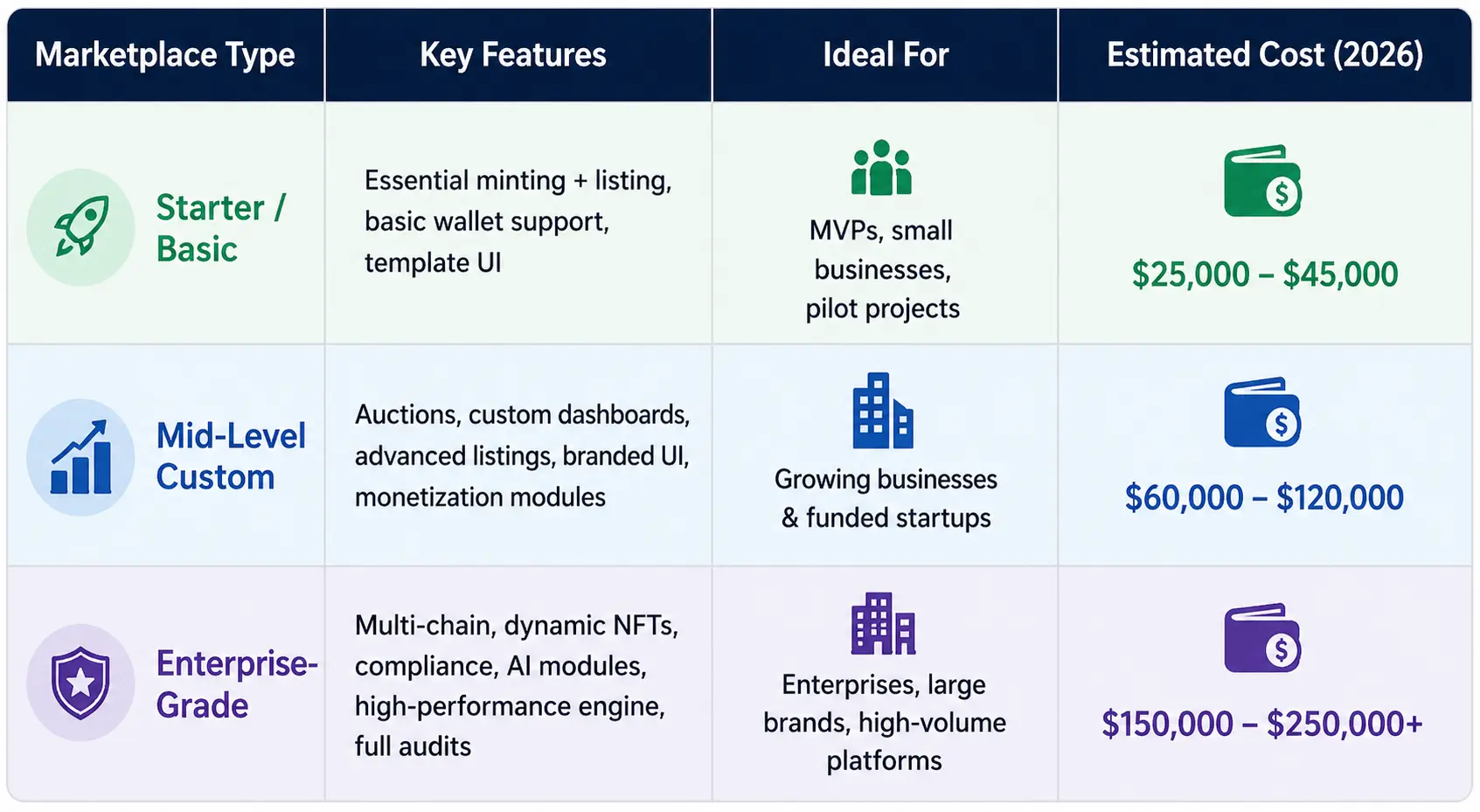
A standard NFT marketplace is ideal if you run a small business or brands testing the Web3 waters. The key focus is only on essential functionality, such as minting, listing, basic buying/selling, wallet integration, and a minimal dashboard.
Note: The limited technical customization makes it quicker and more affordable to launch, thus significantly lowering the NFT marketplace development cost in 2026.
Charatertestics:
- Basic NFT minting.
- Simple marketplace engine.
- Essential wallet support.
- Standard smart contracts.
- Basic admin panel.
- IPFS-based storage.
- Template-based UI/UX.
Estimated Price Range in 2026: $25,000 – $45,000
2. Mid-Level Custom NFT Marketplace Cost
A mid-level marketplace is the most suitable option for businesses that want a scalable product with stronger functionality and branded workflows.
It includes more customization and moderate UI/UX enhancements compared to a standard NFT platform. Consequently, the cost of NFT marketplace development could be higher than usual.
What’s included:
- Custom minting modules.
- Auctions, bidding, and bundle listings.
- Role-based dashboards for creators and users.
- Analytics and price history.
- Mobile-responsive UI.
- Additional monetization systems (fees, royalties, memberships).
- Security enhancements + light smart contract audits.
Estimated Price Range in 2026: $60,000 – $120,000
You can also read: Top 5 Blockchain Development Companies in the UAE.
3. Enterprise-Grade NFT Marketplace Development Cost
The Enterprise-level platforms are more complex and cost-intensive, requiring scalability, performance, and complex business models.
An NFT marketplace of this magnitude should be capable enough to handle large transaction volumes, multiple chains, integration-heavy workflows, and advanced smart contract logic.
Advanced features:
- Multi-chain support (Ethereum + Polygon + Solana, etc.).
- Dynamic NFTs and custom smart contract logic.
- High-performance trading engine (real-time data, advanced search, instant execution).
- Compliance layers (KYC/AML, chain analytics, fraud detection).
- Enterprise admin panel with granular access controls.
- Full-scale audits, penetration testing, and performance optimization.
- AI modules, royalty automation, and in-depth analytics.
Note: Ensure your development partner possesses the expertise outlined above before committing to any NFT marketplace development service.
Estimated Price Range in 2026: $150,000 – $250,000+
NFT Marketplace Cost Summary Table
Next: Discover the unspoken costs no development company will disclose directly.
Hidden/Additional NFT Marketplace Costs You Should Prepare For in 2026
Don't miss out on these additional expenses that are often overlooked while estimating the cost of NFT marketplace development.
Compliance, KYC/AML, and Legal Requirements
An NFT marketplace demands strict adherence to legal compliance and security measures. Moreover, compliance becomes mandatory if your marketplace handles payments, royalties, or user identity data.
Possible expenses:
- KYC/AML integration tools.
- Licensing and legal consultation.
- GDPR, data protection, and privacy compliance measures.
- Chain analytics tools for fraud and risk detection.
Estimated Cost: $4,000 – $25,000+ annually.
Marketing, Branding & Community Building
Similar to any stock market, an NFT marketplace is a platform for facilitating transactions (or digital transactions). For that, a strategic, ongoing marketing campaign is a must to attract creators, collectors, and brands.
This may include:
- Social media and community management.
- Influencer collaborations.
- NFT collection partnerships.
- Paid promotions and PR.
- Discord/Telegram moderation.
- Content creation (blogs, videos, tutorials).
Monthly Budget: $2,000 – $20,000 depending on campaign scale.
Long-Term Maintenance & Feature Upgrades
Web3 evolves rapidly, constantly introducing new chains, new token standards, and new use cases. A dedicated support and maintenance team is a must to stay relevant through updates and technical improvements.
Maintenance tasks include:
- Bug fixes & performance optimization.
- Smart contract upgrades.
- Blockchain version updates.
- New feature rollouts.
- Security patching & infrastructure upgrades.
The NFT marketplace development cost in 2026 may increase due to regular audits and testing processes. These processes help prevent hacking, exploits, and fraud, thereby building trust among users.
Annual Maintenance Cost: 15%–25% of the original development cost.
Regular Audits & Testing
Auditing Includes:
- Smart contract audits.
- Frequent testing.
- Quality assurance.
- Security assessments.
Estimated Cost: $8,000 – $50,000+ for enterprise-level marketplaces.
Follow the tips below to keep your NFT marketplace development cost-effective.
Tips to Reduce the Cost of NFT Marketplace Development
Here are some key tips if you want to cut down the Cost to develop an NFT Platform:
- Choose a scalable, low-gas blockchain like Polygon or Solana to cut operational costs.
- Start developing the MVP and add advanced features only after user validation.
- Use pre-built smart contract templates to reduce custom development time.
- Outsource to an experienced NFT marketplace development company instead of hiring a full in-house team.
- Opt for modular architecture so new features don’t require rebuilding the entire platform.
- Prioritize essential features first and delay non-critical integrations.
- Leverage open-source tools wherever security and compliance allow.
- Use cloud-based and shared node infrastructure instead of managing dedicated nodes early on.
Conclusion
It is advised not to jump into building an NFT marketplace before estimating its overall cost, including both development and maintenance. That is because the cost of developing an NFT marketplace can vary based on multiple factors, including platform complexity, blockchain network, team location, and more.
So always choose to work with a professional NFT marketplace development company that helps build a robust, future-proof NFT marketplace.
You can also read: Top New Blockchain Technology Trends to Follow
Frequently Asked Questions
1. How much time does it take to build an NFT app?
Ans. NFT application development consists of various stages, each with its own complexity. Overall, the complete development phase usually takes around 3 to 5 months.
2. What are the stages of an NFT marketplace development?
The typical development process is divided into these five core stages:
- Discovery & Strategy: Defining the platform's niche, features, and smart contract architecture.
- UI/UX Design: Designing the user interface (frontend) with a sheer focus on Web2-level smoothness and intuitive workflows.
- Smart Contract & Backend Development: Building the core blockchain logic (minting, trading) and the API/Admin Panel.
- Frontend & Integration: Developing the user-facing application and integrating wallets, analytics, and payment gateways.
- Testing, Audit, & Deployment: Rigorous QA, mandatory third-party security audits, and final launch.
3. How much does it cost to build an NFT marketplace?
The estimated cost of developing an NFT application varies due to various influential factors. While you can consider a range from $45,000 to $50,000, you must also be aware of other variable costs such as maintenance, marketing, and more.
4. Is the NFT marketplace accessible from a mobile phone?
Yes, the NFT marketplace is easily accessible from your mobile phone through a dedicated app or a mobile-friendly website.
5. How much time does it take to build an NFT marketplace?
It is challenging to provide a precise timeline without understanding the project’s requirements. On average, though, developing an NFT app takes 3 to 5 months.

Sakshi Aggarwal is the Co-CEO of CodeAegis, a visionary leader with 12+ years of experience in transforming complex business requirements into high-impact technology solutions across industries. Her core contribution lies in architecting the company's customer-centric service delivery model and optimizing cross-functional execution. She has become a driving force for ensuring project success and cultivating a culture of accountability across the software development life cycle.