


Difference Between Custom and White-Label NFT Marketplace Development
Table of Contents
What Is NFT Marketplace Development?
What Are White-label NFT Marketplaces?
Custom NFT Marketplace Development
White-label NFT Marketplace Solutions
Comparison of Custom vs. White-label
Cost to Build an NFT Marketplace
Conclusion
FAQs
 Add us as a preferred source on Google
Table of Content
+Custom NFT Marketplace Development vs White-Label NFT Marketplace: Complete Guide for 2026
The NFT world is creating headlines for its volatility. By 2026, demand for structured and innovative NFT platforms will be growing exponentially. Consequently, businesses are no longer launching the platforms just to "join the trend". They are building real revenue ecosystems around collectibles, gaming assets, real estate tokens, and luxury digital goods.
But most founders are stuck with a critical choice: to move forward with full-scale, custom NFT marketplace development or compromise on scalability and launch a white-label NFT marketplace solution.
The answer may differ based on various determining factors. For example, a successful product strategy for a global brand won't ensure the same results for your idea or product.
Also, there are many hidden complexities and risks that most founders underestimate or don't encounter, and thereby settle for a subpar solution that drives minimal revenue and limited scalability.
This guide breaks down every minor to major aspect, including features, technology, and costs, to help you make a strategic decision to launch a leading NFT marketplace in 2026.
What Is NFT Marketplace Development?
The concept of NFT marketplace development refers to building a marketplace or platform from scratch, tailored for your idea and brand, encompassing design, architecture, smart contracts, blockchain integrations, dashboards, payment systems, security layers, and more.
Think of it as building your own eCommerce store or a trading platform from the ground up, but powered by decentralized technology.
A custom-built marketplace gives you:
- Full control over the UI, functionality, workflows, and smart contracts.
- Ability to design unique auction models or royalty logics.
- Multi-chain optionality (Ethereum, Polygon, Solana, BNB Chain, Avalanche, etc.).
- Full ownership of the platform’s codebase.
- Unlimited room for future scaling.
This option is ideal for businesses that want something future-proof and not dependent on any external provider.
What Are White-label NFT Marketplaces?
White-label NFT marketplace solutions are pre-built platforms, ready to be customized and deployed. This type of solution is easy to launch, but it comes with limited customization options. However, they do include the essential modules baked in:
- NFT minting.
- Wallet integration.
- Auctions, fixed-price listings, bidding.
- Basic dashboards.
- Smart contract templates.
- Payment modules.
What Businesses need to do is customize branding, add features, tweak UI, and launch. You’re good to launch.
Custom NFT Marketplace Development: What You Really Get?
Key Features You Can Build
When you decide to go full-custom with your NFT solution, possibilities are endless. Here are some of the most in-demand features.
- Multiple auction models can support English, Dutch, and fixed-price formats in your marketplace to match diverse trading behaviors.
- Creator royalty automation ensures transparent, on-chain royalty payouts for every secondary sale without manual intervention.
- AI-driven NFT search and recommendations make user discovery easy and personalized by analyzing behavior, trends, and asset relevance.
- Multi-chain minting enables creators to launch NFTs across Ethereum, Polygon, Solana, and L2 networks for a broader reach and lower fees.
- Fiat and crypto payments allow users to purchase NFTs without any hassle using cards, bank transfers, UPI, or digital wallets.
- Gas-less minting is an innovative mechanism that allows users to create NFTs without paying gas fees by leveraging meta-transactions.
- Advanced admin controls provide role-based access to platform owners with in-depth analytics and governance tools.
- Fraud detection mechanisms protect your NFT marketplace by identifying counterfeit NFTs through metadata verification and AI monitoring.
- Layer-2 transaction optimization improves the performance of your NFT marketplace development solution by reducing transaction costs and increasing speed while maintaining security.
Pros of Custom NFT Marketplace Development
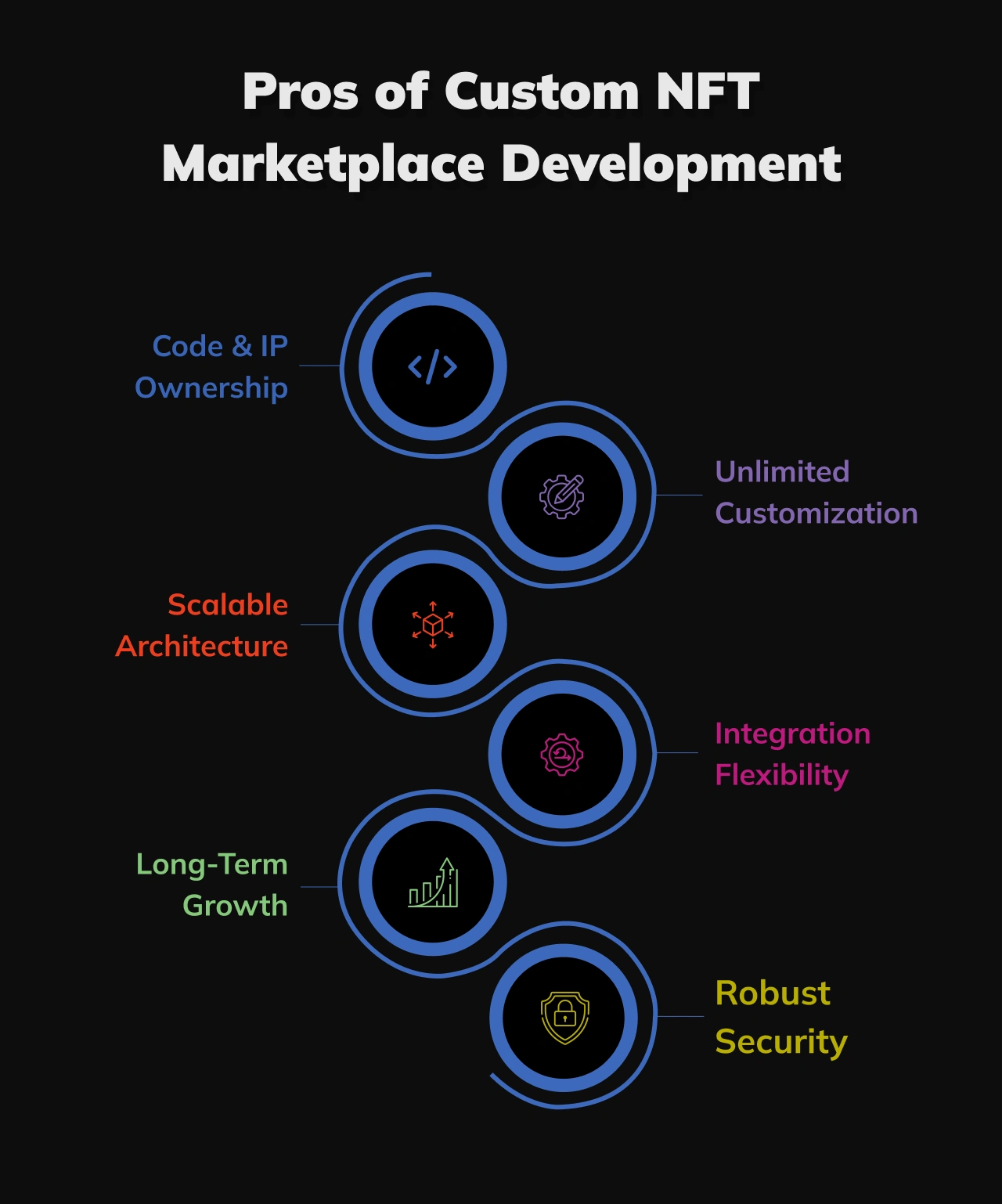
Full ownership of the code and IP
Unlike White-label NFT Marketplace Solutions, customized development gives you complete control over how the platform evolves with zero third-party restrictions or shared frameworks.
Unlimited customization for features and UI
If your business demands more than standard features, you can add tailored features, the required workflow, and any desired screen that reflects your exact business model.
Ability to build high-performance, scalable architecture
Scalability challenges like growing traffic, complex transactions, and expanding user activity are easily handled by NFT marketplace development without slowing down.
Integration flexibility (AI tools, analytics engines, gaming modules)
Whether it's AI recommendations or gaming mechanics, you can plug in advanced tools whenever your business needs them.
Long-term growth potential
A custom-built marketplace supports future upgrades such as new revenue models, enhanced integrations, and tech innovations without compromising the platform's performance.
Strong security foundation tailored to your platform
Security features like audits, fraud checks, and smart contract hardening can be built around your exact use case and brand instead of generic templates.
Cons of Custom NFT Marketplace Development
- Higher risk of technical debt when early architecture and development decisions are not planned carefully from the start.
- Hiring a seasoned NFT marketplace development company becomes necessary to handle complex blockchain logic and system design.
- A higher upfront cost is involved due to custom design, smart contract development, testing, and security audits.
- Longer development timelines are required since every feature and workflow is built and validated from scratch.
- Platform complexity increases as advanced features like multi-chain support, AI tools, or gaming mechanics are added.
- Post-launch maintenance responsibility shifts to the platform owner for updates, performance optimization, and security management.
Everything You Should Know About White-label NFT Marketplace Solutions
What are the Core Modules Included?
These are some pre-built modules you’ll find in almost all while-labeled NFT marketplace solutions available.
NFT listing engines let users upload, list, and manage their NFTs with structured metadata and pricing options.
Minting mechanisms help creators to generate new NFTs on-chain through simplified workflows and predefined smart contract logic.
Crypto wallet integration is used to connect popular wallets like MetaMask or WalletConnect to securely store, buy, and trade NFTs.
Admin dashboards empower owners to have oversight and control over users, listings, transactions, analytics, and platform-wide settings.
KYC and security features can help verify user identities, prevent fraud, and maintain regulatory compliance in white-label NFT Marketplace development.
Smart contract templates provide ready-made on-chain logic for minting, trading, royalties, and auctions without building them from scratch.
All of these modules work out of the box with quick modifications, which can be delivered by any NFT marketplace development company.
What Are The Pros of White-labek NFT Marketplace Development?
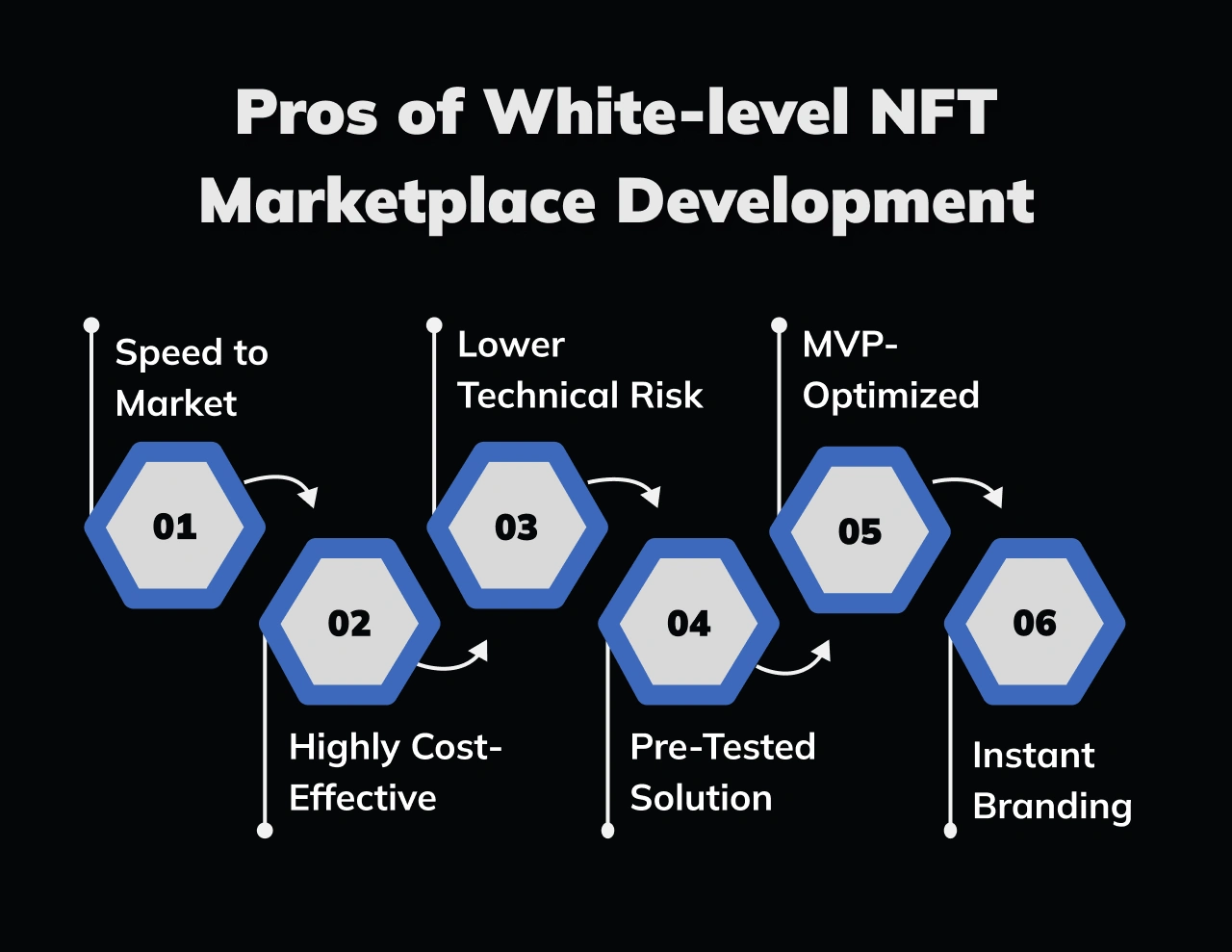
Quick Launch (2–4 weeks)
If your business is focused on immediate time-to-market, you can get your marketplace live fast without waiting months for custom development cycles.
Highly cost-effective
With the limited customization scope and pre-built core modules, you spend far less compared to creating everything from scratch.
Lower technical risk
As your NFT marketplace is running on a proven framework, most bugs, performance issues, and vulnerabilities are already ironed out.
Comes pre-tested
The white-label NFT platform has gone through multiple rounds of testing beforehand, giving you a stable and ready-to-use foundation.
Great for pilot projects or MVPs
Most NFT marketplace owners fail to build a viable MVP. Hence, a white-label solution is perfect when you want to validate your idea quickly before investing in a full-scale custom marketplace.
Easy branding and module configuration
You can customize the look, feel, and essential functions without touching the deeper technical layers or architecture.
What Are The Cons of White-label NFT Marketplace Development?
Feature upgrades rely entirely on the provider’s roadmap, limiting your ability to introduce new functionalities on your own timeline.
Scalability depends on the provider’s infrastructure, which may restrict performance as user traffic and transactions grow.
White-label solutions are not suitable for platforms with complex business models that require deep customization or unique logic.
Customization options remain limited since core functionalities are built on a shared, pre-defined framework.
Limited support for advanced features due to architectural constraints of the pre-built solution.
Vendor dependency can create long-term operational constraints if the provider changes pricing, support, or service terms.
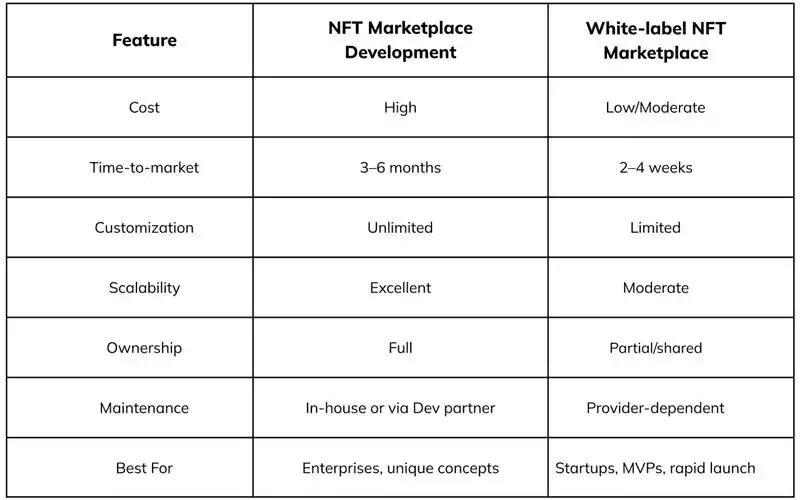
Side-by-Side Comparison of Custom vs. White-label NFT Marketplace
How Much Does It Cost to Build an NFT Marketplace in 2026?
Whether you are choosing a custom-built NFT marketplace or moving forward with a white-label solution, costing is the biggest question businesses ask.
Cost Factors Influencing NFT Marketplace Development
Estimating the development cost for both NFT platform types is highly variable and depends on various determining factors. Let's uncover them first.
UI/UX design
Choosing intuitive UI/UX design can significantly enhance the overall marketplace experience; however, your NFT marketplace development company may charge a higher fee, ultimately exceeding your assigned budget.
Smart contracts
The cost to develop secure, gas-optimized smart contracts adds to the budget as they require expert auditing and precise logic implementation, which doesn't come in a small investment.
API and wallet integrations
If you want to connect your platform to external services, wallets, and third-party tools for enhanced functionality, implementing all these APIs and integrations will increase the development time and cost.
Blockchain selection
Every blockchain, such as Ethereum, Polygon, and Solana, has its own complexity, transaction logic, and inherent cost to build an NFT marketplace.
Multi-chain architecture
Allowing your NFT platform to support multiple networks increases the development cost as each blockchain requires its own integration, testing, and smart contract setup.
Security and compliance layers
More than saving money, compromising your marketplace security can cost you millions in losses. Therefore, you must include KYC, auditing, fraud detection, and regulatory components to ensure your marketplace stays secure and compliant, even if the budget must be stretched.
Advanced features
Adding complex features such as AI, 3D previews, and off-chain storage requires more engineering hours for your hired NFT Marketplace services and consequently will cost you more than expected.
Post-launch maintenance
Deployment or launching is just the beginning of a long-term commitment. Afterward, you must plan for ongoing updates, performance improvements, and feature upgrades, for which most companies fail to allocate sufficient budget.
Custom Development Cost in 2026
The estimated cost to build a fully custom NFT platform ranges from $30,000 to $120,000, depending heavily on the complexity, number of integrations, and the expertise of the NFT marketplace development company you hire.
White-label NFT Marketplace Cost in 2026
The prices of a White-label NFT platform typically range from $10,000 to $70,000, as it mainly includes the core infrastructure. Like:
- Basic customization.
- Smart contract setup.
- Branding.
- Standard features.
- Admin dashboard.
Note: It also includes subscription-based pricing models for maintenance, hosting, and ongoing support.
Read this detailed guide to discover the full cost of NFT marketplace development.
Which One Should You Choose in 2026?
Here’s the honest recommendation based on business goals and current trends.
Choose Custom NFT Marketplace Development If:
- You’re building a long-term business.
- Your marketplace requires unique mechanics.
- You plan to scale to millions of transactions.
- You want IP ownership.
- Your revenue model is complex (gaming, fractional ownership, etc.).
- You need deep integration with external systems or enterprise-grade infrastructure.
Choose White-label NFT Marketplace Development If:
You want to launch fast.
You have a limited budget.
You want to test the market first.
You need a ready-to-go marketplace with essential features.
You prefer a low-risk development approach with pre-tested modules.
You don’t require heavy customization or highly specialized platform mechanics.
Essential Tech Stack for Scalable NFT Marketplace
These must-have technologies are critical to the success of any NFT marketplace development project.
- Frontend: React, Next.js, Vue
- Backend: Node.js, Go, Python
- Smart Contracts: Solidity, Rust, Move
- Blockchain Networks: Ethereum, Polygon, Solana, BNB, Avalanche, ImmutableX
- Storage: IPFS, Filecoin, Arweave
- Security: Audits, KYC, transaction monitoring
- Integrations: WalletConnect, MetaMask, Coinbase Wallet, fiat on-ramps
The right stack impacts everything from performance to user experience.
Conclusion
Choosing between custom NFT marketplace development and white-label NFT marketplace solutions is challenging. This is because every business has its unique platform demands. For example, speed, affordability, and a quick time-to-market are essential for startup businesses, whereas scalability and deep customization are prominent for large-scale enterprises.
2026 is going to be a defining year for NFTs, and the above analysis helps you analyze and decide whether one approach suits your business objectives. At last, always aim to balance your long-term vision with your immediate budget and time constraints.
Frequently Asked Questions
1. What are the various NFT platforms?
Here are the top 5 benefits of an NFT Marketplace, presented in short points:
- New Revenue Streams: Generates income for the platform owner via transaction fees, commissions, and listing fees.
- Automated Royalties for Creators: Guarantees artists and creators a continuous source of passive income every time their NFT is resold.
- Immutable Ownership & Authenticity: Provides verifiable proof of ownership and provenance, eliminating the risk of counterfeiting digital assets.
- Global Market Access: Connects creators with a vast, worldwide audience of collectors without geographical limitations.
- Full Control & Customization: Allows the platform owner to set specific rules, fees, branding, and niche focus for better user targeting.
2. What is an NFT marketplace?
An NFT marketplace is a dedicated platform that allows users, including artists, musicians, influencers, and other content creators, to buy and sell Non-Fungible Tokens (NFTs).
3. What features should I include in my NFT marketplace?
To ensure your NFT marketplace is competitive and functional, you should include these essential user-facing features:
- Storefront: Visually appealing display of NFT listings and details.
- Wallet Integration: Support for major Web3 wallets (e.g., MetaMask).
- Listing & Minting: Easy process for creators to upload, set pricing, and mint NFTs.
- Auction & Bidding: Support for fixed-price, English, and Dutch auction formats.
- Search & Filters: Advanced tools for users to quickly find assets by category, price, or creator.
- User Profiles: Dedicated pages to display collections, transaction history, and creator information.
- Smart Contracts: Secure, audited code for governing all transactions and royalties.
- Admin Dashboard: Backend tool for managing users, listings, fees, and analytics.
4. What are White Label NFT Marketplace Solutions?
A white-label NFT marketplace solution is a pre-built, fully functional software platform. Its core code and features are already developed and tested, allowing a business to quickly rebrand the platform with its own identity (logo, color scheme) and launch rapidly at minimum cost.
5. How to choose the right NFT marketplace development company?
Here are all the critical factors you must check before hiring an NFT marketplace development agency.
- Technical Portfolio: Check for proven experience with smart contracts and diverse blockchains.
- Security Focus: Ensure they prioritize rigorous auditing and compliance (KYC/AML).
- Scalability: The architecture must support high transaction volumes and future growth.
- Customization Flexibility: Verify they can deliver unique features and deep UI/UX customization.
- Post-Launch Support: Confirm long-term maintenance and upgrade services are included.
- Cost Transparency: Demand a clear, detailed cost breakdown with no hidden fees for future maintenance.
6. How much does it cost to build an NFT game marketplace?
The overall cost of NFT game marketplace development usually varies on different factors. However, the estimated budget ranges from $40,000 to $150,000, considering the level of customization and unique gaming features.

Sakshi Aggarwal is the Co-CEO of CodeAegis, a visionary leader with 12+ years of experience in transforming complex business requirements into high-impact technology solutions across industries. Her core contribution lies in architecting the company's customer-centric service delivery model and optimizing cross-functional execution. She has become a driving force for ensuring project success and cultivating a culture of accountability across the software development life cycle.