


Virtual Reality in Healthcare: Applications, Benefits & Future Trends 2026
Table of Contents
What is Virtual Reality in Healthcare?
Core Applications of VR in Healthcare
Key Benefits of VR in Healthcare
Real-World Case Studies and Clinical Evidence
How Medical VR Apps Are Built
Medical VR App Development: Key Features
VR Healthcare App Development Company
How to Choose the Right VR Healthcare Development Company
Future Trends in VR Healthcare
Final Thoughts
Frequently Asked Questions
 Add us as a preferred source on Google
Table of Content
+Virtual Reality in Healthcare: Applications, Benefits and Trends
The global market for virtual reality in healthcare is growing faster than most experts predicted just a few years ago. Industry reports estimate that the healthcare VR market could cross $11 billion by 2026.
Surgeons are walking through a patient's anatomy before the first incision. Students are practicing procedures they might not see in real life for months. People dealing with chronic pain are getting relief without a single pill. This is what VR in healthcare looks like right now.
Whether you are a healthcare startup founder or successful enterprise, this guide will help you clearly understand where healthcare VR is heading.
What is Virtual Reality in Healthcare?
It covers training, treatment, rehabilitation, diagnostics, and patient engagement. With VR headsets, motion sensors, and interactive simulations, Healthcare professionals can step into realistic medical scenarios within a completely safe digital environment
Healthcare VR operates under fundamentally different standards than consumer VR. In medicine, accuracy, safety, compliance, patient privacy, and clinical validation matter a lot. Even a small technical issue in a medical simulation can directly compromise training quality and patient safety outcomes, so healthcare VR systems need much higher standards.
Today, VR in healthcare is used for:
- Surgical simulations
- Medical education
- Physical rehabilitation
- Pain management
- Mental health therapy
- Remote consultations
- Patient education
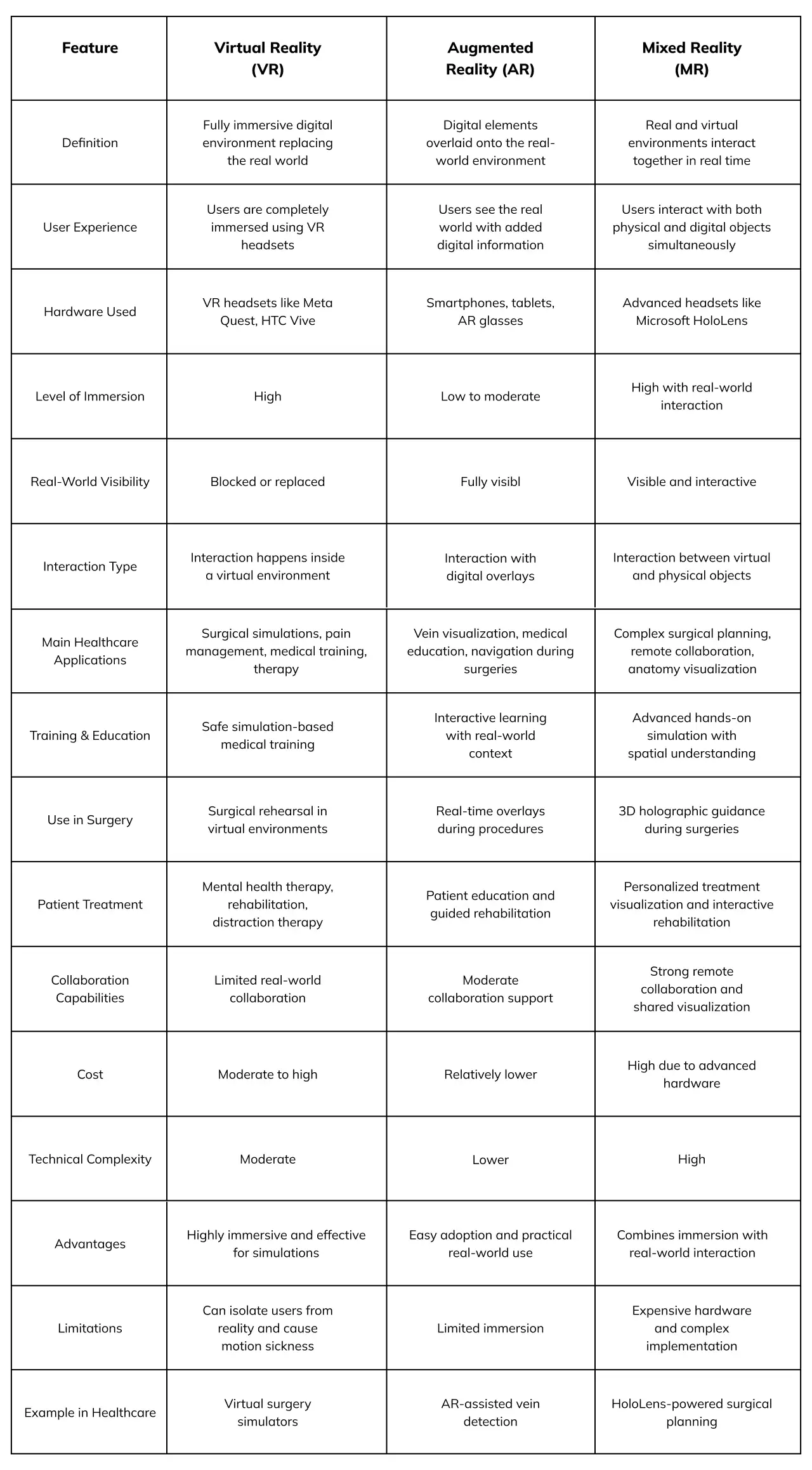
VR vs AR vs MR in Healthcare
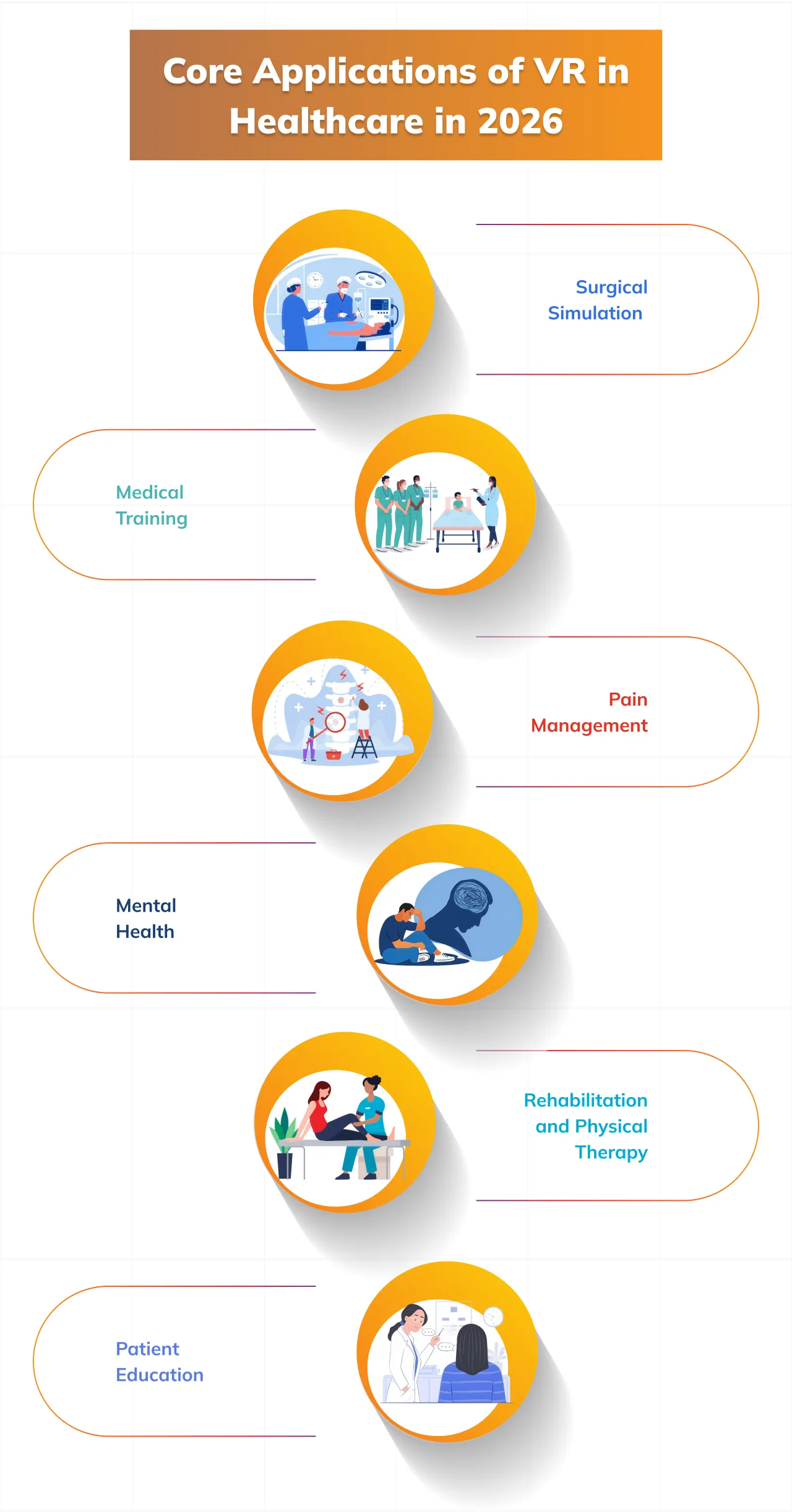
Core Applications of VR in Healthcare in 2026
By 2026, hospitals and medical institutions have moved decisively beyond pilot programs and are integrating VR into routine clinical and training workflows.
Surgical Simulation
VR surgery simulation is no longer stuck in the experimental stage. Surgeons can now rehearse a specific patient’s procedure using that patient’s real imaging data before they even step into the operating room.
Cleveland Clinic and Johns Hopkins are already working with patient-specific VR models for complex pre-operative planning, and this is happening right now not “sometime in five years.”
Medical Training
Virtual reality medical training solves an issue that has been around in medical education for ages. How do you give trainees sufficient hands-on practice without placing real patients at risk?
With VR, residents can practice intubation, central line placement, laparoscopic techniques, and those rarer procedures they might see only once or twice across the entire training period. Stanford Medical School and Case Western Reserve University both integrated VR anatomy into their programs. The real upside isn’t only safety though. It’s repetition. A trainee can repeat the same procedure up to 50 times in a single afternoon — a volume of practice that is simply not achievable in any traditional clinical setting.
Pain Management
VR represents a meaningful clinical advancement in pain management — particularly given the ongoing need to reduce opioid dependency. This is not just a theory. It has been tested in clinical trials.
Applied VR's Relie VRx system received FDA clearance and showed in trials that patients using VR for chronic lower back pain reported 30 percent greater reduction in pain intensity compared to a control group. The UC San Diego burn center uses VR routinely during wound care, one of the most painful procedures in clinical medicine, to reduce both pain perception and opioid use. A non-invasive, drug-free intervention with measurable clinical outcomes is a significant thing in pain management.
Mental Health
Virtual reality mental health treatment is probably the fastest-growing application in this space. Exposure therapy, where patients are gradually introduced to anxiety-triggering situations, works better when you can control exactly what they’re exposed to, at what intensity, and for how long.
Oxford VR developed a therapy program for severe paranoia and anxiety along with Oxford University. Clinical trials showed a 50 percent reduction in paranoia severity.
Rehabilitation and Physical Therapy
Stroke recovery involves slow, repetitive exercises that patients find genuinely difficult to keep up with. VR transforms that process from a monotonous set of exercises into an engaging, structured experience that patients are more motivated to complete. Patients who use VR rehabilitation programs show measurably higher session completion rates compared to standard therapy, and consistency is one of the biggest predictors of recovery outcomes.
Patient Education
Handing a patient a brochure about their surgery and asking if they have questions is not really education. VR changes what informed consent can look like in practice. Patients walk through their own procedure virtually before it happens, see the anatomy involved, and arrive at consent with genuine understanding instead of just signed paperwork. This reduces pre-surgical anxiety, and improves how well patients follow post-operative instructions too.
Key Benefits of VR in Healthcare
The growing adoption of healthcare VR is driven by measurable improvements in training, patient care, and operational efficiency.
Here are the biggest benefits of VR in healthcare.
Better Medical Training Outcomes
VR training is standardized, repeatable, and measurable in ways that traditional clinical training is not. One meta-analysis found that VR-trained medical students performed 26 percent better on procedural skills assessments than their traditionally trained peers. The ability to repeat a procedure fifty times in one session, receive instant performance feedback, and train outside of scheduled OR time changes the shape of medical education.
Increased Patient Engagement
Passive patients have worse outcomes. This is not a new insight but VR actually does something about it. When treatment is immersive and interactive, patients engage differently. VR mental health programs show lower dropout rates. Rehabilitation programs show higher session completion. Engagement is a clinical outcome variable and VR moves it in the right direction.
Reduced Healthcare Costs
Getting a single cadaver for training can land anywhere from $1,000 to $5,000. Facility costs, consumables, and cadaver management add significantly to that baseline. With VR training though, scaling is almost free for the next extra user. A study published in the Journal of the American College of Surgeons found that surgeons who trained with VR made 29% fewer errors in the operating room compared to those who used traditional training methods.
Faster recovery and improved therapy results
VR increases the perceived engagement of rehabilitation sessions, which directly improves patient adherence. VR helps sessions feel less like a chore , so patients are more likely to keep showing up. In stroke care, PTSD, and chronic pain programs, consistency is tied directly to results. Improved adherence driven by VR engagement represents genuine clinical value, not merely a motivational effect.
Enhanced data visualization and surgical planning
Surgeons planning work involving the brain, spine, or tangled vascular anatomy can step through a patient’s 3D reconstruction made from their MRI or CT scans. This kind of spatial awareness just isn’t there with flat imaging. It can lower the odds of intraoperative surprises, and it also helps surgeons make better decisions before anything begins.
Real-World Case Studies and Clinical Evidence
UCLA Medical Center, Surgical Training
UCLA's David Geffen School of Medicine integrated VR surgical training into its orthopaedic residency program. Residents who completed VR preparation demonstrated 230% better overall performance during live surgical procedures compared to those who used traditional study methods alone. That work was published in npj Digital Medicine back in 2022.
Oxford University and Oxford Health NHS, Mental Health
The gameChange VR trial was a randomized controlled trial where patients with psychosis-related agoraphobia got automated VR therapy. It was published in The Lancet Psychiatry in 2022 and it showed meaningful improvements in how well patients could actually get back into everyday situations. One key point was that no therapist had to be in the room, which makes it easier to scale than classic CBT, even if CBT is already well established.
How Medical VR Apps Are Built: Technical Overview
Building a VR app for healthcare is not the same as building one for gaming or retail. The technical bar is fundamentally different and so is the regulatory environment.
Unlike consumer VR products, medical systems must meet strict regulatory and security standards. This is where medical VR app development becomes highly specialized.
Core Components of Medical VR Platforms
- Headsets and hardware — Things like Meta Quest Pro, HTC Vive XR Elite, or even custom enterprise hardware, depending on the clinical use case in the end.
- Rendering engines — Unity and Unreal Engine are basically the two dominant picks, with Unity showing up more often in medical settings, mostly because of its C# ecosystem and all those medical specific asset libraries, you know.
- Haptic systems — Haptic feedback devices such as those from 3D Systems or HaptX are kinda essential, for making tissue interaction feel realistic in surgical simulation.
- EHR integration — For patient-specific simulations, you need to pull and render real imaging data, using HL7 FHIR API integration with hospital systems.
- AI/ML integration — Adaptive training platforms now lean on AI to tune the difficulty, watch performance metrics and deliver real time feedback to trainees.
- WebXR — WebXR makes browser based VR experiences possible that need no app installation, which is why it is getting more practical for patient education.
- Cloud infrastructure — Cloud infrastructure (like AWS HealthLake, and Azure Healthcare APIs) helps with scalable storage for session data, performance analytics, and even multi-user virtual environments.
Technology Stack Used in Healthcare VR
AI integration is becoming increasingly important for predictive diagnostics and personalized treatment experiences. Most modern VR healthcare app development services use technologies such as:
- Unity
- Unreal Engine
- WebXR
- AI/ML frameworks
- Cloud computing platforms
- Real-time analytics systems
Compliance & Regulatory Requirements
This is where many generic VR development teams fall short. Healthcare VR must navigate:
HIPAA requires that any patient data the application handles is encrypted end to end, with strict access controls and full audit logging. This has to be built into the architecture, not added later.
FDA classification depends on what the application does. VR tools used for clinical diagnosis or treatment may qualify as Software as a Medical Device and require 510(k) clearance or De Novo authorization. Getting this wrong can mean pulling a deployed product.
GDPR governs applications deployed in Europe, with strict rules on data residency and patient consent.
CE Marking is required for EU medical device market access.
On the technical side, latency below 20 milliseconds is generally required to prevent motion sickness in most users. Content validation, meaning clinical review of whether the simulated scenarios accurately represent real anatomy and procedures, requires medical oversight that a standard development process does not include.
Medical VR App Development: Key Features That Matter
When evaluating or building a medical VR app, these are the features that separate clinical-grade tools from toys:
- Real-time performance analytics: The application should track user actions, identify errors, and generate performance reports that can be reviewed by instructors or clinicians
- Secure patient data handling: Encryption at rest and in transit, role-based access controls, and full audit trails
- Multi-device compatibility: Clinical environments use different hardware across departments and institutions. A good VR healthcare solution works across device types
- AI integration: For adaptive training and personalized patient experiences
- Motion tracking precision: Sub-millimeter accuracy for surgical simulation; broader tolerance acceptable for patient education
- Offline functionality: Hospitals often have restricted networks. Applications should function without constant internet connectivity
- Accessibility settings: Adjustable for patients with limited mobility, visual impairments, or vestibular sensitivity
What to Look for in a VR Healthcare App Development Company
Choosing the wrong development partner for a healthcare VR project is an expensive mistake. Here is what actually matters when you are evaluating a VR app development company for clinical work.
Healthcare domain expertise
Building a convincing game environment and building a clinically valid surgical simulation require completely different knowledge. Ask about their medical advisory relationships and how clinical accuracy is validated during development. If they do not have a clear answer, that is your answer.
A real compliance track record
Have they built HIPAA-compliant applications before? Have they navigated FDA SaMD classification? Can they show documentation? This is not a box-checking exercise. It is a fundamental requirement for anything that touches patient data or clinical workflows.
A healthcare portfolio specifically
General enterprise VR projects do not demonstrate clinical rigor. Look for hospital clients, academic institution partnerships, or published outcomes from applications they have built.
Cross-platform development capability
Your project may start on one headset and expand. You should not have to rebuild from scratch as the hardware landscape shifts.
UX experience for clinical environments
Surgeons, nurses, and patients in recovery interact with software very differently from general consumers. The design team needs to understand that.
Long-term maintenance commitment
Medical software requires ongoing updates as regulations evolve, hardware changes, and new clinical evidence emerges. A partner who disappears after launch creates real risk.
How to Choose the Right VR Healthcare Development Company?
Most VR studios are genuinely good at building VR. The problem is that building for healthcare is a different job entirely. And most studios are not set up for it.
So before you sign anything, run through these questions:
- Does the team build compliance into the architecture from the start, or do they patch it in later? HIPAA, GDPR, and FDA SaMD requirements cannot be bolted on after the fact without serious cost and structural damage.
- How does clinical accuracy actually get reviewed? Who reviews it, and at what point in the project? "We consult with doctors" is not a process.
- Has the team navigated an FDA SaMD submission before, or will your project be their first attempt?
- Can the application run across multiple devices? Clinical environments rarely run on a single headset.
- What happens after launch? Both healthcare regulations and VR hardware change. You need a team that stays engaged.
What a Specialist Looks Like in Practice?
CodeAegis is one of the few development companies that works specifically at the intersection of VR and clinical requirements. Our work covers surgical training simulations, rehabilitation programs, and patient education systems.
We address HIPAA, GDPR, and FDA SaMD requirements at the architecture stage, before feature development begins. Clinical accuracy is reviewed through active medical advisory relationships built into the development cycle itself.
Our scope runs from discovery and clinical requirements mapping all the way through to post-launch maintenance. CodeAegis is worth looking at against that same list.
Future Trends in VR Healthcare: 2026 and Beyond
AI-Powered VR Diagnostics
The next step is using VR environments not just for treatment but for assessment. AI systems that observe how a patient navigates a virtual space can identify early markers of cognitive decline, motor impairment, or vestibular dysfunction. Several academic medical centers are already piloting this.
Metaverse Healthcare Ecosystems
Virtual hospitals, persistent shared environments where patients receive consultations, complete therapy sessions, and interact with care teams, are moving from concept to early deployment. This is no longer science fiction — major technology companies and university hospital systems are already building the infrastructure for persistent virtual care environments.
Haptic Feedback Technology
Current haptic systems simulate general resistance and pressure. The next generation will simulate tissue texture, temperature, and fine surgical feel with enough fidelity that training in VR becomes effectively indistinguishable from training on real tissue.
Digital Twins in Healthcare
Patient-specific digital twins, virtual replicas built from a patient's own imaging, genomic, and clinical data, allow surgeons to rehearse on a model of the actual person they will be operating on. This is already in use at specialized centers for cardiac and neurosurgical planning and will expand significantly.
Cloud-Based VR Healthcare Platforms
Subscription-based cloud VR platforms mean smaller hospitals and clinics no longer need significant on-site hardware investment to access the same tools available to large academic centers. This democratizes access in a meaningful way.
Wearable VR Medical Devices
VR combined with biometric monitoring, heart rate, EEG, eye tracking, and galvanic skin response creates systems that are simultaneously therapeutic and diagnostic. A rehabilitation session that also tracks neurological recovery in real time is a qualitatively different clinical tool.
Final Thoughts
VR in healthcare is not a trend to watch. It is a capability that is already delivering measurable outcomes in surgical training, mental health treatment, pain management, and rehabilitation. The market is growing, the evidence base is maturing, and the tools are getting better every year.
Organizations that are building VR healthcare infrastructure now are not early adopters taking a gamble. They are positioning themselves ahead of a shift in how clinical training and patient care get delivered.
If you are ready to move from evaluating VR to actually building something, the CodeAegis team is the right place to start. They will tell you honestly what is feasible for your specific use case, what it will take to build it, and what outcomes you can reasonably expect.
Get in touch with CodeAegis today and talk to a team that actually understands healthcare VR.
Frequently Asked Questions
1. What is virtual reality used for in healthcare?
VR in healthcare covers a wide range of use cases. Surgeons use it to rehearse procedures before operating, like on a calm mental run through. Medical students practice techniques that are hard to access in real clinical settings. Patients use it for pain relief , mental health therapy, and even rehabilitation. It is also used to help patients understand their diagnosis, or the upcoming surgery in a way that a brochure just can’t do, not even close.
2. Is VR in healthcare actually proven to work, or is it still experimental?
Honestly it’s way past the experimental stage. Clinical trials have shown measurable results across multiple areas. VR-trained surgeons made 29 percent fewer errors in the operating room than traditionally trained peers. An Oxford University clinical trial showed a 50 percent reduction in paranoia severity using VR therapy. The FDA has already cleared VR based products for chronic pain treatment. So the evidence base is real, and it keeps growing.
3. How is healthcare VR different from gaming VR?
The big difference is the standard it has to meet. In gaming, a bug is basically just an inconvenience. In healthcare, inaccurate anatomy in a surgical simulation can affect how a trainee performs in a real operating room. Healthcare VR has to be clinically validated, HIPAA compliant, and in some cases FDA cleared. The entire development process, the testing, and the ongoing maintenance are all held to a completely different bar, very much stricter.
4. What is the difference between VR, AR, and MR in healthcare?
VR replaces your environment entirely. You put on a headset and you are inside a virtual space. AR keeps the real world visible and adds digital information on top of it, like overlaying a patient's vein map onto their arm. MR goes further and lets you interact with both the real and digital worlds at the same time. Each has different strengths. VR works well for immersive training and therapy. AR is useful during live procedures. MR suits complex surgical planning and remote collaboration.
5. How does VR help with pain management?
When your brain is fully engaged in an immersive VR environment, it has less capacity to process pain signals. This is called attentional distraction and it has been tested in proper clinical trials. The UC San Diego burn center uses VR routinely during wound care, which is one of the most painful procedures in medicine. Applied VR's system received FDA clearance after trials showed patients reported 30 percent greater reduction in pain intensity compared to a control group. It is drug-free and the results are measurable.
6. Can VR really help with mental health treatment?
Yes, and it’s also among the fastest-growing applications in healthcare VR right now. Exposure therapy tends to work better when you can precisely manage what a patient is exposed to and with what intensity. VR gives therapists that kind of control, not guesswork. Veterans Affairs hospitals across the US are using virtual reality for PTSD care, and in several settings it’s become pretty common. Studies also suggest VR-delivered phobia treatment delivers outcomes that are comparable to face-to-face therapy. Oxford’s trial focused on paranoia and anxiety, showing meaningful clinical improvement in patients who had not responded well to the usual standard approach.
7. What does it actually cost to build a healthcare VR application?
It depends a lot on what you’re building. A patient education experience is far less complex than a surgical simulator that pulls real patient imaging data, and it can require FDA clearance. In many cases that kind of work lands around $50K. Compliance-focused tasks only, like HIPAA architecture , FDA SaMD classification, and clinical validation, add serious cost and a lot of timeline pressure too.
8. What regulations apply to healthcare VR applications?
The big ones are HIPAA for patient data privacy in the US, GDPR for anything deployed in Europe, and FDA SaMD rules if your app is used for clinical diagnosis or treatment. In the EU, CE marking is basically required to access the medical device market. None of this is “nice to have” or optional, and it can’t be treated as an afterthought. If your application handles patient data or affects clinical decisions, then compliance has to be designed into the architecture from the start, like from day one.
9. What should I look for when choosing a VR healthcare development company?
Ask three things. First, where does compliance enter their process? If the answer is not the architecture stage, that is a problem. Second, how is clinical accuracy reviewed and who does that review? "We work with doctors" is not a sufficient answer. Third, have they actually navigated FDA SaMD classification before or will your project be their learning experience? A general software company with a healthcare vertical is not the same as a team that has shipped clinical VR products.
10. What does the future of VR in healthcare look like?
The near-term developments that matter most are AI-powered diagnostics through VR, where systems track how a patient moves through a virtual space to identify early signs of cognitive or motor decline. Haptic technology is advancing toward simulating real tissue feel, which will make VR surgical training significantly more effective.

With over 12 years of experience, Mansi Garg is the Chief Operating Officer (COO) of CodeAegis, specializing in optimizing business performance and ensuring operational maturity across the technology landscape. Known for designing scalable governance and quality assurance frameworks, she ensured on-time project delivery. Mansi is the true leader behind the successful execution of cutting-edge digital solutions for a diverse global clientele.