

The Role of Scalable Software For Future-Proofing Business
Table of Contents
What Is Scalable Software?
How Scalable Software Boosts ROI?
Key Benefits of Scalable Software
Modern Software Development Trends
Future Developments
Software Development Process
Things to Consider
Conclusion
Trusted Software Development Company
Frequently Asked Questions
 Add us as a preferred source on Google
Table of Content
+Future-Proofing Your Business: The Role of Scalable Software in 2026
Global enterprises lose over $370 million every year due to outdated, legacy software. Are you one of them? The reason behind this massive setback is the use of generic software that is not tailored to your industry and domain. As a result, businesses face various challenges, including low ROI, risk of failure, lack of automation, and inefficient resource utilisation. That's why the role of scalable software in 2026 becomes essential to upscale such businesses and witness steady growth.
Developing customised, scalable software becomes a reality, and enterprises are gaining lucrative advantages in the market and establishing a strong foothold. But how exactly?
The available resource doesn’t offer in-depth knowledge about the importance and benefits of scalable software for businesses. Consider this blog a guide to know how scalable software can boost ROI and transform key areas, including customer experience, global expansion, and more.
What Is Scalable Software?
A scalable software is a specialized tool or application capable of managing your business in a dynamic and growing environment. Unlike your outdated, inflexible systems, its next-generation software architecture doesn’t compromise in adapting to your business requirements, customer feedback, market trends, and much more.
In short, a system that guarantees speed, growth, and much-needed digitization.
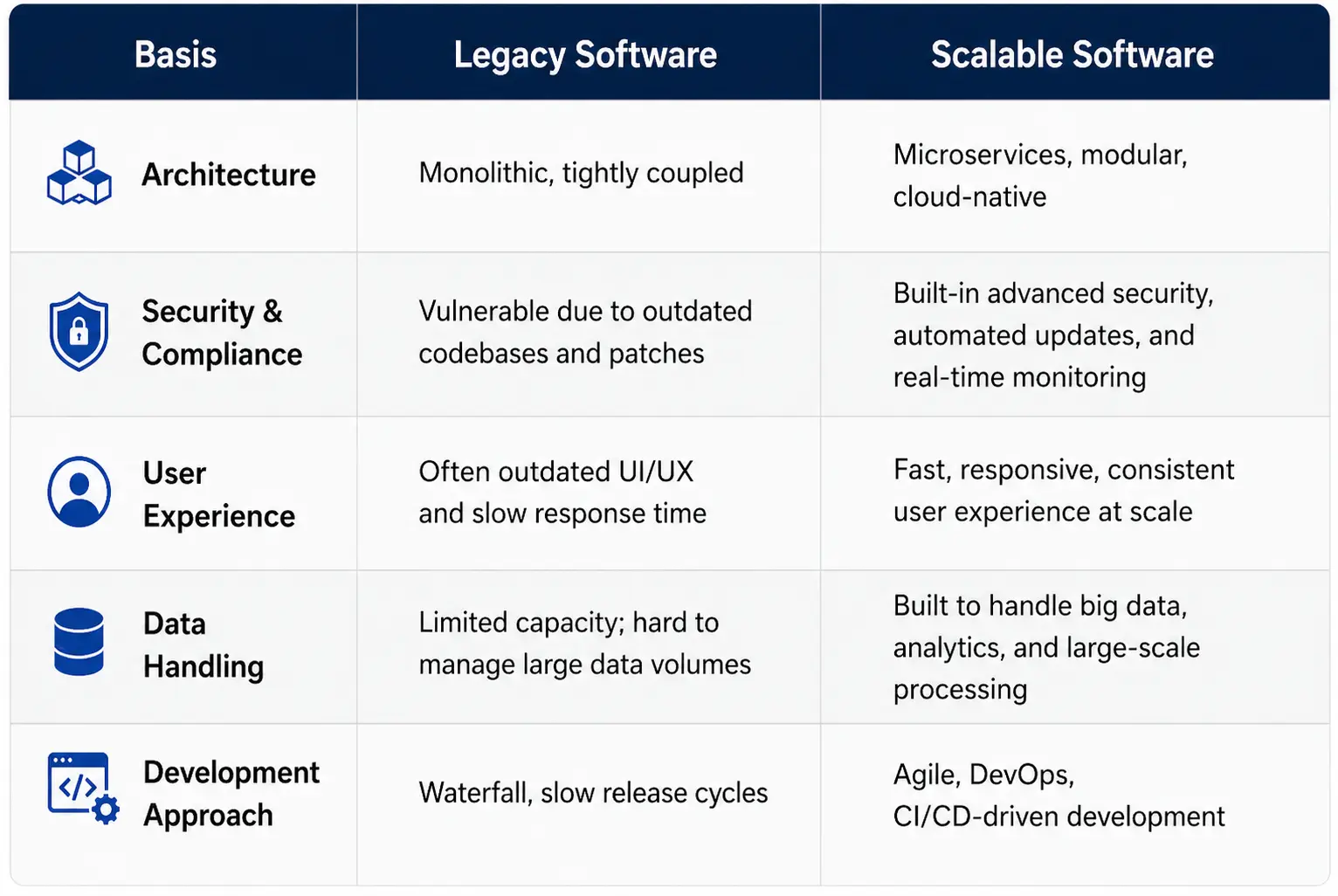
Let’s understand the difference between legacy software and scalable software.
Legacy Software Vs Scalable Software
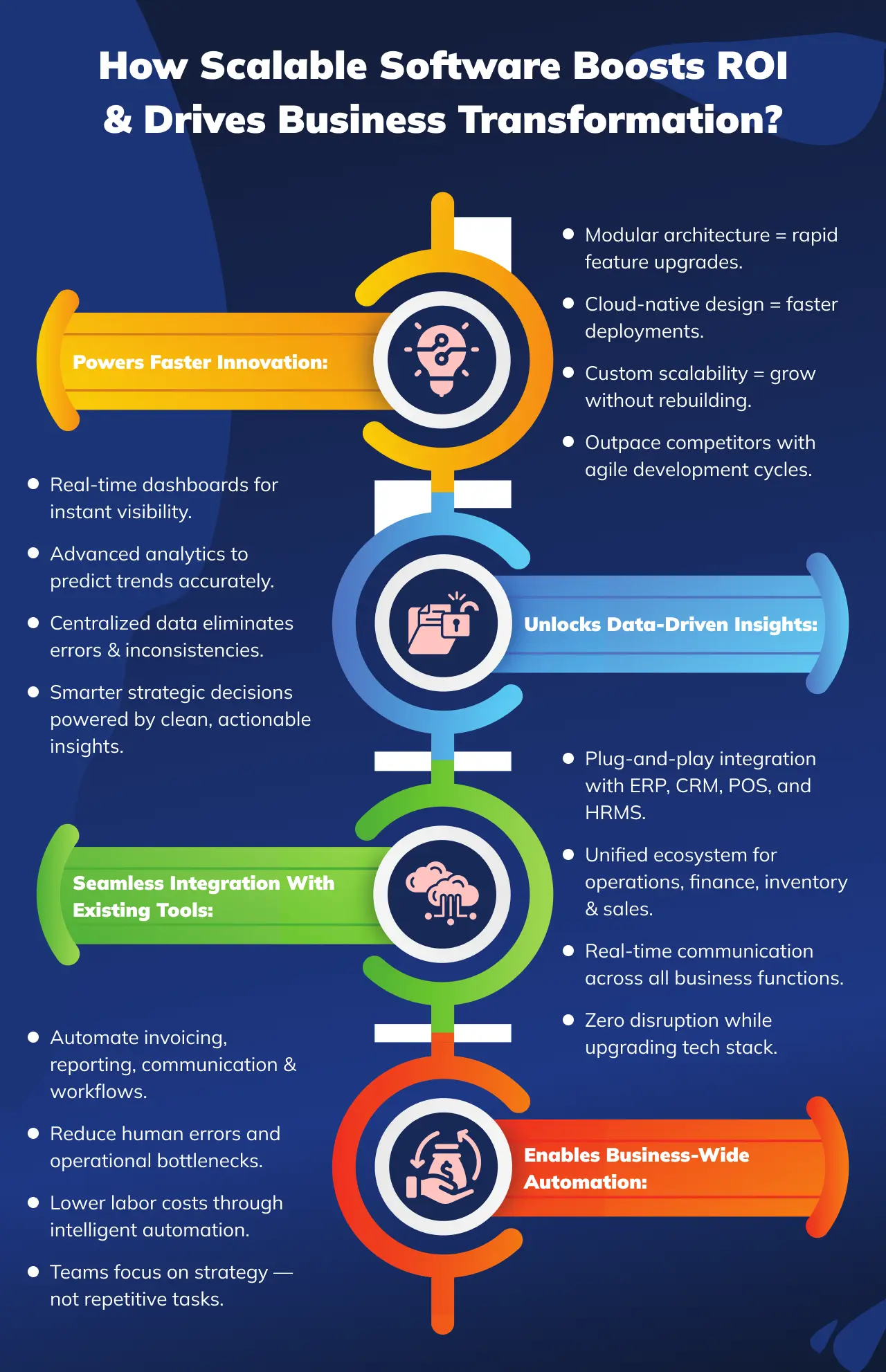
How Scalable Software Boosts ROI and Drives Business Transformation?
Before discussing the role of scalable software in 2026, let's explore its impact on business performance and long-term growth.
Enables Faster Innovation
Switching to customized and scalable software can be a game-changer for your business. With a modular architecture and cloud-native design, companies can outpace their competitors and achieve improved operational efficiency.
Data-driven Insights
No more false Predictions. The scalable software not only helps your business work faster but also provides valuable insights through dynamic analytical tools (Dashboards & Reports). This redefines how you make strategic decisions and gives a clear and accurate picture of your business performance.
Seamless Integration with Existing Tools
The scalable software solutions often come with easy integration options to your existing ERP or any other management software. Hence, it creates a unified operational environment where everything from sales orders to inventory levels is connected with real-time communication.
Introduce Automation
Still handling the operating business activities manually? Automate repetitive tasks such as invoicing, communication, and data entry, with customized software developments. This avoids major setbacks businesses often face due to human intervention, and it also minimizes costs.
Moving Forward……
The future of software is more than just cool and engaging design. Rather, it's about how the latest technologies help businesses of different industries achieve accelerated growth and deep automation that regular legacy software fails to deliver. To leverage the benefits of scalable software, tech companies need to replace their rigid Waterfall methodology with modern Agile and DevOps principles.
Key Benefits of Scalable Software for Businesses
̆Knowing how scalable software empowers businesses isn’t enough. Every company must also understand the key areas that experience a measurable impact.
1- Enhanced Performance & Reliability
Horizontal scaling or auto-scaling ensures a smooth system workflow even when demand surges. This leads to fewer downtime moments and more reliable service to customers.
2- Cost Efficiency
One-size-fits-all software costs more while providing unreliable functions and a very low scope of customization. On the contrary, a cloud-native setup enables pay-as-you-go models and avoids costly rewrites.
3- Faster Innovation Cycles
The role of scalable Software in 2026 involves modular and scalable architectures that make it easier to build, test, and deploy new features quickly. That means a faster development cycle with transparency and growth potential.
4- Business Agility
Every scalable software development service provider leaves no possibility of rebuilding the software from scratch when you’re expanding into new markets or launching a new product line. This is exactly where the real benefits of scalable software for businesses come into play.
5- Improved User Experience
A scalable software delivers an exceptional user experience through personalized UI/UX designs. This empowers users to explore and navigate through menus effortlessly. In short, more engagement and higher revenue.
6- Stronger Security & Compliance
The future of custom software development is packed with scalable security protocols, including automated monitoring, dynamic threat detection, and compliance checks.
Modern Software Development Trends in 2026 You Shouldn’t Miss out
Technology is evolving rapidly, and so are modern business requirements. Identify the latest software trends to guide your strategic development decisions and maintain a competitive advantage.
Cloud-Native Architecture
Containerization and microservices allow teams to break applications into bite-sized, independently deployable modules. Additionally, serverless platforms such as AWS Lambda or Azure Functions scale your application with zero infrastructure management needed.
AI & Machine Learning
Artificial Intelligence and machine learning embedded in your scalable software transform your entire business operations. It predicts your usage and monitors real-time business performance. It also optimises load balancing, detects inefficiencies, and fine-tunes performance automatically.
Low-Code / No-Code Platforms
The low-code business platforms have become one of the key technology trends in 2026. Now, businesses no longer need to write thousands of lines of code to build some part of the system. It reduces the burden on the development team while delivering flexibility and scalability.
API-First Ecosystems
Application Programming Interface (API) helps your business work seamlessly and underscores the role of scalable software in 2026. Now, companies have the flexibility to integrate modern solutions, reduce operational bottlenecks, and grow faster.
Quantum Computing
Quantum computing is one of the most modern software development trends, steadily moving from theory to early commercial reality. Industries such as finance, logistics, cybersecurity, and pharmaceuticals are already experimenting with quantum-powered simulations and optimization models. Moreover, it’s starting to influence how businesses think about long-term software scalability.
IoT Networks
The Internet of Behavior (IoB) is a new software development trend that fetches data from your smart devices, including watches, tablets, and phones, to predict and analyze user preferences. Businesses can leverage such technology to understand users’ needs in real time and tailor their offerings for more personalized experiences and smarter recommendations.
Future Developments for Software Development in 2026
The role of scalable software in 2026 is no longer a technical consideration but a mandatory strategic requirement. Modern solutions are shifting toward customer-centric features rather than systems that demand constant fixes.
1- Fully Autonomous Scaling Platforms
A digital Infrastructure that monitors and optimizes itself with zero human intervention. These are thinking AI models that tune your system in real time.
2- Hyper-Personalized Experiences
The importance of data is invaluable and one of the key benefits of scalable software for businesses. Enterprises can integrate systems with real-time analytics and AI to deliver personalized content, offers, and workflows to their customers.
3- Unified Cross-Platform Development
2026 is all about custom software development companies offering solutions that run seamlessly on web, mobile, IoT, and AR/VR.
4- Sustainable & Green Scaling
Business scalability and growth should never come at the expense of our sustainability and environmental health. Nowadays, every custom software development company must follow carbon-aware autoscaling, energy-efficient infrastructure, and greener DevOps practices.
5- Industry-Specific Scalability
The scalable software for businesses is equipped with industry-specific features and designs that solve your unique business challenges.
- Retail: Real-time inventory forecasting, inventory control, and auto scaling with demand surges
- Healthcare: Scalable patient-data platforms, AI-based diagnosis, better monitoring
- Finance: Global payment support, fraud detection, and risk analytics.
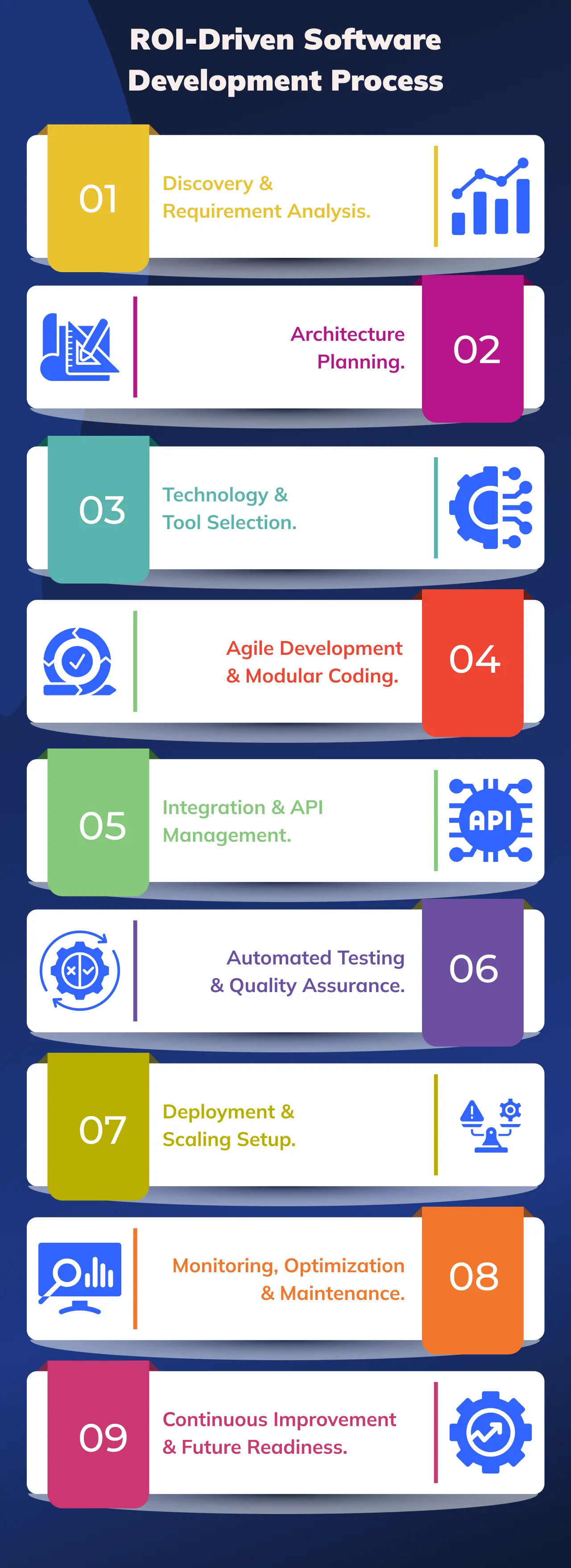
ROI-Driven Software Development Process Your Business Needs
A strategic development process is exactly what your business needs to sync with the role of scalable software in 2026.
Read Also: What is the right software development model for startups?
6 Things to Consider Before Hiring a Software Development Company
A generic software company often limits the ability to seek the benefits of scalable software for businesses. So it becomes essential to evaluate potential partners on the following basis:
Cost Structure & Value Delivered
It is one of the key aspects that can define the role of scalable software in 2026. As a business owner, consider a software development company offering the most suitable payment plan. Also, carefully look for future scalability, support, and long-term ROI.
Proven Experience in Your Industry
Always choose a mobile app development company that directly addresses your business’s unique challenges and supports your long-term goals. Moreover, it should’ve proven industry experience and tailored development processes for your business.
Technical Expertise & Modern Tech Stack
A reliable software development partner should utilize microservices, cloud-native development, DevOps, AI integrations, and other modern tools and technologies. This ensures your software is scalable, secure, and aligned with modern development practices.
Transparency in Process & Communication
Another trait of an experienced development partner is its ability to provide regular updates and achievable timelines. From identifying business goals to providing ongoing support, each development step should be well-documented and provide a 360-degree overview.
Possibility of Long-Term Support
Software without continuous support is an invitation to system failure and major security breaches. Whereas a software with a dedicated team of technical expertise can show significant growth. It will help in long-term maintenance, scalability planning, and continuous optimization.
High ̆Security Standards
For any business, security is non-negotiable. Choose a team that follows industry-standard security practices like secure coding, data encryption, API security, and more. In case your industry demands compliance with HIPAA, GDPR, ot PCI-DSS, then your development company should implement it from the very first day.
Conclusion
The technology trends in 2026 are evolving rapidly, and soon, it will become the most necessary thing every organization needs. Therefore, to unlock the benefits of scalable software for businesses, the team must be familiar with every development aspect, including trends, processes, and tools. Whether you require an ERP, CRM, or simple management tool, every software should solve your business problems and drive potential growth.
CodeAegis: Your Most Trusted Software Development Company
With more than 10 years of experience, CodeAegis is the best software development partner to transform your business. Companies around the globe trust CodeAegis with their customized software development requirements. Furthermore, the company anticipates the role of scalable software in 2026 and invests heavily in the latest technology, such as cloud-native development, microservices architecture, advanced AI integration, and blockchain. It follows a scalable development process and delivers projects with innovation and precision.
Frequently Asked Questions
1- How scalable software reduces long-term costs?
Reducing long-term costs is one of the key benefits of scalable software for businesses. As the entire system or tool is developed according to need and handles large users and data, it prevents expensive system failures and avoids the need for complete system overhauls. Also, its modular architecture allows companies to deliver inexpensive updates instead of massive, costly rewrites.
2- How to build scalable software in 2026?
To build a scalable software in 2026, the development team should focus on modern architecture and a tested development approach. Start the process by leveraging cloud-native design, adopting microservices, and using API-first development for seamless integrations. Lastly, be sure to partner with a firm that possesses deep knowledge of 2026 technology trends and offers solutions for long-term scalability.
3- How long does it take to develop customized software?
The development phase of any customized software is highly dependent on the team you choose and the complexity of your business requirements. Though a customer software typically takes 3 to 9 months.
4- What are the benefits of scalable software for businesses in 2026?
Here are some of the top benefits of scalable software:
- Capable of handling future business growth (rising users, traffic, heavy data, and more).
- Reduces long-term costs by leveraging the latest technologies and development methods.
- Enhances customer experience with reliable performance and engaging UI/UX designs.
- Improves security & reliability by using modern DevSecOps, cloud security, and fault-tolerant architecture.
- Supports data-driven decisions by integrating real-time analytics and Artificial intelligence (AI).

Sakshi Aggarwal is the Co-CEO of CodeAegis, a visionary leader with 12+ years of experience in transforming complex business requirements into high-impact technology solutions across industries. Her core contribution lies in architecting the company's customer-centric service delivery model and optimizing cross-functional execution. She has become a driving force for ensuring project success and cultivating a culture of accountability across the software development life cycle.