


ERP Software Development Cost in 2026: The Complete Pricing Guide
Table of Contents
What Is ERP Software Development?
How Much Does ERP Development Cost?
ERP Software Cost by Business Size
What Affects ERP Development Cost?
ERP Development Cost by Project Phase
Custom vs Off-the-Shelf ERP Costs
Cloud vs On-Premise ERP Costs
Hidden ERP Costs Most Guides Miss
How to Reduce ERP Development Cost
Real-World ERP Cost and ROI
How to Choose an ERP Development Company
Get an Accurate ERP Cost Estimate
Frequently Asked Questions
 Add us as a preferred source on Google
Table of Content
+ERP Software Development Cost in 2026 (Full Guide)
Most ERP projects don't fail because the technology was wrong. They fail because the number quoted at the start bears little resemblance to the number the business ends up paying. Panorama Consulting's annual research on ERP implementations puts this in concrete terms: roughly 65 percent of ERP projects exceed their original budget, 74 percent run past their planned timeline, and the average budget overrun sits at 53 percent. These aren't edge cases. They represent the typical outcome for organizations that scope an ERP build on incomplete cost assumptions.
This guide addresses that gap directly. Below is a complete breakdown of ERP software development cost by business size, project phase, and deployment model, in both USD and INR, built around actual project economics rather than a single averaged figure that obscures the variables driving it.
What Is ERP Software Development
ERP software development refers to building a system that consolidates finance, inventory, HR, procurement, and operations into a single connected platform, replacing the fragmented spreadsheets and disconnected point tools most growing businesses accumulate over time. A custom build is architected around how a specific organization actually operates, rather than requiring that organization to restructure its workflows around a generic package built for no one in particular.
This distinction is the foundation of CodeAegis's custom ERP software development services, and it matters before any cost figure becomes meaningful, since price is a function of scope, not a fixed industry rate.
How Much Does ERP Software Development Cost in 2026
Cost scales predictably with organizational complexity. Beyond the initial build, ongoing maintenance and support typically adds 15 to 20 percent of that original figure annually, a recurring cost that many proposals understate or omit entirely.
| Business Size | USD Range | INR Range | Typical Timeline |
|---|---|---|---|
| Small Business | $10,000 to $40,000 | ₹8 lakh to ₹33 lakh | 2 to 4 months |
| Mid-Market | $40,000 to $150,000 | ₹33 lakh to ₹1.25 crore | 4 to 9 months |
| Enterprise | $150,000 to $500,000+ | ₹1.25 crore to ₹4+ crore | 9 to 18+ months |
ERP Software Development Cost by Business Size
A single figure cannot answer what an ERP system costs, because a fifteen-person retail operation and a twelve-hundred-person manufacturer are not scaled versions of the same problem. They require fundamentally different architecture, integration depth, and support infrastructure.
Small Business ERP Cost
A small business implementation typically covers finance and basic inventory management for a single-location operation, built on a lighter technology stack with a limited integration footprint. These systems generally support fewer than 25 concurrent users and are often launched as an MVP, with additional modules layered in once the core platform has proven stable in production.
Mid-Market ERP Cost
A mid-market build spans multiple departments simultaneously, typically finance, HR, inventory, and procurement, frequently extending into manufacturing or logistics depending on the business model. Integration with an existing CRM, e-commerce platform, or accounting system is usually required at this tier, and the platform generally supports between 25 and 200 concurrent users, along with reporting dashboards that inform operational decisions rather than serving as a compliance formality.
Enterprise ERP Cost
Enterprise ERP spans multiple locations, plants, or business units operating on a unified platform, which introduces deep customization requirements, complex workflow automation, and granular role-based access control. These systems support 200 or more concurrent users with genuine high-availability requirements, and typically include advanced analytics, AI-driven forecasting, and compliance modules configured for the organization's specific regulatory environment.
What Affects ERP Software Development Cost
Enterprise resource planning cost is the sum of twelve interdependent variables, and any one of them can shift a quote by tens of thousands of dollars independently of the others. Module count is the most visible driver, but user volume and concurrent access requirements carry comparable weight. The trade-off between fully custom work and configuring an existing framework has an impact on both timing and maintenance in the future, while the difference in where the solution will be hosted – in the cloud or in-house – determines the cost distribution, in opposite directions, infrastructure investment upfront and subscription fees over time.
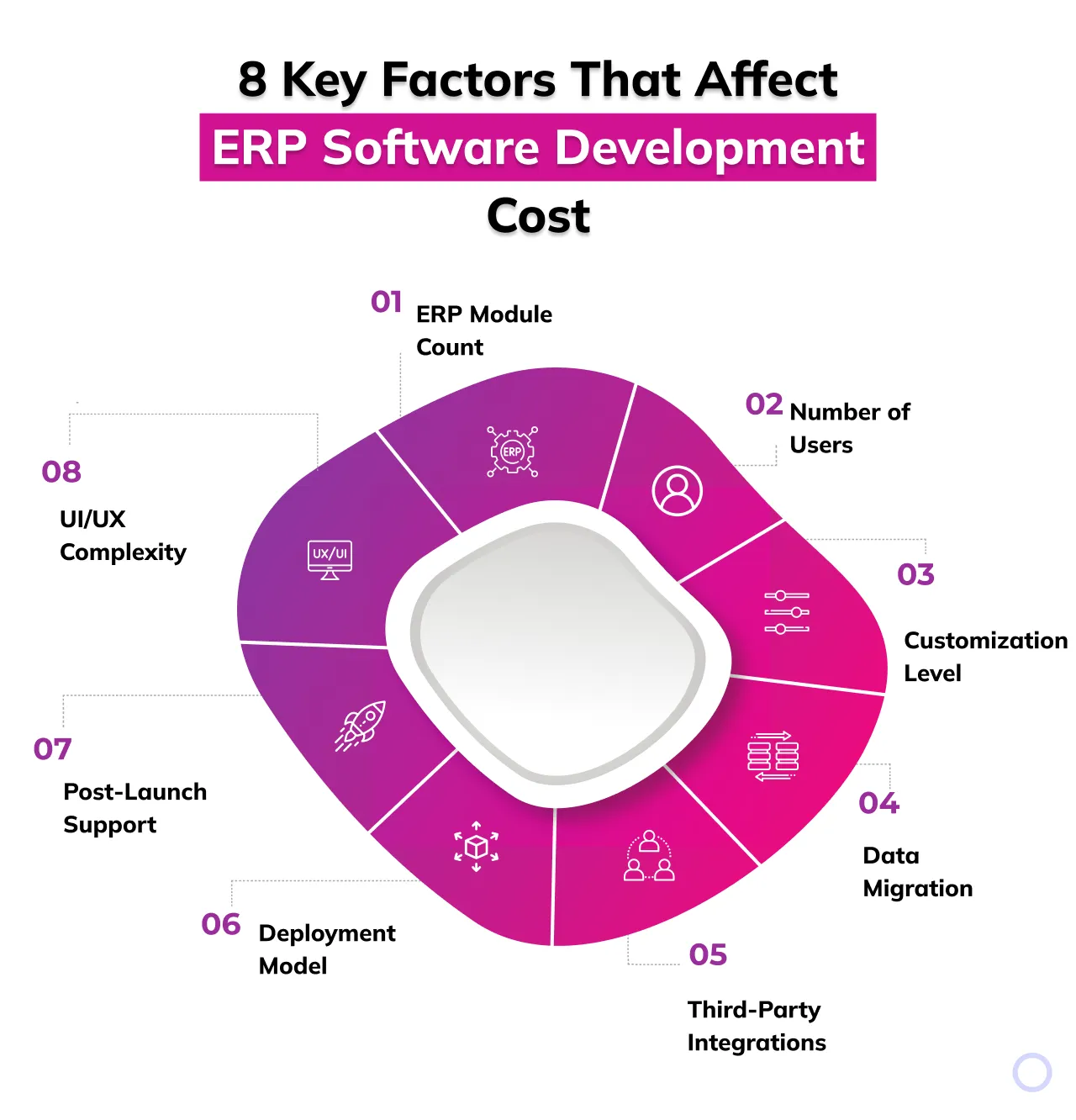
Data migration tends to be underestimated, especially with years worth of data that need to be cleaned and mapped before migration into a new schema. The third-party integration with the customer relations management systems, accounting tools, or e-commerce solutions adds another layer of development work, while regulations around HIPAA, SOC 2, GST invoicing requirements, and others might further increase the scope and duration of the testing. The UI/UX complexity, presence of a mobile application in addition to the web app, and necessary change management to ensure adoption are all part of the total cost, as well as post launch support for the application.
Team location is usually the largest factor in determining price before even one feature gets mentioned.
| Region | Typical Hourly Rate (USD) |
|---|---|
| India | $20 to $50 |
| Eastern Europe | $30 to $70 |
| Latin America | $35 to $75 |
| United States | $80 to $150+ |
This differential accounts for much of the confusion when two organizations compare ERP quotes for what appears to be an equivalent scope and arrive at figures three or four times apart. Working with an in-house software development team, rather than a fragmented network of independent contractors, also reduces the coordination overhead that quietly inflates cost across longer ERP engagements, since institutional context does not need to be rebuilt every time personnel changes.
ERP Development Cost by Phase
CodeAegis structures every ERP engagement around the same eight-phase methodology, and mapping cost against each phase clarifies exactly where budget is allocated, rather than presenting a single opaque total.
| Phase | What Happens | Estimated Cost Range | Timeline |
|---|---|---|---|
| Discovery | Requirements gathering, current-process audit | $2,000 to $8,000 | 1 to 3 weeks |
| Consulting Roadmap | Module planning, tech stack selection | $3,000 to $10,000 | 1 to 2 weeks |
| Design | UI/UX design, workflow mapping | $5,000 to $20,000 | 3 to 6 weeks |
| Configuration | Core module build and setup | $15,000 to $150,000+ | 6 to 20 weeks |
| QA | Testing across modules and integrations | $3,000 to $15,000 | 2 to 4 weeks |
| Training | Staff onboarding and documentation | $2,000 to $8,000 | 1 to 3 weeks |
| Implementation | Go-live, data migration, cutover | $5,000 to $20,000 | 2 to 4 weeks |
| Post-Implementation Support | Ongoing maintenance and updates | 15 to 20% of build cost annually | Ongoing |
The concentration of cost within the Configuration phase is consistent across nearly every ERP engagement, and it is precisely this phase that first-time buyers most often underestimate when evaluating a low-cost quote against a more realistic one.
Custom ERP vs Off-the-Shelf ERP: Cost Comparison
| Factor | Custom ERP | Off-the-Shelf ERP |
|---|---|---|
| Upfront Cost | Higher ($40,000 to $500,000+) | Lower ($5,000 to $50,000 for licensing) |
| Long-Term Cost | Lower over 5+ years, no recurring license fees | Higher over time due to per-user licensing |
| Customization | Built entirely around your workflows | Limited to what the platform allows |
| Scalability | Scales with your business without licensing caps | Often capped by vendor pricing tiers |
| Time to Launch | Longer (3 to 18 months) | Shorter (weeks to a few months) |
| Best Fit | Businesses with unique processes or growth plans | Businesses needing a fast, standard solution |
Custom erp vs off the shelf erp cost is properly evaluated over a five-year horizon, not against the initial invoice. Off-the-shelf software typically presents the lower upfront figure. The comparison shifts by year three, once per-user licensing fees and paid add-on modules accumulate on top of the base subscription, at which point the total cost of ownership frequently favors the custom build.
Cloud ERP vs On-Premise ERP Development Cost
Cloud ERP development cost is generally lower upfront, since no server hardware needs to be procured, racked, or maintained before deployment can begin. On-premise ERP requires a larger initial infrastructure investment but avoids the recurring subscription fees that accumulate over a cloud system's operational life. Cloud ERP also scales more efficiently as user count grows, typically through a tiered subscription adjustment rather than a hardware procurement cycle.
- On-premises retains one structural advantage: tighter control over data residency, which is a material requirement for organizations operating under regulatory frameworks that restrict where data can be physically stored.
- Cloud ERP generally reaches production faster as well, since there is no server provisioning step between build completion and go-live.
- Over a longer 5 to 7 year horizon, on-premise total cost of ownership can be lower for large, stable user bases that are not scaling headcount rapidly.
Hidden ERP Costs Most Guides Don't Mention
Data migration from legacy systems, particularly when years of historical records require cleaning and restructuring before import, consistently exceeds initial estimates. Change management and staff resistance can extend timelines and add training cost well beyond the original scope, since adoption failure undermines the return on the entire investment regardless of how well the system was engineered. Third-party API and integration fees are frequently absent from the initial quote and surface later as a change order.
- Scope creep during configuration is a persistent risk.
- Incremental requests to add "one more module" accumulate quickly across a multi-month engagement, and this rarely appears as a flagged budget risk until after it has occurred.
- Downtime cost during go-live and data cutover is a further consideration, particularly for organizations that cannot tolerate an operational pause, alongside the annual license renewals attached to any third-party components embedded in the finished system.
- Industry data confirms how routinely this is underestimated.
- A widely cited Software Path analysis places the average ERP budget per user at approximately $8,265, a figure that consistently exceeds what organizations had planned for at the outset of the project.
How to Reduce ERP Software Development Cost
Sequencing is the most effective lever available. Launching with a phased MVP covering core modules, then extending functionality once that foundation is validated in production, prevents budget expansion before the underlying architecture has been proven. Prioritizing configuration over heavy customization, wherever a standard workflow genuinely meets the requirement, is the second most effective lever, since custom logic carries both a higher build cost and a higher long-term maintenance burden.
Consolidating third-party integrations early, rather than adding them incrementally after launch, avoids much of the fragmented cost that accumulates over time. Proper investment in the discovery phase pays for itself many times over, since unclear requirements remain the leading cause of budget overruns industry-wide. Partnering with a team that has direct sector experience reduces the iteration required during configuration, and scoping data migration accurately at the outset, rather than discovering its true complexity midway through the engagement, prevents that specific line item from becoming the primary driver of cost overrun.
Real-World Example: ERP Cost and ROI in Action
A $180 million company running four plants and employing about 1,200 workers had approached CodeAegis with an end-of-month financial closure process taking 84 days, because of the use of independent spreadsheets and plant-based systems that did not have any common data layer. The custom-built ERP solution integrated finance, inventory, and production data onto a unified platform based on the operational framework of the company, not a template.
The result: month-end closure took only five days from 84 days, inventory accuracy stood at 99.2%, and the company had an ROI of 147% in one year, with a payback period of 14 months. Such an instance shows why the cost of ERP implementation, when assessed on the basis of an extended period of time, and not simply the initial cost, usually pays for itself in the first two years.
How to Choose the Right ERP Development Company
Seven questions consistently separate a well-scoped engagement from one that runs into the overrun statistics cited earlier.
- Does the company have direct experience building ERP systems within your specific industry, rather than general software development experience alone?
- Can they provide a named case study with verifiable, project-specific numbers, rather than aggregated company-wide metrics?
- How is pricing structured, fixed-price by phase or open-ended time-and-materials, and what does each model mean for your risk exposure?
- What does the post-launch support and maintenance package include, specified in writing rather than described verbally?
- Does the company maintain an in-house development team, or does the work route through third-party subcontractors?
- What is their specific methodology for legacy data migration, beyond a general assurance that it will be handled?
- What formal process governs scope changes once the engagement is underway, since this is where most budget overruns originate?
Get an Accurate ERP Development Cost Estimate for Your Business
Every figure in this guide represents a planning range, not a quote. Determining actual erp software development cost for your organization requires a direct conversation about your modules, user count, and existing systems. Book a free ERP consultation with CodeAegis's ERP development company team to receive a scoped estimate built around your specific requirements, rather than an industry average.
Frequently Asked Questions
How much does ERP software development cost in India?
Erp development cost in India typically runs lower than US or UK-based development due to regional hourly rate differentials, generally ranging from ₹8 lakh to ₹4 crore depending on business size and scope, with the same phase-based cost drivers outlined above applying regardless of the delivery region.
Is cloud ERP cheaper than on-premise ERP?
Generally yes for the first several years, since cloud ERP eliminates the upfront hardware investment on-premise deployment requires. On-premise can become more cost-effective over a longer 5 to 7 year horizon for large, stable organizations without rapidly scaling user counts.
How long does ERP implementation take?
A small business ERP typically requires 2 to 4 months from discovery to go-live, a mid-market build runs 4 to 9 months, and enterprise implementations often extend to 9 to 18 months or longer depending on module count, number of locations, and integration complexity.
Is custom ERP more expensive than buying an existing ERP license?
Upfront, generally yes. Over a 5-year period, custom ERP frequently proves less expensive once recurring per-user licensing, paid add-on modules, and vendor lock-in associated with off-the-shelf platforms are factored into total cost of ownership.
How can I estimate ERP ROI before building?
Begin by quantifying the cost of existing inefficiencies, hours lost to manual processes, inventory discrepancies, delayed financial reporting, and compare that figure against projected build and maintenance cost over a 3 to 5 year period. A vendor with a documented case study, such as the manufacturing example above, provides a useful benchmark for realistic ROI expectations at comparable scale.

Sakshi Aggarwal is the Co-CEO of CodeAegis, a visionary leader with 12+ years of experience in transforming complex business requirements into high-impact technology solutions across industries. Her core contribution lies in architecting the company's customer-centric service delivery model and optimizing cross-functional execution. She has become a driving force for ensuring project success and cultivating a culture of accountability across the software development life cycle.