


Ecommerce App Development Cost in 2026: Complete UAE & Global Pricing Guide
Table of Contents
Ecommerce App Development Cost
Cost by Ecommerce Business Type
Factors Affecting Ecommerce App Cost
Cost by Ecommerce Platform
Cost by Development Phase
Native vs Cross-Platform vs PWA
UAE-Specific Ecommerce Cost Factors
Cost of Advanced Ecommerce Features
Hidden and Ongoing Costs
Ways to Reduce Ecommerce App Cost
CodeAegis Ecommerce Cost Estimation Approach
Choosing an Ecommerce App Company
Get an Accurate Cost Estimate
Frequently Asked Questions
 Add us as a preferred source on Google
Table of Content
+Ecommerce App Development Cost in UAE (2026 Guide)
Ask a retailer in Dubai and one in Denver the same question, "what does an ecommerce app actually cost," and most agencies hand back nearly identical USD ranges, as though VAT invoicing, Arabic RTL layout, and local payment gateways simply don't factor in. That gap is a bigger deal than it sounds. The UAE ecommerce market sits at roughly $12.30 billion in 2026 and is expected to reach $21.01 billion by 2031, with smartphones already handling close to 79 percent of all orders, according to Mordor Intelligence's UAE ecommerce market analysis. A market moving that fast, that mobile-heavy, operating in two languages under VAT rules, isn't something you can scope off a template built for anywhere else.
This guide pulls the ecommerce app development cost apart two ways at once: global USD ranges for anyone comparing quotes against international agencies, and UAE AED figures built around what actually needs to get done for this specific market. Whether that distinction matters to you usually comes down to one thing, whether your first quote still holds once development is underway, or quietly grows the moment someone remembers VAT display wasn't in the original scope.
What Is Ecommerce App Development? (Quick Context)
At its core, ecommerce app development means building something customers can browse, buy from, and manage orders through, backed by everything running underneath that they never see: inventory sync, payment processing, fulfillment, account management. As an ecommerce development company, we treat this as building a full commerce system, not dressing up someone else's infrastructure in your brand colors, because the backend is usually what decides whether a store survives a real traffic spike or buckles under it.
Cost follows what's actually being built, not the other way around. A single brand's storefront and a marketplace juggling payouts across dozens of vendors both technically count as "an ecommerce app." They are nowhere close to the same project.
How Much Does an Ecommerce App Cost?
A few things worth knowing before the full breakdown:
- Business model complexity drives cost more than platform choice alone
- A single-vendor storefront costs meaningfully less than a marketplace handling vendor payouts and commission tracking
- UAE-specific requirements, VAT display, Arabic RTL, local payment methods, add real development time a global average won't capture
Ongoing maintenance typically runs 15 to 20 percent of the original build cost every year, a number most quotes leave out
Business Type USD Range AED Range Typical Timeline Single-Vendor / D2C App $15,000 to $50,000 AED 55,000 to AED 185,000 2 to 4 months Multi-Vendor Marketplace $50,000 to $150,000 AED 185,000 to AED 550,000 4 to 8 months B2B Ecommerce App $40,000 to $120,000 AED 147,000 to AED 440,000 3 to 7 months Subscription Ecommerce App $30,000 to $90,000 AED 110,000 to AED 330,000 3 to 6 months
AED figures are indicative and based on current exchange rate assumptions. Confirm current ranges directly with our team, since regional pricing shifts with market conditions.
Ecommerce App Development Cost by Business Type
Single-Vendor / D2C Ecommerce App Cost
- Covers one brand's catalog, checkout, and order management
- Typically includes product pages, cart, payment integration, and basic customer accounts
- Lower integration overhead, since there's no multi-party payout logic involved
- Fits brands validating demand or replacing a templated storefront with something built around their actual workflow
Multi-Vendor Marketplace App Cost
- Needs vendor onboarding, individual vendor dashboards, and commission-based payout logic
- Order management gets more complex, since one order can involve several vendors shipping independently
- Search and filtering have to scale across a much larger, more varied catalog
- Costs more because the backend is effectively running several interconnected businesses at once, not one
B2B Ecommerce App Cost
- Often needs custom pricing tiers, bulk ordering, and negotiated contract terms per account
- Integration with an existing ERP or procurement system is common and adds genuine development time
- User roles get more layered, since a single business account may have multiple buyers with different approval rights
- Checkout frequently needs to support purchase orders and invoicing, not just card payments
Subscription Ecommerce App Cost
- Centers on recurring billing, subscription management, and self-service for pausing or adjusting orders
- Requires dunning management for failed payments, an item that's easy to underscope
- Retention features, like recommendations tied to subscription cadence, add build time
- Sits between single-vendor and marketplace pricing depending on how much personalization is involved
Not sure which business model fits your budget?
Let's talk through your product catalog, vendor structure, and timeline.
What Affects Ecommerce App Development Cost?
A handful of variables move a quote independently of business type, and understanding them is what actually lets you compare two proposals fairly.
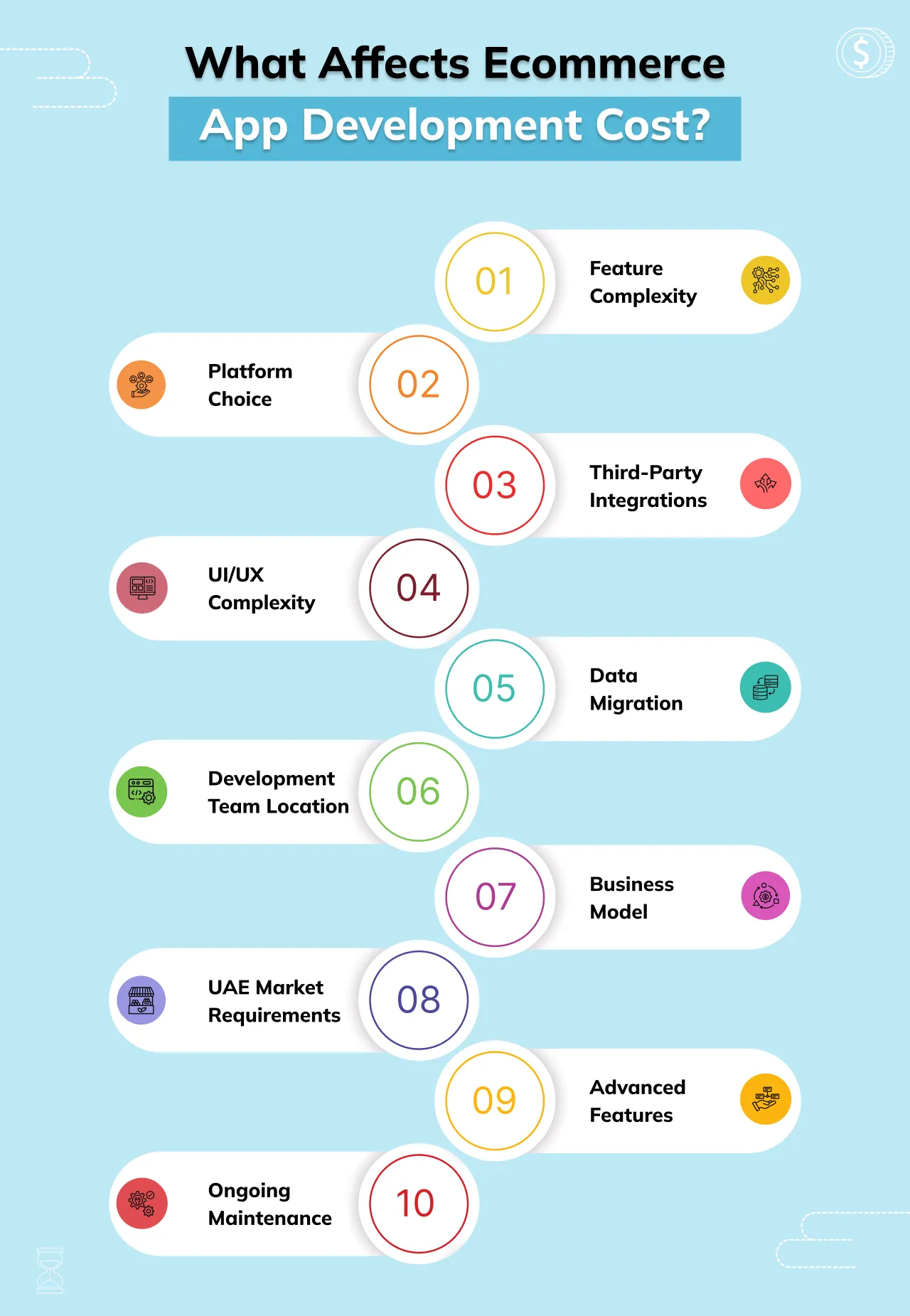
- Feature depth — a basic checkout costs far less than one supporting multiple payment methods, saved carts, and guest checkout
- Platform choice — an existing platform versus a fully custom build changes both cost and long-term flexibility
- Third-party integrations — payment gateways, shipping providers, and inventory systems each add setup and testing work
- Design complexity — a templated UI costs less than a custom design system built around a specific brand
- Data migration — moving an existing catalog and customer base off a legacy system adds effort that's routinely underestimated
- Team location — rates vary a lot by region and shape the final number more than most buyers expect going in
| Region | Typical Hourly Rate (USD) |
|---|---|
| UAE / Middle East | $35 to $75 |
| India | $20 to $50 |
| Eastern Europe | $30 to $70 |
| United States | $80 to $150+ |
Ecommerce App Development Cost by Platform (Shopify vs Magento vs WooCommerce vs Headless vs Custom-Built)
Platform choice is one of the more consequential decisions in scoping a build, and most cost guides skip comparing it directly.
| Platform | Typical Cost Range | Best Fit |
|---|---|---|
| Shopify (App/Plus) | $10,000 to $40,000 | Fast launch, standard ecommerce workflows |
| Magento (Adobe Commerce) | $25,000 to $80,000 | Complex catalogs, heavy customization needs |
| WooCommerce | $8,000 to $30,000 | WordPress-based businesses, smaller catalogs |
| Headless Commerce | $40,000 to $120,000 | Brands needing full control over frontend experience |
| Fully Custom-Built | $50,000 to $150,000+ | Unique business logic, marketplaces, long-term scale |
Shopify and WooCommerce get to market fastest but come with platform-imposed ceilings once a business outgrows standard workflows. A fully custom build costs more upfront but avoids the licensing limits and plugin dependency that tend to surface once a store scales past what an off-the-shelf platform was designed for.
Ecommerce App Development Cost by Phase (With Timeline)
Breaking cost down by phase shows exactly where the budget goes instead of presenting one opaque total.
| Phase | What Happens | Estimated Cost Range | Timeline |
|---|---|---|---|
| Discovery | Requirements gathering, competitor and catalog analysis | $2,000 to $6,000 | 1 to 2 weeks |
| UI/UX Design | Wireframes, design system, checkout flow mapping | $4,000 to $15,000 | 2 to 4 weeks |
| Core Development | Catalog, cart, checkout, account management | $15,000 to $80,000+ | 6 to 16 weeks |
| Payment & Integrations | Payment gateways, shipping, inventory sync | $3,000 to $15,000 | 2 to 4 weeks |
| QA & Testing | Functional, security, and payment flow testing | $3,000 to $12,000 | 2 to 3 weeks |
| Launch & Deployment | Go-live, app store submission, cutover | $2,000 to $8,000 | 1 to 2 weeks |
| Post-Launch Support | Ongoing maintenance and updates | 15 to 20% of build cost annually | Ongoing |
Core development consistently takes the largest share of the budget, and it's the phase most first-time buyers underestimate when comparing a cheap quote against a realistic one.
Want to see how this maps against your actual project scope?
Native vs Cross-Platform vs PWA: Cost Comparison
| Approach | Cost Impact | Trade-off |
|---|---|---|
| Native (iOS + Android separately) | Highest | Best performance, but effectively two builds |
| Cross-Platform (Flutter/React Native) | Moderate | Single codebase, strong performance, faster to ship |
| Progressive Web App (PWA) | Lowest | No app store dependency, but limited native device access |
Most businesses launching a first ecommerce app land on cross-platform development through our native and cross-platform mobile app development work, since it reaches both iOS and Android without duplicating cost, saving native builds for later once app store presence and raw performance become genuine differentiators rather than assumptions made too early.
UAE-Specific Cost Factors (VAT, Arabic/RTL, Local Payment Gateways)
Building for the UAE market carries real requirements that a generic global estimate simply won't account for.
- VAT and tax invoice display — UAE regulations require clear VAT breakdowns on invoices and checkout summaries, and that needs to be built into the checkout flow itself, not bolted on afterward
- Arabic RTL layout — right-to-left support is a design task, not a translation task. Layouts, navigation flows, even icon orientation need to be rebuilt for RTL, not just mirrored automatically by a plugin
- Local payment gateways — Apple Pay, regional payment providers, and cash on delivery, still widely used across the UAE, each require separate integration and testing work
- Business and trade licensing considerations — certain payment and data handling requirements tie back to UAE trade licensing categories, which can shape technical scope depending on how the business is structured
This is exactly why an ecommerce app development cost in Dubai built from a purely global template tends to miss real requirements that only surface once development is already in motion.
Cost to Add Advanced Features (AI, AR/3D Preview, Multi-Vendor Tools)
| Feature | Estimated Add-On Cost |
|---|---|
| AI-Powered Product Recommendations | $5,000 to $20,000 |
| AR/3D Product Preview | $8,000 to $30,000 |
| Multi-Vendor Management Tools | $10,000 to $35,000 |
| Advanced Search & Filtering | $3,000 to $12,000 |
| Loyalty & Rewards Programs | $4,000 to $15,000 |
AR and 3D product visualization has moved from a novelty to a genuine conversion driver for categories like furniture, fashion, and home goods, where customers hesitate without a clearer sense of scale or fit. This connects directly to our own delivered work on AR and 3D product visualization in ecommerce, a capability that's part of what we've actually built for clients, not something listed speculatively to fill out a features page.
Hidden & Ongoing Costs After Launch
- App store fees — annual developer account fees for both iOS and Android, small individually but easy to forget when budgeting only for the build
- Payment gateway transaction fees — ongoing per-transaction costs that scale with sales volume rather than a one-time setup charge
- Third-party API licensing — shipping, tax calculation, and inventory tools often carry recurring subscription costs
- Content and catalog updates — adding products, categories, and promotional content requires ongoing operational time from someone
- Security patches and compliance updates — payment security standards evolve, and staying compliant means continuous maintenance, not a one-time certification checkbox
How to Reduce Ecommerce App Development Cost Without Cutting Corners
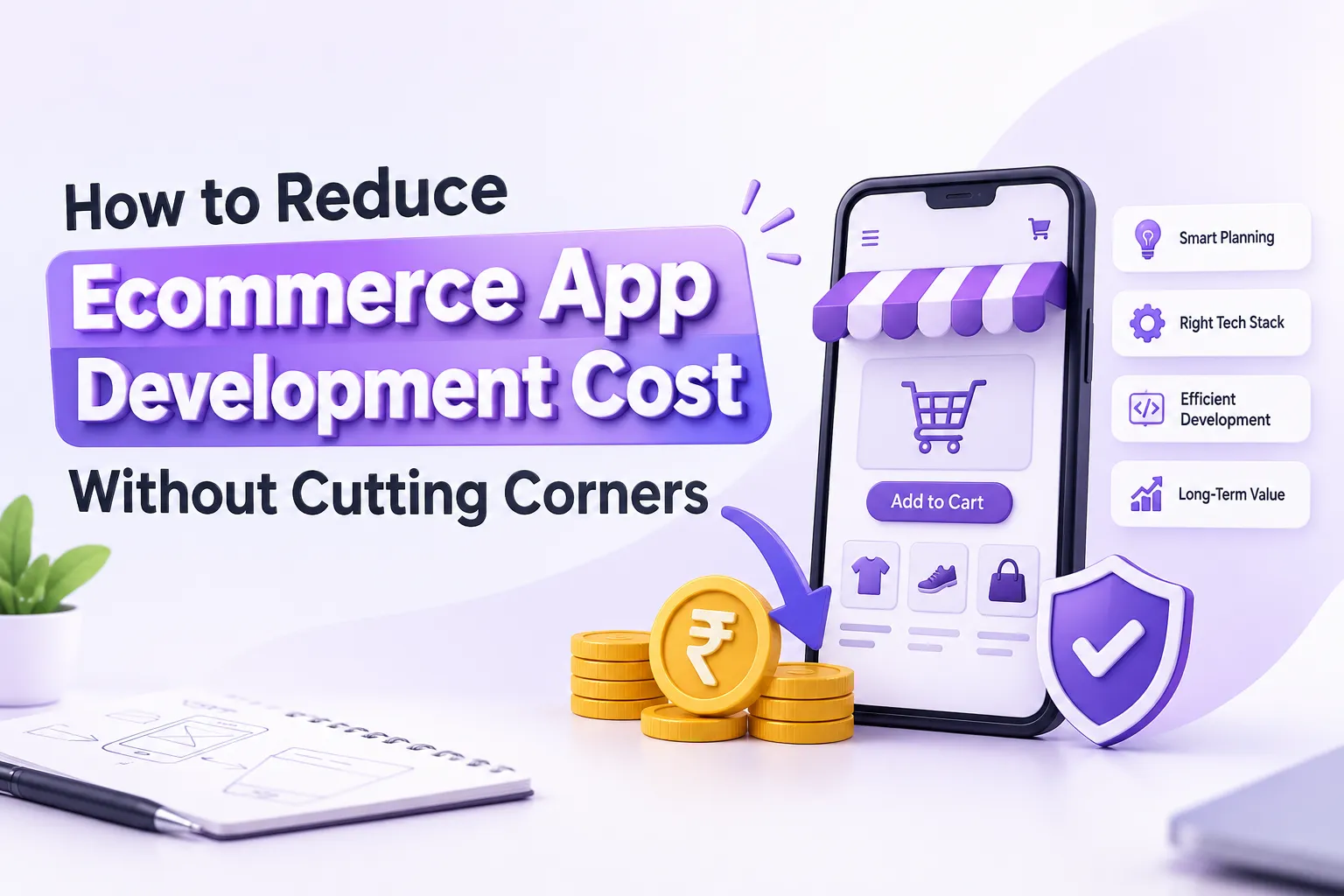
- Launch with a focused MVP — core catalog, cart, and checkout first, with AI recommendations or AR preview added once demand is validated
- Choose the right platform for your stage — Shopify or WooCommerce for a fast, standard launch; reserve custom builds for genuinely unique workflows
- Consolidate integrations early — adding payment and shipping integrations incrementally after launch usually costs more than scoping them upfront
- Invest properly in discovery — unclear requirements remain the single biggest cause of ecommerce app development cost overruns industry-wide
- Prioritize configuration over custom logic — wherever a standard checkout or catalog workflow genuinely meets the need, custom logic on top of it adds cost without adding real value
How CodeAegis Approaches Ecommerce App Cost Estimates
We don't hand out numbers pulled from an industry average. Every estimate starts with an actual conversation, your business model, your catalog, what systems you're already running, and whether you're building for one market or need Arabic RTL and local UAE payment gateways baked in from day one. That conversation is what separates a number that survives contact with real development from one that quietly creeps up once the actual requirements show themselves. Anything touching vendor payouts, AR product preview, or ERP integration for B2B ordering gets priced on its own terms, based on what it genuinely takes to build, not folded into a round number that doesn't reflect the real work.
How to Choose an Ecommerce App Development Company in UAE
- Do they actually have UAE market experience, VAT display, Arabic RTL, local payment gateways, not just general ecommerce work dressed up as regional expertise?
- Can they point to a real project with numbers attached, not a portfolio page of screenshots that never mentions outcomes?
- Is their pricing model clear, fixed-price by phase or time-and-materials, and do you actually understand what that means for your risk if scope shifts?
- What's included in post-launch support, written down somewhere, not just promised verbally in a sales call you can't refer back to later?
- Is the team in-house, or does the work get handed off to subcontractors you'll never actually talk to?
- How do they handle data migration if you're coming from an existing storefront or an older catalog that needs cleaning up first?
- What happens when scope changes mid-project, because this is where most ecommerce app development cost overruns actually begin?
Get an Accurate Ecommerce App Development Cost Estimate
Every figure in this guide is a planning range, not a quote. The real ecommerce app development cost for your business depends on your specific catalog, business model, and market requirements, and the only way to land on an accurate number is a direct conversation about what you're actually building. If you're ready to scope your project properly, get your customized ecommerce application built with a team that works across global and UAE markets, and prices against your real requirements rather than an industry average.
Frequently Asked Questions
How much does an ecommerce app cost in Dubai or the UAE?
Costs typically range from AED 55,000 for a focused single-vendor app to AED 550,000 or more for a full multi-vendor marketplace, depending on feature depth and whether UAE-specific requirements like Arabic RTL and local payment gateways are included from the start. Confirm these figures directly with a development partner, since regional pricing shifts with market conditions.
Is Shopify cheaper than a custom-built ecommerce app?
Upfront, yes. Shopify builds typically start lower than fully custom development. Over a longer stretch, per-transaction fees, app subscription costs, and the limits Shopify places on custom workflows can make a custom build more cost-effective for businesses with complex or unique operational needs.
How long does it take to build an ecommerce app?
A single-vendor app typically takes 2 to 4 months from discovery to launch. A multi-vendor marketplace usually runs 4 to 8 months, depending on how many vendor-side features and integrations are involved.
How much does a multi-vendor marketplace app cost?
Multi-vendor marketplace apps generally range from $50,000 to $150,000, driven mainly by vendor dashboard development, commission and payout logic, and the more complex order management required when a single order can involve multiple sellers.
What ongoing costs should I budget after launch?
Plan for app store developer fees, payment gateway transaction costs, third-party API subscriptions, and general maintenance, which typically runs 15 to 20 percent of the original build cost annually. Budgeting only for the initial build is one of the most common planning mistakes in ecommerce app projects.

Sakshi Aggarwal is the Co-CEO of CodeAegis, a visionary leader with 12+ years of experience in transforming complex business requirements into high-impact technology solutions across industries. Her core contribution lies in architecting the company's customer-centric service delivery model and optimizing cross-functional execution. She has become a driving force for ensuring project success and cultivating a culture of accountability across the software development life cycle.