

Custom Software Development vs Off-the-Shelf Software: Which is better for growing businesses?
Table of Contents
What Is Custom Software Development
What Is Off-the-Shelf Software
Custom Software vs Packaged Software
Pros and Cons of Custom Software Development
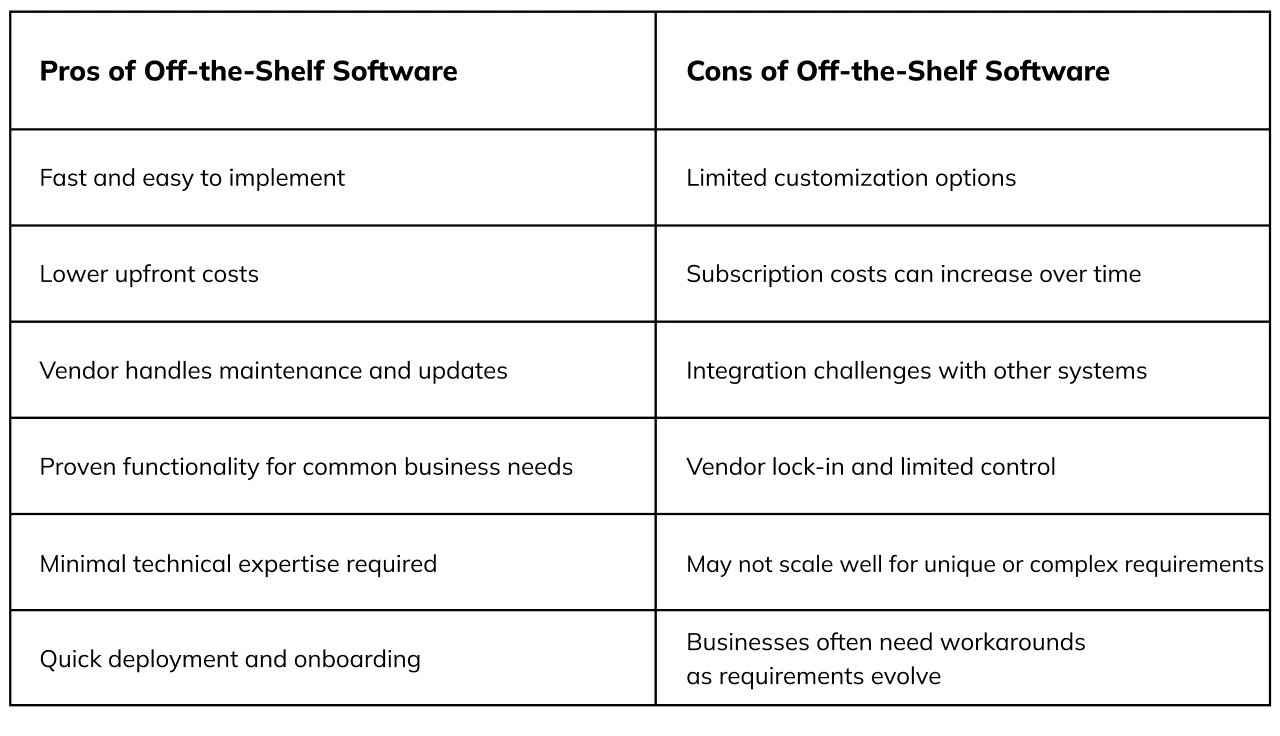
Pros and Cons of Off-the-Shelf Software
When a Growing Business Should Choose Custom Software Development
When Off-the-Shelf Software Is the Right Choice
Cost Comparison: Custom Software Development vs Off-the-Shelf Software
How Product Engineering and AI Development Are Changing Business Software
How CodeAegis Helps Growing Businesses Build the Right Software
Conclusion
Frequently Asked Questions
Table of Content
+Custom Software Development vs Off-the-Shelf Software Guide
Every business eventually hits a wall where the tools meant to help it grow start holding it back. The software decision you delay or outsource to chance is often the one that quietly caps your growth. Most entrepreneurs tend to see software not as a strategic element, but as a tool. Something that should be purchased and forgotten about until it fails or somebody complains about it.
This approach is quite costly behind its facade.
So here is what the actual numbers are saying to us. Global custom software development market size is expected to reach US$ 146.18 billion by 2030, growing at a CAGR of 22.4% during the forecast period. And the wave of AI Development makes it even more obvious.
By 2027, according to IDC, over 75% of commercial applications would include some level of AI functionality. The only problem with it is that most out-of-the-box software solutions lack architectural capacity for such specific workflow-related AI features.
This is the decision you are actually making when you choose custom software development vs off-the-shelf software. This guide will give you a clear breakdown of both paths.
What Is Custom Software Development?
Custom software development is the process of building a software application from scratch, designed specifically for one business, built around its exact workflows, its data, and its operational goals. Nothing is borrowed from a template designed for ten thousand different businesses. Every feature, every integration point, every data model is built with your specific operations in mind.
Custom software development starts with your business and builds the mold around it.
It starts with discovery. A product engineering team works with your leadership and operational teams to map how your business actually functions, not how it should function in theory, but how it runs day to day. Where the bottlenecks are. Where data gets stuck. Where your team is creating workarounds just to get through their week.
From that foundation, they design and build a system that eliminates those gaps. The architecture is planned with your current scale in mind and your projected growth accounted for. Integrations with your existing tools are built in from the start.
What Is Off-the-Shelf Software?
Off-the-shelf software is a commercial product built for a broad, general market. It is designed to be useful to thousands of different businesses across different industries, which is both its main selling point and its fundamental limitation.
You subscribe to it, configure what the vendor allows you to configure, and operate within the boundaries they have defined. You do not own the underlying code. You do not influence the product roadmap. You are a customer, which means your specific needs are always weighed against the needs of every other customer the vendor is trying to serve simultaneously.
When you sign up for off-the-shelf software, you are renting access to a tool someone else built for someone else's version of your problem. The vendor handles updates, security patches, and new feature releases on their timeline. Customization exists but it is always limited to the parameters the vendor has made available.
As your business grows and develops genuinely unique processes, which every scaling business does eventually, you will begin to feel the ceiling of what packaged software allows.
Custom Software vs Packaged Software: Which Is Better for Growing Businesses?
There is no universal answer. There is only the right answer for your specific business at this specific stage of growth.
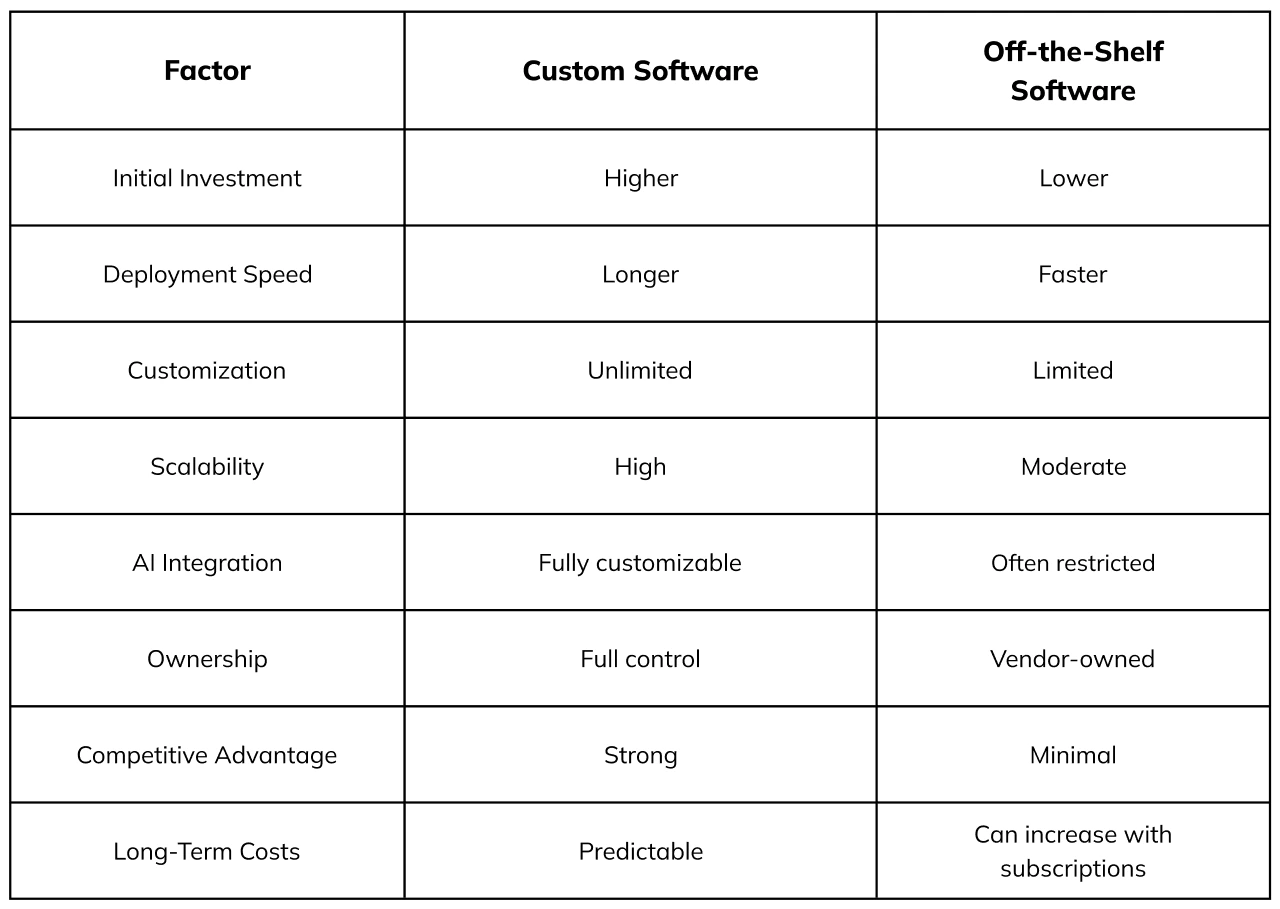
Choose Custom Software Development if:
- Your business processes are unique and give you a competitive edge worth protecting
- You need genuine scalability without being financially penalized for growing
- You want AI capabilities embedded into your actual operations
- Your team is currently wasting significant time managing disconnected systems
- Data security, compliance, or operational control are non-negotiable
Choose Off-the-Shelf Software if:
- You need a working solution within days and cannot wait for a build
- Your processes are genuinely standard and customization is not yet needed
- Budget is constrained and you are still validating your model
- Your current requirements do not yet justify the investment in custom development
The mistake most growing businesses make is staying on off-the-shelf software too long, after they have clearly outgrown it, because the transition feels difficult. That delay is expensive. The operational drag compounds every month.
Pros and Cons of Custom Software Development
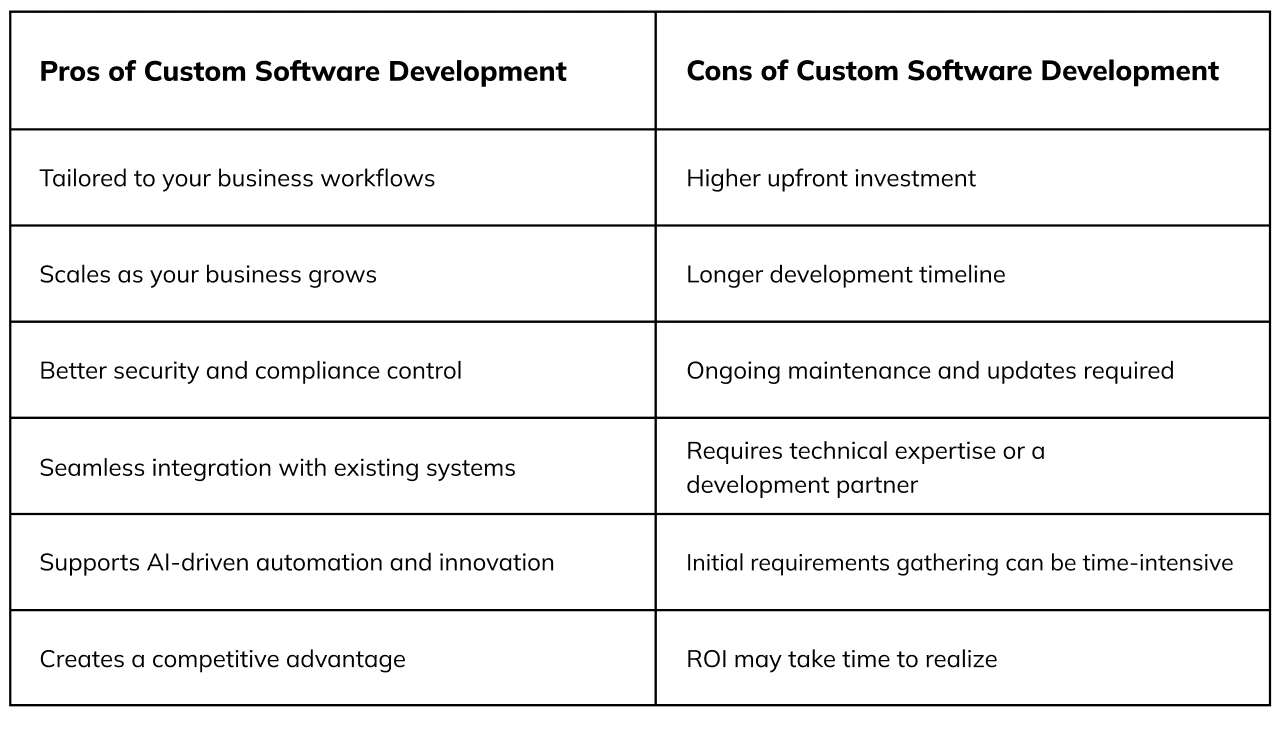
Pros and Cons of Off-the-Shelf Software
When a Growing Business Should Choose Custom Software Development
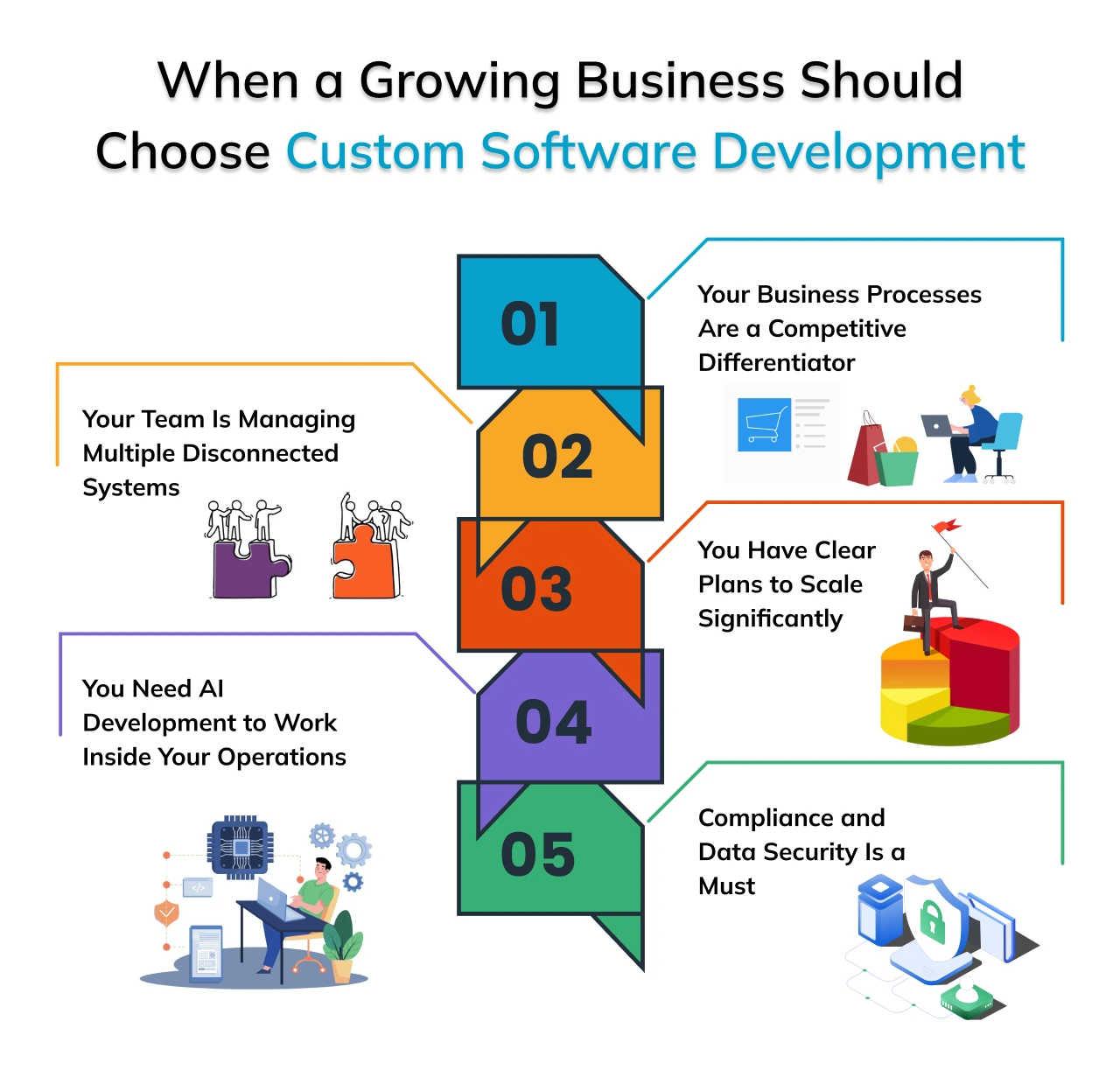
Your Business Processes Are a Competitive Differentiator
If the way you deliver your service, manage your supply chain, or handle your customer relationships is part of what makes you better than your competitors, then forcing those processes into a generic software mold will dilute that advantage. Custom software protects what makes your business different.
Your Team Is Managing Multiple Disconnected Systems
If your team is manually transferring data between platforms, maintaining duplicate records across systems, or spending significant time each week on reconciliation tasks, that is a direct, measurable operational cost. A unified custom platform eliminates that entire category of waste.
You Have Clear Plans to Scale Significantly
Do not build for where you are. Build for where you are going. Custom software can be architected from the start to handle the volume, complexity, and user load your growth plans will require, without a platform change or significant cost increase when you get there.
You Need AI Development to Work Inside Your Operations
For you to be able to incorporate AI into your workflow process in order to make it more effective in its processes other than answering questions through chatbots, software infrastructure is required in order to enable a deeper level of AI Development.
Compliance and Data Security Is a Must
Healthcare, financial service providers, law firms, and government contracts; these all fall under the scope where custom software is a necessity when it comes to building your software infrastructure. Your compliance posture will largely depend on your vendor, as it is with packaged software solutions.
When Off-the-Shelf Software Is the Right Choice
You Need Immediate Deployment
If it is impossible for your company to afford to wait from three to nine months in order for you to develop your custom software solution, then packaged software is your best option.
Your Processes Are Genuinely Standard
If your business runs on widely shared, conventional processes and you do not foresee needing significant customization, off-the-shelf software handles those use cases reliably. Do not build custom for problems that packaged software already solves well.
You Are Still Validating Your Business Model
Before investing in custom software development for a new product line or business concept, prove that the concept works. Use off-the-shelf tools to validate. Invest in custom once you know you have something worth building properly.
Your Budget Cannot Support a Custom Build Right Now
Starting with off-the-shelf software while building capital for a custom investment later is a completely sensible path. The mistake is staying on generic tools after you have clearly outgrown them, not using them in the early stages when they serve the purpose.
Your Requirements Are Simple Enough That Custom Is Overkill
Not every business needs custom software. If off-the-shelf business software is genuinely meeting your needs without significant friction and without meaningful workarounds, there is no case for the investment. Build custom when there is real operational pain to solve, not theoretical future risk to hedge against.
Cost Comparison: Custom Software Development vs Off-the-Shelf Software
Initial Development Costs
Developing customized software comes at a cost. Depending on the nature of project and complexity, it costs between $30,000 and $500,000 for enterprise grade solutions. The upfront development cost for off-the-shelf software is negligible.
Subscription & Licensing Costs
Off-the-shelf software incurs ongoing fees that keep growing each year. With a mid-size company employing CRM, project management, HR platform and ERP software, the monthly subscription cost will be around $5,000 - $20,000, which is getting higher with the growth of team and yearly changes in vendor's pricing. Subscription fees are not applicable for custom software once implemented.
Costs Related To Maintenance, Updates, Upgrades
The custom software requires further investment in maintenance, security updates and additional features implementation. The annual budget for this purpose is estimated at 15 to 25 percent of initial development costs. The costs are real and cannot be ignored during evaluation of total cost.
Total Cost of Ownership in 3 to 5 Years
After you calculate the total cost in 3-5 years, taking into account subscription growth, integration tools, add-on fees and the cost of productivity loss due to workarounds, off-the-shelf software becomes even more expensive than custom development. This is especially true for businesses with 50 or more employees using multiple platforms.
Which Option Delivers Better ROI?
Custom software typically delivers stronger ROI for businesses with complex operations, unique processes, and clear growth plans. Off-the-shelf software delivers better short-term ROI for early-stage or simpler businesses where custom investment is not yet justified by operational scale.
How Product Engineering and AI Development Are Changing Business Software
Building Future-Ready Software Through Product Engineering
Product engineering is not just writing code. It is designing software as a long-term product with architecture that can evolve, scale, and absorb new capabilities without needing to be rebuilt from the ground up every few years.
Businesses that invest in proper product engineering are not just solving today's problem. They are building infrastructure that will support where they want to be in 2027 and beyond. That architectural thinking is what separates software that scales from software that breaks.
Using AI Development to Automate Operations
AI Development is moving from a specialized, expensive capability into a practical operational tool for mid-sized and growing businesses. Intelligent automation, predictive analytics, real-time anomaly detection, smart demand forecasting — these are not future concepts. They are being deployed right now by businesses that have built software infrastructure capable of supporting them.
The critical point is that AI works best when it is embedded deeply into your operational software, not added on as a separate tool. Custom software development, combined with deliberate AI Development, makes that integration possible and effective.
Creating Personalized Customer Experiences with AI
Organizations that have their custom software infrastructure in place have a great opportunity to employ AI to create user experiences that are not possible using general platforms. Personalization, smart routing, predicting services delivery, and even dynamic pricing are all possible once your software platform is ready for those capabilities from the architecture standpoint.
Why Generic Software Often Struggles to Support Advanced AI Requirements
General platforms are made for the standard cases. Proper AI integration needs well-formatted, structured, and business-oriented data. It also needs custom models capability and control over the ways AI outputs can be utilized within your processes. All of these are normally limited by any off-the-shelf software solution. You get what the vendor thinks about integrating AI into its products.
How CodeAegis Helps Growing Businesses Build the Right Software
Most software development conversations stay theoretical until a business finds itself deep in a migration problem, a failed integration, or an AI initiative that their current platform cannot support.
CodeAegis exists to prevent those situations and to solve them when they happen.
We work with growing businesses at the intersection of custom software development, product engineering, and AI Development. Our work is not about writing code for the sake of it. It is about building software infrastructure that actually serves your business objectives over the long term.
What we do specifically:
Custom Software Development
We create our software from scratch, according to your workflows, your data structure, and how your business really works. Each solution we create is built specifically to get rid of inefficiencies, workarounds, and disconnected data that hinder the growth of growing businesses.
Product Engineering
We look at things as products rather than projects. Whenever we develop software for a company, we do it in the context of architectural thinking so that the product would be scalable, modular, and capable of evolution along with the company without having to go through costly redevelopments every few years.
AI Development
We create AI solutions that work within your real business environment rather than separate tools that need to be integrated. Whatever it may be: predictive analytics, intelligent automation, AI-enabled customer workflows, or machine learning models that have been trained using your business data, we create solutions that generate tangible value for your business.
Integration and Migration
When there are multiple disconnected systems, or when moving from one-off software to a custom-built platform, we provide the integration architecture and migration services in such a way that will minimize the disruption and prevent the inevitable data loss that comes with poorly executed migrations.
What makes CodeAegis different:
We do not sell a solution before we understand your problem. We start every engagement with a clear-eyed assessment of what you actually need, what your current tools are and are not doing for you, and what the most practical and cost-effective path forward looks like.
We are not going to recommend custom software development if off-the-shelf software genuinely serves your needs. And we are not going to let you stay on a generic platform that is costing you more in operational drag than a custom build would cost to develop.
The businesses we work with are typically at an inflection point. They have outgrown their current tools, they have a clear growth trajectory, and they need software infrastructure that can keep pace with where they are going.
Conclusion
Choosing between custom software development and off-the-shelf software is not a technical decision. It is a business strategy decision that has technical implications.
Off-the-shelf software is the right starting point for many businesses. It is fast, accessible, and functional for standard use cases. The problem is not using it. The problem is treating it as a permanent solution when your business has clearly grown beyond what it can support.
Custom software development, built with proper product engineering thinking and AI Development capabilities embedded from the architecture level, gives growing businesses something packaged software fundamentally cannot. Software that works for the business instead of a business that works around the software.
Not sure where your business sits in this decision?
Our team works through exactly this assessment with business owners before recommending any direction. If you want to see whether custom software development makes sense for your business right now, schedule a consultation and get a straight answer.
Frequently Asked Questions
What is the difference between custom software and off-the-shelf software?
The main difference is that custom software development creates software specifically for your business requirements, workflows, and goals, while off-the-shelf software is a pre-built solution designed for a broad range of users. Custom software offers greater flexibility, scalability, and control, whereas off-the-shelf software is typically faster to implement and has lower upfront costs.
Is custom software worth the investment?
For many growing businesses, custom software development is a worthwhile long-term investment. Although the initial cost is higher, custom solutions can improve operational efficiency, support AI Development, reduce reliance on multiple tools, and eliminate recurring expenses associated with software that no longer fits your needs. The return on investment often comes from increased productivity, better customer experiences, and the ability to scale without major limitations.
Which software is better for small businesses?
The right business software depends on your needs and growth plans. Small businesses with standard processes and limited budgets often benefit from off-the-shelf software because it is affordable and easy to deploy. However, businesses with unique workflows, industry-specific requirements, or ambitious growth strategies may benefit more from custom software development, especially if scalability and differentiation are priorities.
What are the disadvantages of off-the-shelf software?
The biggest drawbacks of off-the-shelf software include limited customization, rising subscription costs, integration challenges, and vendor dependency. As businesses grow, they often find that generic software cannot fully support their evolving processes, leading to manual workarounds and operational inefficiencies. These limitations are common reasons businesses eventually consider custom software development.
Is custom software more secure?
In many cases, yes. Custom software development provides greater control over data storage, user permissions, security protocols, and compliance requirements. Businesses in industries such as healthcare, finance, and legal services often choose custom solutions because they can implement security measures tailored to their specific risks and regulatory obligations.
How much does custom software development cost?
The cost of custom software development varies depending on project complexity, features, integrations, and technology requirements. Small applications may cost tens of thousands of dollars, while enterprise platforms with advanced capabilities, Product Engineering, and AI Development components can require investments ranging from hundreds of thousands of dollars to more. The best way to estimate costs is through a detailed requirements assessment and development roadmap.
Can custom software grow with my business?
Yes. One of the biggest advantages of custom software development is scalability. Custom solutions can be expanded with new features, integrations, users, and technologies as your business evolves. Whether you need advanced analytics, new customer experiences, or AI-powered automation, custom software can adapt to your changing requirements without forcing your business to fit the limitations of pre-built software.

Sakshi Aggarwal is the Co-CEO of CodeAegis, a visionary leader with 12+ years of experience in transforming complex business requirements into high-impact technology solutions across industries. Her core contribution lies in architecting the company's customer-centric service delivery model and optimizing cross-functional execution. She has become a driving force for ensuring project success and cultivating a culture of accountability across the software development life cycle.