


How Blockchain Development Services Are Transforming Businesses in the UAE (2026 Guide)
Table of Contents
Why Blockchain Is Becoming Important for UAE Businesses
How Blockchain Development Services Are Transforming UAE Businesses
Top Industries Using Blockchain Development in the UAE
Key Blockchain Development Services for UAE Businesses
Blockchain Development Use Cases in the UAE
Benefits of Blockchain Development for UAE Businesses
How to Choose a Blockchain Development Company in the UAE
Blockchain Development Process for UAE Businesses
What Is the Future of Blockchain Development in the UAE?
Why UAE Businesses Choose CodeAegis for Blockchain Development
Conclusion
Frequently Asked Questions
 Add us as a preferred source on Google
Table of Content
+Blockchain Development UAE | Expert Guide
Digital transformation in the UAE stopped being a buzzword a while ago. Blockchain is one of the clearest proofs of that. What used to be a conversation mostly about crypto speculation has quietly turned into something far more practical: banks, real estate developers, logistics firms, and hospitals are now using blockchain development services UAE businesses can actually put to work, not to chase a trend, but to fix problems that were costing them time and money.
The UAE blockchain market is estimated to be worth between $1.1 billion by 2031, with growth forecasts running anywhere from 35 to 42 percent annually through the early part of this decade. That’s not a projection built on hype. It’s a market that’s already moving real capital and producing measurable results for the companies using it.
Part of what’s pushing this forward is simple. Blockchain solves transparency, security, automation, and operational efficiency, and those four things sit near the top of almost every UAE business’s priority list right now, regardless of industry. As adoption picks up speed, more companies are treating enterprise blockchain development as infrastructure rather than an experiment worth testing quietly on the side. This guide covers why that shift is happening, where blockchain development UAE companies are seeing the strongest results, and what actually matters when picking a development partner.
Why Blockchain Is Becoming Important for UAE Businesses
Growing Digital Transformation in the UAE
The UAE’s push toward a fully digital economy isn’t new, but it’s speeding up. Government-led technology initiatives keep raising the bar on what “secure digital infrastructure” actually means, and that pressure lands on private businesses fast. Companies in Dubai and Abu Dhabi are increasingly expected to run smart services and digital records that hold up under scrutiny, both from regulators and from customers who’ve simply gotten used to better systems. Blockchain fits that expectation naturally, since it was designed from day one to solve exactly this kind of trust problem.
Need for Greater Transparency
Traditional record-keeping depends on a central authority everyone has to trust blindly. Blockchain gets rid of that single point of failure by creating records that can’t be quietly edited, records every authorized party can see and verify on their own. That shared visibility cuts disputes down fast, since there’s no longer a “my version says this, yours says that” standoff over which record is correct. For industries built around multi-party transactions, real estate, trade finance, supply chains, that kind of traceability removes entire categories of friction that used to be considered just part of doing business.
Automation Through Smart Contracts
Smart contracts are self-executing agreements written directly into the blockchain, and they’re one of the more immediately useful pieces of this whole picture. Instead of routing payments, approvals, and agreements through five manual checkpoints, a smart contract fires automatically the moment predefined conditions are met. A payment releases the second a shipment gets confirmed. An approval triggers without anyone manually checking a box. Workflows that used to take days start wrapping up in minutes.
Growing Web3 Adoption
Alongside the enterprise side, Web3 development has picked up real momentum across the region. Decentralized applications, digital assets, and tokenization have moved out of niche crypto circles and into mainstream boardroom conversations. The UAE actually topped the Henley Crypto Adoption Index for global cryptocurrency adoption, ahead of both Singapore and Hong Kong. That level of public familiarity with digital assets creates fertile ground for decentralized ecosystems that go well beyond just trading.
How Blockchain Development Services Are Transforming UAE Businesses
Improving Data Transparency
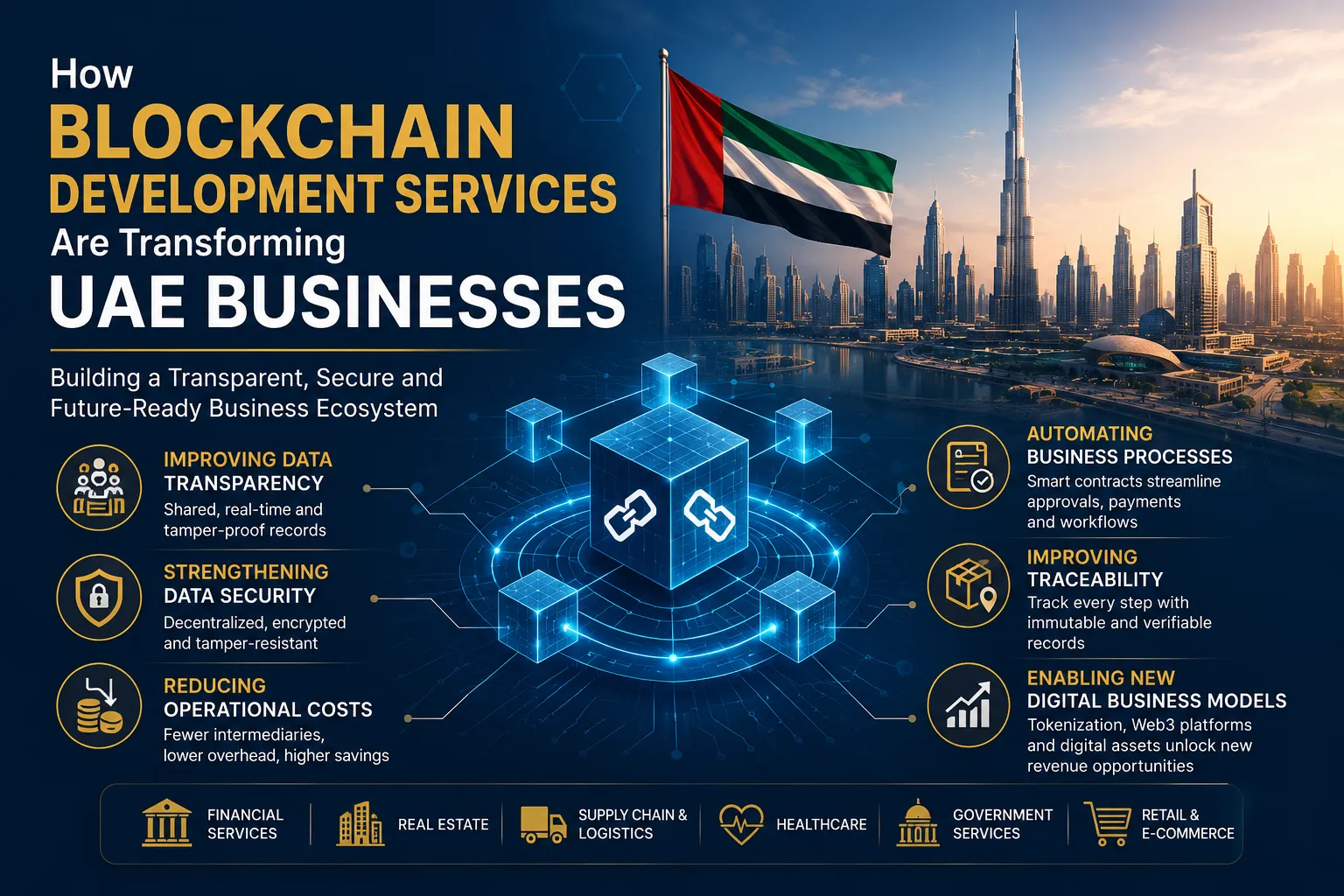
Distributed ledgers give every authorized party the same version of a record, updated in real time. That kills the reconciliation headaches that come from each party keeping its own separate database, which for years meant mismatched records and slow, manual cross-checking every time something needed verifying.
Strengthening Data Security
Blockchain architecture is just harder to tamper with than a traditional centralized database. Encryption, decentralized storage, and controlled access mean altering a record takes a lot more than compromising one server somewhere. For industries handling sensitive data, financial transactions, patient files, legal documents, that resistance to tampering is a real security upgrade over what most businesses are running today.
Reducing Operational Costs
This is where the business case gets concrete. Dubai’s government projected that blockchain adoption could unlock roughly 5.5 billion dirham in savings annually in document processing alone, a figure the city compared to building an entire Burj Khalifa’s worth of value every single year. That number is specific to government operations, but the logic underneath it, fewer intermediaries, less manual reconciliation, lighter admin overhead, applies just as directly to a private business trying to trim costs.
Automating Business Processes
Smart contracts don’t stop at payments. Approval chains, compliance checks, multi-step agreements, all of it can get encoded and executed automatically, cutting out the delays that come from waiting on someone to manually sign off at each stage.
Improving Traceability
For supply chain-heavy businesses, this tends to be the single biggest draw. Every step a product takes, raw material to shelf, gets logged on a record that can’t quietly be altered, giving businesses and their customers actual proof of origin, handling, and authenticity instead of just a claim on the packaging.
Enabling New Digital Business Models
Tokenization and Web3 platforms are opening up business models that flat out didn’t exist a decade ago. Real estate tokenization lets people buy fractional ownership of high-value property. Decentralized marketplaces cut out the usual platform middleman. Digital assets are creating revenue streams that enterprise blockchain solutions are increasingly built specifically to support.
Top Industries Using Blockchain Development in the UAE
Financial Services and FinTech
Banks and FinTech companies are leaning on blockchain for secure transactions, cross-border payments, and fraud reduction. Smart contracts handle settlement logic automatically, which cuts down the delays and intermediary fees typical of traditional trade finance. Digital asset infrastructure is fast becoming a standard offering among UAE financial institutions trying to keep up with a tech-savvy customer base.
Real Estate
Property deals have always come with layers of paperwork, intermediaries, and manual verification. Blockchain is chipping away at that through tokenized ownership records, automated agreements, and transaction histories that are effectively impossible to falsify after the fact.
Fractional property ownership through tokenization is also opening real estate investing up to a much wider pool of buyers who couldn’t previously afford in.
Supply Chain and Logistics
Product tracking, shipment verification, and provenance records are a natural match for what blockchain does best. Logistics companies working across UAE trade corridors are using it to give every stakeholder, suppliers, customs, retailers, real visibility into exactly where a shipment is and what condition it’s in.
Healthcare
Secure health records and controlled data sharing matter more every year as UAE healthcare providers digitize patient management. Blockchain-based systems let authorized providers pull accurate, tamper-proof patient histories without the usual friction of manually requesting records from another institution. Medical supply tracking rides on the same traceability logic used across broader logistics.
Government and Public Services
A core national target has been shifting roughly half of government transactions onto blockchain-based systems, using immutability, transparency, and real-time verification to modernize how public services actually run. Digital identity, document verification, and public records systems are the clearest wins here, cutting both fraud and the administrative slog tied to manual verification.
Retail and E-Commerce
Product authenticity is a growing headache for UAE retailers up against counterfeit goods. Blockchain-backed supply-chain transparency lets a customer verify a product’s origin directly instead of just trusting a label, and loyalty programs built on blockchain rails are turning out to be more flexible and interoperable than the siloed point systems retailers used to run.
Key Blockchain Development Services for UAE Businesses
Enterprise Blockchain Development
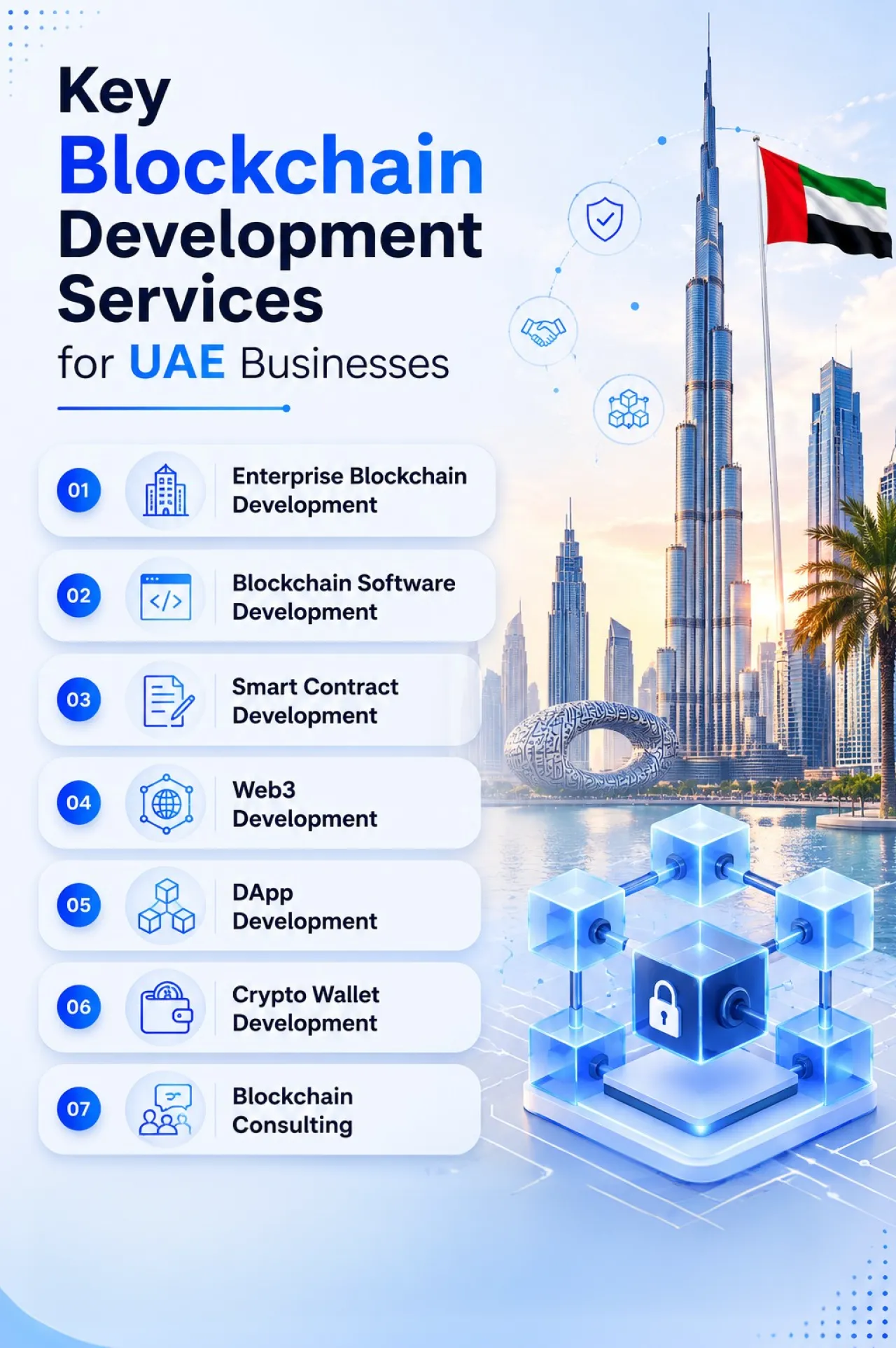
For most established UAE businesses, enterprise blockchain development means building private or permissioned networks rather than fully public ones. That gives an organization control over who can access and validate data, while still keeping the transparency and security benefits distributed ledgers are known for. A well-built enterprise blockchain integrates cleanly with existing systems instead of forcing a business to rip out its current infrastructure, and scalable architecture means the network can grow with transaction volume instead of buckling under it.
Blockchain Software Development
Beyond the underlying network sits custom blockchain software built around a business’s specific operational needs. That might be a tracking dashboard for supply chain partners, a settlement system for financial transactions, or a records interface for a healthcare provider. Off-the-shelf blockchain tools rarely map cleanly onto a specific process, which is exactly where custom development earns its cost.
Smart Contract Development
Smart contract development is the logic layer that actually automates business rules on-chain. That covers writing the contract code, defining the transaction logic and execution conditions, and, this part especially, testing and auditing the contract thoroughly before it ever touches production. A poorly tested smart contract can execute exactly as written and still produce an outcome nobody intended, which is why rigorous auditing isn’t optional.
Web3 Development
Web3 development covers the decentralized platforms and applications that interact directly with blockchain networks, usually including wallet integration so users can transact without going through a centralized middleman. For UAE businesses exploring digital assets or decentralized services, Web3 development is typically the foundation everything else gets built on top of.
DApp Development
Decentralized applications, or DApps, take blockchain functionality into consumer and enterprise-facing products across finance, gaming, marketplaces, and broader enterprise ecosystems. Unlike a typical app that leans on a central server, a DApp runs its logic directly on-chain, which changes how it gets architected, tested, and maintained from the ground up.
Crypto Wallet Development
Wallet development spans custodial and non-custodial models, multi-chain support for businesses working across different networks, and the transaction management and security features that actually protect user funds. Given how high UAE crypto adoption already is, demand for solid wallet infrastructure keeps climbing alongside the wider digital asset ecosystem.
Blockchain Consulting
Not every business is ready to jump straight into a build, and that’s exactly where blockchain consulting UAE providers usually start. This covers feasibility assessment, use-case identification, technology selection, architecture planning, and a roadmap that keeps a project grounded in an actual business need instead of a fascination with the tech itself.
Blockchain Development Use Cases in the UAE
A handful of practical use cases keep showing up across UAE deployments:
- Real estate tokenization enabling fractional property investment
- Supply-chain tracking for verified product provenance
- Digital identity verification tied to government services
- Cross-border payments settled faster and cheaper than traditional banking rails
- Smart-contract-based transactions that remove manual approval delays
- Decentralized marketplaces cutting out platform intermediaries
- Healthcare data management that improves both security and access
| Industry | Blockchain Use Case | Business Benefit |
|---|---|---|
| Real Estate | Asset tokenization | Greater accessibility |
| Logistics | Product tracking | Better traceability |
| FinTech | Digital transactions | Faster processing |
| Healthcare | Data sharing | Improved data integrity |
| Retail | Product verification | Greater trust |
Benefits of Blockchain Development for UAE Businesses
The benefits tend to cluster into a few buckets. Transparency improves first, since shared, verifiable records cut down disputes over conflicting data almost immediately. Security follows right behind it, with decentralized architecture and encryption making unauthorized data manipulation a lot harder than it is on a traditional centralized system.
Cost and speed gains tend to show up next. Lower operational costs come from cutting reliance on manual processes and unnecessary intermediaries, while faster transactions come from automating steps that used to require several manual checkpoints. Traceability improves right alongside that, making it far easier to track transactions, products, and assets across their entire lifecycle.
The longer-term wins are more strategic than operational. Process automation through smart contracts means predefined business rules execute without anyone stepping in manually, and new revenue opportunities open up through tokenization, Web3 products, and decentralized ecosystems, business models that simply weren’t possible before blockchain existed.
How to Choose a Blockchain Development Company in the UAE
Picking the right blockchain development company UAE businesses can actually trust starts with checking real experience, not just marketing copy on a homepage. A few things worth confirming before signing anything:
- Blockchain development experience specific to your industry, not just blockchain in the abstract
- Technical expertise in smart contract development, since this is where most blockchain vulnerabilities originate
- Clear security and auditing practices, including how contracts get tested before deployment
- Integration capabilities with your existing CRM, ERP, or operational systems
- Scalable architecture that can handle real transaction volume, not just a pilot’s worth
- Understanding of UAE-specific business and regulatory requirements
- Post-launch support, since blockchain systems need ongoing monitoring like any production software
A simple way to frame it: experience, technology expertise, security, scalability, industry knowledge, and support, roughly in that order.
Blockchain Development Process for UAE Businesses
1. Business and Blockchain Consulting
The process starts by identifying the actual business problem and honestly checking whether blockchain is the right tool for it, since not every problem needs a distributed ledger attached to it.
2. Use-Case and Feasibility Analysis
Once a use case is identified, the team weighs both technical feasibility and commercial viability before anything gets committed further.
3. Architecture and Technology Selection
This stage decides the right blockchain platform, public, private, or permissioned, along with the broader technical architecture the solution runs on.
4. Development
The actual build phase covers smart contracts, backend systems, applications, wallets, or DApps, depending on what the use case actually calls for.
5. Testing and Security
Every component gets tested for functionality, performance, integration reliability, and smart contract security before anything reaches production.
6. Deployment and Maintenance
Once live, the solution needs ongoing optimization and support, since blockchain systems, like any production software, need continued monitoring as usage and requirements shift over time.
What Is the Future of Blockchain Development in the UAE?
The next phase of blockchain adoption in the UAE looks less experimental and a lot more structural. Recent industry analysis suggests the country has already moved past the experimentation phase, actively folding blockchain into government services, financial networks, and trade infrastructure instead of treating it as a side pilot. The Central Bank of the UAE has also started testing its own digital currency infrastructure, with early pilot transactions already running.
Asset tokenization is expected to spread well beyond real estate into broader categories of both digital and physical assets. Web3 applications are likely to keep pushing further into mainstream enterprise use instead of staying boxed into crypto-native circles. The convergence of AI and blockchain is picking up attention too, particularly for automating verification and compliance work at scale. Digital identity systems, blockchain-powered financial services, and cross-border digital transactions all look set to become standard business infrastructure over the next several years, not emerging technology anymore.
Why UAE Businesses Choose CodeAegis for Blockchain Development
Choosing a technology is one decision. Choosing who builds it is a separate one, and it’s usually the one that decides whether a blockchain project actually delivers or quietly stalls somewhere between the pilot and production.
CodeAegis approaches blockchain development the same way this guide has framed it throughout, starting with the business problem, not the technology itself. Before recommending a private network, a smart contract system, or a Web3 platform, the priority is confirming blockchain is genuinely the right fit for what a business is trying to solve. That consulting-first approach avoids one of the more common mistakes UAE businesses run into: sinking money into blockchain infrastructure for a problem a simpler, cheaper system could’ve solved just as well.
Where blockchain is the right fit, CodeAegis builds with UAE-specific business and regulatory context baked in, not a generic global template repurposed for the region. That means integration with the systems a business already runs on, thorough smart contract testing and auditing before anything touches production, and architecture built to scale instead of needing a rebuild the moment transaction volume climbs.
Support doesn’t stop at deployment either, since blockchain systems need the same ongoing monitoring and optimization any production infrastructure does as a business and its requirements change.
For companies exploring enterprise blockchain development, smart contract development, or Web3 platforms in the UAE, that mix of business-first consulting and technical depth is what turns blockchain from an interesting idea into infrastructure that actually holds up under real use.
Conclusion
Blockchain in the UAE has moved past the pilot stage. It’s turning into infrastructure, quietly running behind transactions, records, and workflows across finance, real estate, logistics, healthcare, and government services. The businesses getting real value out of it aren’t the ones chasing the technology for its own sake. They’re the ones that pinned down a specific transparency, security, or efficiency problem first and found that blockchain genuinely was the right tool to fix it.
The opportunity ahead is real, but so is the risk of building the wrong thing with the wrong partner. Getting the use case right, picking an experienced blockchain development company, and building with UAE’s regulatory and business context in mind, that’s what separates a blockchain project that delivers actual operational value from one that never makes it past a proof of concept.
Looking to implement blockchain for your UAE business? Talk to our blockchain development experts to assess your idea, choose the right technology, and build a scalable blockchain solution.
Frequently Asked Questions
What are blockchain development services in the UAE?
Professional services covering blockchain consulting, custom software development, smart contracts, Web3 platforms, and enterprise blockchain networks tailored to UAE business and regulatory requirements.
Why should UAE businesses invest in blockchain development?
Blockchain improves transparency, strengthens security, reduces operational costs, and automates workflows, all while aligning with the UAE’s broader digital transformation priorities.
How much does blockchain development cost in the UAE?
Costs vary widely based on complexity, ranging from smaller smart contract projects to full enterprise blockchain networks, with pricing shaped by scope, integration needs, and security requirements.
Which industries benefit most from blockchain development in the UAE?
Financial services, real estate, logistics, healthcare, and government services see the strongest results, largely due to their reliance on secure, multi-party transactions and record-keeping.
What does a blockchain development company do?
It handles everything from feasibility assessment and architecture design to smart contract development, security auditing, and post-launch support for blockchain-based systems.
What blockchain development services do businesses typically need?
Most businesses need a combination of consulting, custom software development, smart contract development, and ongoing security and maintenance support.
How long does it take to develop a blockchain solution?
Timelines depend heavily on scope, but most projects range from a few months for a focused smart contract build to a year or longer for a full enterprise blockchain platform.

With over 12 years of experience, Mansi Garg is the Chief Operating Officer (COO) of CodeAegis, specializing in optimizing business performance and ensuring operational maturity across the technology landscape. Known for designing scalable governance and quality assurance frameworks, she ensured on-time project delivery. Mansi is the true leader behind the successful execution of cutting-edge digital solutions for a diverse global clientele.